
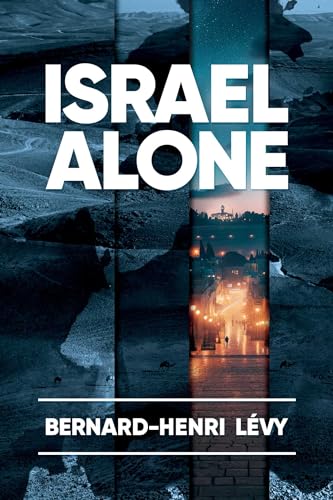
Israel Alone
- Author: Bernard-Henri Lévy
- Genre: Politics
- Publication Date: September 10, 2024
- Publisher: Wicked Son
Thank you to NetGalley and Wicked Son for providing me with an ARC of this book in exchange for an honest review.

Weaving in fifty years of experience with Israel, Bernard-Henri Lévy analyzes global responses to October 7, the new virulent waves of the oldest hatred in the world: antisemitism, why Israel is waging this existential war against barbarism alone, and what’s at stake for Israel and the world.
Bernard-Henri Lévy’s Israel Alone is a passionate and outraged cri-de-coeur, about the loneliness of Israel and the tragedy of October 7, starting with Lévy’s eyewitness account the day after the pogroms.
On October 8, 2024, Bernard-Henri Lévy flew to Israel to bear witness to the unprecedented invasion and massacre committed by Hamas. Israel Alone begins here and weaves in Lévy’s fifty years on the ground in Israel, from his first trip in 1967, his experiences writing on all the conflicts since, and his participation in various peace plans and contacts with all the Israeli leaders from Menachem Begin to Shimon Peres and from Ariel Sharon to Yitzak Shamir and Yitzak Rabin.
From his unique philosophical and humanist perspective, Lévy analyzes the ultimate evil unleashed on Israel on October 7 and delves into how the Islamic Republic of Iran, Russia, radical Islamist groups, Turkey, and China have played roles and profited from this tragedy.
The book addresses how October 7, though historic in scope, became, within weeks, a “detail” in the global consciousness amid a worldwide eruption of anti-Semitism, cloaked in anti-Zionism.
Lévy deconstructs the arguments of those calling for a “cease-fire now” without the release of all hostages and of those who demand that October 7 be seen within a greater “context.”
Lévy’s meditation on the soul of Zionism and Israel shows why this war is existential, not only for Israel but for the global West.
And yet, despite the urgency and critical nature of this war, Israel takes it on alone.
Lévy analyzes, today, why this is so and why Israel’s solitude is greater than ever.

This was the kind of book that I didn’t want to read, but felt it was important to do. It’s like Holocaust memoirs—I never *want* to read one, but I do whenever I get the chance because I was raised to bear witness and work hard to make a better world for all of us. This wasn’t an easy book to read, but it’s so important, and really addresses a lot of issues, both historic and current, that have led to Israel’s isolation on the world stage.
October 7th, 2023 is a day that I already know I’ll remember vividly for the rest of my life. While I wasn’t in Israel, someone very close to me was at the Nova festival, and when I saw the news, I was one of the people waiting with my heart in my mouth to find out if my loved one was safe … and alive. Someone let me know that she was okay, and safety at home. But three of her close friends were taken hostage, and one is still a hostage, but there hasn’t been any news about him, so it’s just a waiting game. It wasn’t just my moral obligation to bear witness that led me to read this book, but more in an effort to understand how the world has seemed to flip upside down and antisemitism has exploded around the world.
To start with, I hadn’t heard of Bernard-Henri Lévy before this, but was very impressed with his background—fifty years of visiting Israel, engaging in activism, creating documentaries about various wars around the world, and advising Israeli leaders on peace plans and conflicts since the 1970s. His extensive knowledge shows in this work, especially as he connects the dots between past and present, and exploring how this massive increase in antisemitism developed, seemingly out of nowhere, and has changed how our world views not only Israel, but diaspora Jews.
What hit me first about this book was that it is dedicated to the hostages held in Gaza. At the time of this book’s original French printing, there were 131. When the English version was made available, the number was changed to 120—but no one has been able to provide an exact count of how many remain alive. Five hostages had been rescued alive, others have had their bodies recovered. I started this book and was immediately struck by the name Hersh Goldberg-Polin, one of the six hostages who was murdered by Hamas just days before they were found by the IDF, since he was still alive at the time that this book was printed.
I was really worried that it would be difficult to read, because of the emotional aspect of this whole situation. However, Lévy tackles the subject matter with respect and sensitivity, focusing more on the background of the conflict and the aftermath than the gory aspects of the tragedy. Initially, he discusses his experiences visiting Israel the day after, on October 8th, with busy cities more like ghost towns, and everyone trying to put their shattered lives and sense of safety back together. By the time of his visit, most of the bodies had been cleaned up, but touring towns and kibbutzim surrounding Gaza revealed the extent of the pogrom: he describes what he saw, what he smelled, allowing readers to visualize the aftermath.
Lévy explores the mind-boggling phenomenon of how Hamas terrorists filmed their acts and proudly bragged about them to their parents, friends, and sharing videos on the internet, yet:
“In spite of this evidence, there were some cynical souls who came forward immediately after October 7 to say that they either saw nothing or did not believe what they had seen.”
Over the last 11 months, we have watched in real time as people refused to believe what they saw and heard with their own eyes, called facts ‘propaganda,’ creating new definitions for words that don’t align with what the word really means, and blaming everything on Israel and the Zionists, while ignoring everything negative about Hamas, even to the point of people on the streets calling to globalize the intifada and gas Jews. This wasn’t the response that we were expecting, and it wasn’t a response that helped the conflict in any way.
“The truth is, the pogrom that should have been—and was, for a brief moment—the occasion for seamless solidarity with the dead and those who mourned them, produced the opposite effect: a gale of anti-Semitism (sic). Or, to call it by its right name, a tempest of hatred for Jews without precedent since the Second World War.”
This book also debunks a lot of the misinformation that is being spread around about Israel and its history, the conflict between Hamas and Israel, and offers plenty of factual, historical information that is freely available in this day and age. However, dialogue and research seem to have gone out of fashion, in favor of being able to shout louder than your opponent, and an inability to accept views that don’t align with one’s own echo chamber. Discussing how Israel is not a ‘settler-colonial project,’ but rather one of the most successful decolonization efforts by an Indigenous population (yes, Jews are indigenous to the Levant, not Europe).
Finally, the book turns its attention to radical Islamism, and how the spread of it threatens not only Israel and Jews, but is a threat to democracy, Western values, and freedom. Another easily observed fact is the blatant Arab imperialism that is ignored—Islam has been spread from the Arabian peninsula to the entire SWANA (Southwest Asian and North Africa) region, much of Africa and Asia, in their own brand of settler-colonialism, while blaming Jews for the same thing in their own ancestral homeland. Islamist violence threatens us all, no matter your religion. The goal is a global caliphate, and Israel is on the front lines of this fight … alone.
Overall, this is an exceptional book. It’s thoroughly researched and should be read by everyone. Yes, the author talks about gore that he’s seen in a straightforward manner, without it ever feeling like trauma porn or gratuitous gore. The connections between ancient and current antisemitism can’t be ignored, and Lévy gives a clear and easy to understand analysis of this major Event (as he terms it) and what happened afterwards. If you know a Jewish person or don’t, if you’ve been personally affected by October 7th or not, or if you are only becoming aware of the increasing antisemitism and want to learn more, this is a great place to start.
Disclaimer: This post contains affiliate links, and I may earn a small commission at no cost to you if you purchase through my links.
Categories: Book Review
 Leah's Books
3 replies »