
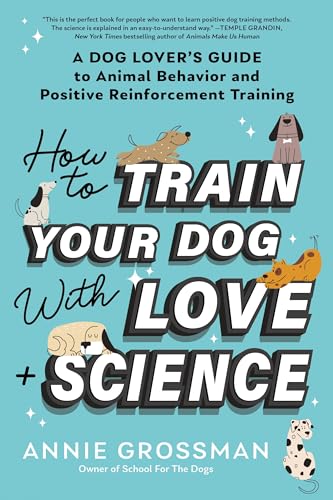
How to Train Your Dog with Love + Science: A Dog Lover’s Guide to Animal Behavior and Positive Reinforcement Training
- Author: Annie Grossman
- Genre: Science
- Publication Date: October 29, 2024
- Publisher: Tantor Media
Thank you to NetGalley and Tantor Media for providing me with an ARC of this audiobook in exchange for an honest review.

A dog training book that makes sense―for both dogs and humans―using positive reinforcement techniques based on animal behavioral science. For generations, celebrity trainers have preached that dog owners must “dominate” dogs and have criticized people for daring to treat pets with affection.
How To Train Your Dog with Love + Science presents a modern and science-based approach to dog training, showing how behavior can be changed without coercion and force. Annie Grossman, a journalist-turned-dog trainer, breaks down what positive reinforcement actually is and makes the case that “good dog training” may even be a window into understanding ourselves.
Grossman offers building-block exercises and tips on how to train effectively using the reward-based methods she’s honed over the last decade with clients at her Manhattan training center, School For The Dogs. Whether you’ve just brought a new dog into your home or you’re wanting to teach an old one new tricks, How to Train Your Dog with Love + Science will help you consider what behaviors you want and help you to achieve your goals using techniques rooted in the science of behavior.
Woven into this lively how-to guide is the century-long history of positive reinforcement training, from Pavlov’s dogs and Skinner’s rats to today’s apartment-dwelling dogs using Wifi-enabled devices.
By employing the easy-to-understand techniques laid out in this book, you will be able to train your dog to live confidently, comfortably, and happily in your world.

You might know that I recently adopted two rescue puppies. When they came, they were basically feral, and I couldn’t get near them with a leash. That made it impossible to take them to standard puppy kindergarten classes, and someone at the vet told me they had a trainer who came to the house. We hired that trainer and she was fantastic. She used the same theories that I was familiar with from my masters in Mental Health Counseling, including exposure therapy and positive reinforcement.
I wasn’t surprised to see that Grossman’s book espouses the same principles. She refers to Pavlov’s dogs and B.F. Skinner, among other notable names in behavioral science, psychology, and explains how they relate to dog behavior.
My favorite thing about this book is how well the author conveys her message and voice, which comes through loud and clear even when narrated by someone other than the author. I didn’t even realize that the narrator and author weren’t the same person until I was well into the book. Eunice Wong does a fantastic job of bringing Grossman’s words to audio, and it’s clear that she had a fun time with the reading, which already utilized humor in multiple places.
I also loved the enthusiasm that Grossman shares in this book. She so obviously loves dogs, and wants to bring this information to a wider audience than she can through her own School for Dogs. I’m so grateful that books like this exist, since it helps to reinforce the training methods that I learned and have instinctively applied. Rather than punishing our dogs for engaging in a behavior we don’t want them to do, Grossman encourages her readers to learn why their dogs are engaging in a specific behavior, in order to determine how to get them to stop doing it.
Throughout the book, Grossman explores what natural dog behaviors mean, and how we can get them to want to change that. The reward-based training has worked best for my own dogs, and there are practical ways to use this kind of training to get our dogs to do what we want, whether it is sit, stay, lie down, or do cool tricks. This kind of training focuses on the dog’s strengths, and allowing them to feel safe enough to actively participate in training, which was one of the first things that the trainer I hired did—provide a ‘safe space’ for the dogs to indicate they were willing to engage. One was always ready, the other had her moments where she’d just bow out of training, and I was never asked to force her to come back and be willing to learn. Instead, I had to earn her trust first, and then be flexible with our training sessions.
Grossman devotes earlier chapters in the book to explaining the psychological underpinnings of behavioral training, and honestly? The biggest difference between applying these principles to dogs or humans is that dogs can’t speak to us using words—instead we have to rely on their nonverbal cues, knowledge of dog behavior, and our understanding of our own individual dog(s). She does an outstanding job with explaining the similarities and differences between positive reinforcement, negative reinforcement, positive punishment, and negative punishment, which can be difficult to grasp if any of these are new terms.
This is the kind of book that everyone who has a dog should be reading immediately. The author is excited about her work with dogs, wants to help people learn more about how to train their dogs in the best way for them, and does so in a clear and easy-to-understand manner. Positive reinforcement is a technique that encourages dogs to do what you want through rewards and praise, not punishment, which has shown to work fast but actually not be the most effective and safest method of training. Grossman has a lot to say about more well-known methods of training, such as that used by Cesar Milan, but it’s easy to see where she is coming from. If you have a dog, are thinking of getting a dog, or just want to learn how to understand dogs better, this is the book for you.
Disclaimer: This post contains affiliate links, and I may earn a small commission at no cost to you if you purchase through my links.
Categories: Book Review
 Leah's Books
2 replies »