
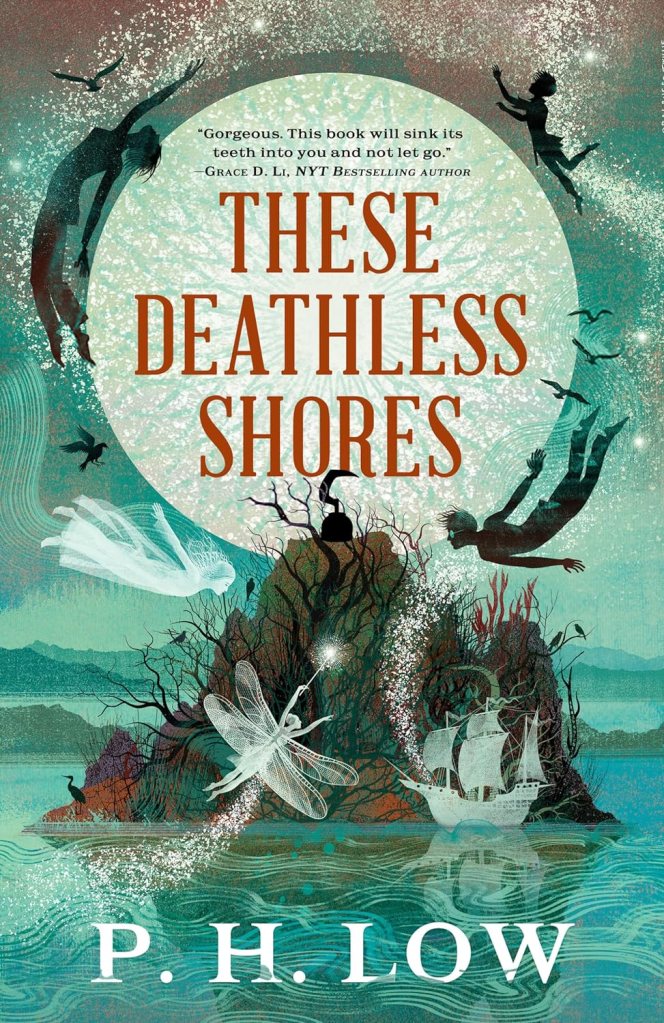
These Deathless Shores
- Author: P.H. Low
- Genre: Fantasy
- Publication Date: July 9, 2024
- Publisher: Orbit
Thank you to NetGalley, Orbit, and Angela Man for sending me a copy of this ARC in exchange for an honest review.
CONTENT WARNING: addiction, violence, blood, self-harm, anxiety, panic attacks, disordered eating

Jordan was once a Lost Boy, convinced she would never grow up. Now she’s twenty-two and exiled to the real world, still suffering withdrawal from the addictive magic Dust of her childhood. With nothing left to lose, Jordan returns to the Island and its stories—of pirates and war and the cruelty of youth—intent on facing Peter one last time, on her own terms.
If that makes her the villain … so be it.

I am simply unable to control myself around retellings, especially when they’re done really well. Retellings have had a heyday in the last few years, with authors putting their own spin on everything from mythology to fairy tales. For a really long time, fantasy relied on the standard setting based on medieval Europe. Lately, more diverse settings and stories have been published, and I personally find it both thrilling and refreshing to see something other than what the market has been saturated with.
As a fantasy reader, I had to have this book as soon as I heard about it, because it was the first time I have ever seen a Peter Pan retelling. I was immediately intrigued, and this is one of those rare times when a debut author far exceeds my expectations. I’m also a sucker for a good morally gray character, which is the perfect setup for a villain origin story.
It becomes clear early on that there is a distinct and heavy Asian influence on the story, incorporating mythology and culture seamlessly into this quintessentially British story. I did listen to part of this as an audiobook, and the inflection and pronunciation of at least one of the spoken languages in the story made me think of the tonal nature of various Asian languages. It wasn’t any surprise to learn that the author is Malaysian American, and does an incredible job of incorporating both of their Eastern and Western cultures quickly apparent with casual mention of cram schools, pork buns, and char siu.
The story vacillates between several perspectives: Jordan, Baron, and Tier, although there are a couple of chapters from the POV of another character and the island itself, all through a third person narration. I loved that the island had its own ideas about the events occurring there. Low demonstrates their writing skills by developing a large cast of characters who all sounded so different from each other. I never had to question which character was primary in the story.
The writing is so lyrical, with the comforting feel of a familiar bedtime story, but this is a significantly darker story than the one Disney has raised generations on. It’s more like a crossover between Peter Pan and Golding’s Lord of the Flies, delving into the heavier themes of unwanted children, child abuse, violence, and addiction. Ultimately, Low still manages to make this story feel full of wonder while offering the most sensitivity to these topics.
“She peered inside: narrow cots, dim portholes, bare walls.
And the ocean beneath, hushing like a heartbeat.
Home.
The rare times she remembered her dreams in San Juking, they were always of running—up the next skyscraper, through train tunnels and alleyways, into wood-paneled halls dogged by Peter’s laughter. But walls stood between her and danger now. Walls and people, plural, who had promised to keep watch for her, and she for them, at least for tonight.”
See what I mean? The way Low reshapes the setting from the innocence and joy of Never Neverland to the darker and more haunting Island, side by side with the fast-paced and gritty underbelly of life in San Jukong felt so natural and smooth, making me question if I’ve ever actually read the original JM Barrie version as opposed to the Disneyfied version. I’m pretty confident that I would have remembered this line if I had read the original story that is just sitting on my shelf:
“When they seem to be growing up, which is against the rules, Peter thins them out…
—J.M. Barrie, Peter Pan (1911)”
The Peter Pan in this story is infinitely creepier and more terrifying than the original, with his savagery on full display juxtaposed with references to Peter’s juvenile nature: his childish giggle, baby teeth, and as narrated in the audiobook, a high-pitched voice. I’m not a parent, and most of the kids I know are into their teen years and past that savage creepiness that only small kids with no adult supervision are capable of. This is where the Golding reference comes into play for me, except the depiction of Peter himself kind of had me picturing a sociopathic toddler running a violent dictatorship. Luckily, even the toddlers I’ve had contact with seemed pretty tame—probably because they have parents who love them, and don’t typically roam around in packs, which is the stuff of nightmares for me.
Tier hails from a different country, and there are echoes of British colonialism throughout the story—his country isn’t well-liked in the region because of the damaging influence that his country has had. Even the Island has views. However, Tier crosses paths with someone who doesn’t judge him based on his appearance, described as red hair, light eyes, and pale skin that sunburnt easily. Any group of children is obviously going to need a mother figure, in this case, described as an Ama. Chay is the Ama to the Lost Boys, and has her own brand of darkness; she’d have to in order to stay on the Island and function. Low’s true talent for me was how they were able to craft a character that I found very unlikable, get me to keep reading by keeping her on the sidelines of the story, and then coming in with the most incredible arc that made me completely change my views on her by the end.
One significant change is the relationship between the Twins, who aren’t actually twins, but are Jordan and Baron glamoured to look the same. In an adult twist, their connection completely changes from best friends to a sort of codependency between two former Lost Boys who have no one else they can rely on aside from each other, and to add a little more dysfunction, there’s loads of sexual tension added to the mix. I could easily see the growth in Baron over the course of the story too, and I really loved how Low tied all of this up.
There is also disability representation depicted in this story. In this world, one character has a limb difference and is missing a hand and part of a forearm, and Baron, who relies on glasses to see, has to spend a good portion of the story without the ability to see what is around him without the use of Dust. The descriptions of taking Dust are vivid depictions of getting high, but the dark side of addiction are also shown vividly.
Overall, this is a really dark version of Peter Pan and how the lure of escapism and no rules and endless highs (at the expense of poor Tink) had turned into a trap that isn’t easy to escape, especially for children seen as unwanted, as opposed to the Darling children that we grew up seeing. I was immensely impressed by Low’s writing skills: both in completely altering a familiar story to make it seem the same yet totally new, their gift for merging cultures and tales into one gorgeous new piece of literature, and wonderful talent for creating compulsively readable characters and stories. This one is a strong recommendation from me, particularly if you like fantasy, darker tellings of fairy tales, morally gray characters and villain origin stories, and characters who show clear evidence of growth and change over the course of the book.
Disclaimer: This post contains affiliate links, and I may earn a small commission at no cost to you if you purchase through my links.
Categories: Book Review
 Leah's Books
Well… that’s another book you’ve added to my TBR! What a brilliant review, and I’m especially intrigued by the darker take on Peter Pan who, let’s be honest, isn’t a nice character even in the original book.
LikeLiked by 1 person
Thank you! If I ever read the book, it was probably a Disney one, so the dark side of Peter really sounded too good to pass up, and it was! There’s also a semi-open-ended ending that leaves the door open for possible future books in this world!
LikeLiked by 1 person
Ooooh I’m quite partial to an open ending lol.
LikeLiked by 1 person
I’m not usually a fan of them, but it was done so well here.
LikeLiked by 1 person