
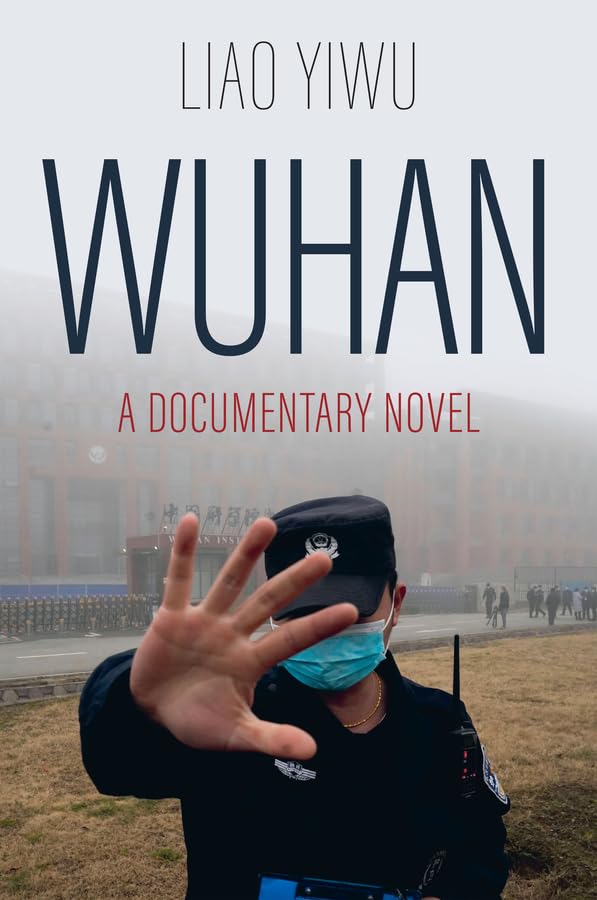
Wuhan: A Documentary Novel
- Author: Liao Yiwu
- Genre: Historical Fiction
- Publication Date: July 1, 2024
- Publisher: Post Hypnotic Press Inc.
Thank you to NetGalley and Post Hypnotic Press Inc. for providing me with access to this audiobook in exchange for an honest review.

As rumours of a strange new illness in Wuhan spread via social media in China, 25-year-old citizen reporter Kcriss decides to travel to the epicentre of the disaster to try to find out what is really going on. He sees an ad for corpse carriers at a funeral home – Male or female, 16-50 years old, unafraid of ghosts – and decides to apply. He quickly realises that the official death figures bear no relation to what is happening in the local crematoria. But the brief moment when he can tell the truth to his followers on social media is soon over: he is discovered, followed and arrested by the security police – all documented live on the internet.
In this startlingly topical documentary novel, Liao Yiwu takes us into the heart of the crisis that unfolded in Wuhan and unpicks the secrecy and cover-up that surrounded the outbreak of the public health emergency that ravaged the world. Where did the virus come from and what happened in Wuhan? Protocols are buried and new lies cement the story of the party’s heroic victory – propaganda that poisons people like the virus.

I wasn’t sure that I was really ready to read a book about COVID, but I was very interested in getting a behind the scenes look at what was going on in Wuhan. I checked out the author, and was impressed by his willingness to criticize the Chinese Communist Party as well as pay the consequences for that. You know those nonfiction stories that read like fiction? This felt like the exact opposite—a documentary novel that blends both fact and fiction, with characters who are real and those who are made up, yet the book felt like a cohesive peek behind the curtain of secrecy in Wuhan and China as a whole.
This book starts out through the perspective of Kcriss, a citizen reporter who hears about rumors of some mysterious kind of flu occurring in Wuhan. He then makes the decision to travel to Wuhan and see what is happening there for himself. Applying as a corpse carrier at a local funeral home, he realizes how large the death toll is, especially compared to what the government is reporting to its citizens and the world.
From there, we get to see through the eyes of other people close to ground zero for what we know now is COVID-19. Ai Ding is a married man returning from business in Germany, and struggling to get home to Wuhan through all of the roadblocks that arise. His elderly father is sick and he’s very motivated to get home, facing multiple disinfections and quarantines (paid for out of his own pocket), as the government tries to do everything to keep the events in Wuhan quiet. The entire book is told through the eyes of several characters, and narrated by one narrator, Ernest Reid. He did a fantastic job with the characters and the story, effortlessly switching between British-accented English and Mandarin Chinese, with a Wuhan dialect, although I’d defer to a Mandarin speaker since I don’t speak Chinese.
This combination of fact and fiction in order to provide a look into Wuhan gives the start of the pandemic a personalized feel. Rather than seeing lists of names and numbers of people dead, we get to know a few people very well, and see how deeply this wreaked havoc under the oppressive regime in China. I’m always fascinated by the experiences of ordinary people, especially when they’re featured against the backdrop of extraordinary circumstances. We got an in-depth view of what it is like living under a communist regime that controls every aspect of their citizens lives, including using an Internet wall to prevent free exchange of ideas on the web.
It doesn’t take long for claustrophobia to set in while reading this. There’s a simmering threat throughout the story, and it bubbles over as the government works harder to manage the crisis playing out in Wuhan and media propaganda scrambles to find a way to spin it. Despite reading books about life under various dictatorships, and having heard about it first-hand from my father, it wasn’t until this book that it hit home how corrupt the dictatorship always becomes, and how quickly they manage to bring an entire population under their control.
One of the first similarities for me was seeing how this crisis was handled compared to the USSR management of the Chernobyl Nuclear Reactor Meltdown, which I actually remember seeing on the news as a kid. The government of the USSR downplayed the nuclear reactor accident until they were unable to, as reactors in Western Europe were picking up increased levels of radiation. Much like in Wuhan, the government was offering significantly lower death tolls than the people on the ground were seeing, with trucks full of dead bodies being brought to the crematorium. The people of Wuhan were dying in large numbers, with entire families succumbing to this new disease that the government is telling them not to worry about. As with any other oppressive regime, they have a complex system of monitoring residents and quickly identifying anyone who isn’t toeing the party line, subjecting them to imprisonment and torture.
Overall, this was a really well done novel, and it felt like the perfect combination of facts and fiction to give a documentary feel with a personal spin. It’s a lot easier to identify with the characters when we realize it’s just a matter of location between them and us—I may not be living under a dictatorship, but this book also tears off the rose-colored glasses being shone on communism, and how the people in China coped with this explosion of disease. Throughout the book, the author refers to COVID as ‘the Wuhan virus’ in that it originated in Wuhan, and shares the wet market story of where the virus came from, along with the more sinister idea that it was a leak from the P4 lab that led to this pandemic which changed the world as all of us know it. This would be a great read if you like thoughtful novels, getting a sneak peek into the start of a pandemic, are intrigued by China or life under communism, and documentaries that read like fiction, and I can enthusiastically recommend the audiobook version for clear pronunciation of Chinese words that I would never have had any idea how to pronounce, and a fantastic narration experience.
Disclaimer: This post contains affiliate links, and I may earn a small commission at no cost to you if you purchase through my links.
Categories: Book Review
 Leah's Books
This sounds like a great read. I’ve begun reading a little Covid stuff, too. Mostly short stories and such. The nonfiction would be interesting, too, at some point.
(Prepare for a flurry of comments from me today, by the way. I finally have a little time to do them!)
LikeLiked by 1 person
I’m so glad to see you popping in on a day other than Tuesday! I really loved how the book was written like a documentary, but focused so heavily on the people, so it wasn’t as overwhelming as perhaps a long nonfiction book on COVID.
LikeLike
Zhuangzi‘s Return
On Thursday (December 19, 2024) I invited the writer LIAO Yiwu/廖亦武 to discuss his book “Wuhan: A Documentary Novel” in my seminar on “Breath and Breathlessness” (Atem und Atemlosigkeit) at the Institute of Philosophy at Freie Universität Berlin. During the discussion, a student mentioned that the book resembles an “odyssey” (from Changsha to Wuhan) during the first month of the Covid-19 pandemic. This makes sense. It is a modern version of the Odyssey, but without a happy ending: when the main character (AI Ding) finally returns home, his wife has already died.
Life, death, fate, freedom and the relation between nature and humanity were the themes we discussed, including the famous passage in the Zhuangzi about the death of his wife (鼓盆而歌), which LIAO quotes in the novel. And of course, another important character in the novel, Zhuang Zigui (莊子歸), who, like the author of the novel, lives in Berlin, contains an open reference to the Daoist philosopher Zhuangzi. LIAO emphasizes that for him, Zhuangzi is the ancient model of someone who tells stories in which the lives of ordinary people deprived of their voice are recorded in a very condensed and literary way.
The novel is full of hidden references waiting to be discovered and interpreted.
LikeLike