
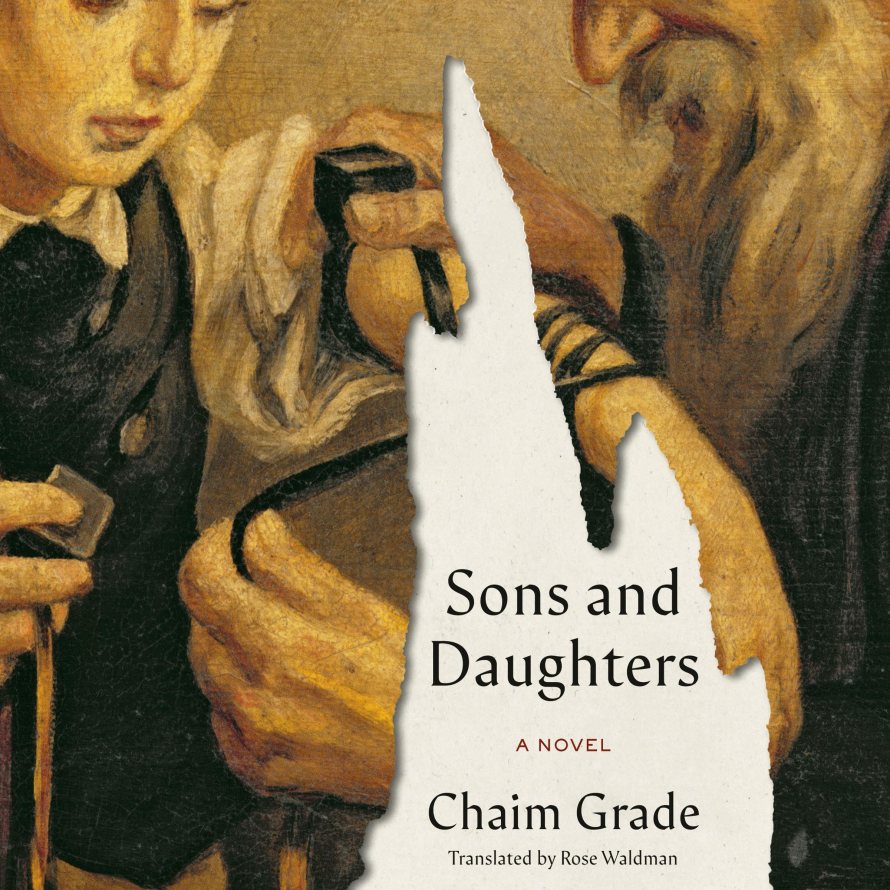
Sons and Daughters
- Author: Chaim Grade
- Genre: Historical Fiction
- Publication Date: March 25, 2025
- Publisher: Random House Audio

From “one of the greatest—if not the greatest—contemporary Yiddish novelists” (Elie Wiesel), the long-awaited English translation of a work, Tolstoyan in scope, that chronicles the last, tumultuous decade of a world succumbing to the march of modernity
“It is me the prophet laments when he cries out, ‘My enemies are the people in my own home.’” The Rabbi ignored his borscht and instead chewed on a crust of bread dipped in salt. “My greatest enemies are my own family.”
Rabbi Sholem Shachne Katzenellenbogen’s world, the world of his forefathers, is crumbling before his eyes. And in his own home! His eldest, Bentzion, is off in Bialystok, studying to be a businessman; his daughter Bluma Rivtcha is in Vilna, at nursing school. For her older sister, Tilza, he at least managed to find a suitable young rabbi, but he can tell things are off between them. Naftali Hertz? Forget it; he’s been lost to a philosophy degree in Switzerland (and maybe even a goyish wife?). And now the rabbi’s youngest, Refael’ke, wants to run off to the Holy Land with the godless Zionists.
Originally serialized in the 1960s and 70s, in New York-based Yiddish newspapers, Chaim Grade’s Sons and Daughters is a precious glimpse of a way of life that is no longer—the rich, Yiddish culture of Poland and Lithuania that the Holocaust would eradicate. We meet the Katzenellenbogens in the tiny village of Morehdalye, in the 1930s, when gangs of Poles are beginning to boycott Jewish merchants and the modern, secular world is pressing in on the shtetl from all sides. It’s this clash, between the freethinking secular life and a life bound by religious duty—and the comforts offered by each—that stands at the center of Sons and Daughters.
With characters that rival the homespun philosophers and loveable rogues of Sholem Aleichem and I. B. Singer—from the brooding Zalia Ziskind, paralyzed by the suffering of others, to the Dostoevskian demon Shabse Shepsel—Grade’s masterful novel brims with humanity and with heartbreaking affection for a world, once full of life in all its glorious complexity, that would in just a few years vanish forever.

I’ve shared a bit about my family background, and I grew up in a home where both of my parents spoke fluent Yiddish (but all I managed to learn is bad words). As such, my parents encouraged me to read, and provided a huge array of reading materials to me. I distinctly recall reading about the thriving world of Eastern European Jews through the works of Isaac Bashevis Singer and Sholom Aleichem. I always enjoyed those tales, and have consistently made an effort to consciously read books by Jewish authors. And much like there is a sense of recognition and comfort when reading a book set in a location you know well, I’ve found that I experience those same feelings of familiarity and comfort when finding a book that is so entrenched in Jewish culture.
This is a long book. The audiobook was over 28 hours, and like the stories of Charles Dickens that were serialized, this was originally published in serialized form in not one, but two prominent Yiddish language newspapers. It is compared to Dostoyevsky’s The Brothers Karamazov, and as a fan of his, I wasn’t surprised to discover that I was falling in love with this story and the tale it was trying to tell. It’s a slow, meandering stroll through the lives of an Orthodox Jewish family caught up in the intersection of their traditional religious and cultural expectations, and the tempting progress of a modern world.
One of the things that I loved the most about this book is that it gave me insight into a world that existed for hundreds of years, and allowed me a glimpse of what pre-war life must have been like for regular people like my father. Jewish families in Eastern Europe lived in what was known as a ‘shtetl,’ (pronounced shte-tell), or the Yiddish word for town. These shtetls were dotted through Eastern Europe, but if you’re picturing the impoverished country village depicted in Fiddler on the Roof, you wouldn’t be too far off. For over a hundred years, the Russian Empire allowed Jews to live in the Pale of Settlement, a region encompassing the western edge of the Russian Empire, encompassing all or part of modern-day Belarus, Moldova, Lithuania, Ukraine, Poland, Latvia, and Russia. However, they were forbidden to leave the Pale of Settlement in most cases, and it offered little hope of economic promise, religious freedom, or even basic safety, as these towns were often subjected to pogroms or other forms of antisemitic violence.
By the time Grade wrote this, the world he takes readers to visit no longer existed. Between the major changes after WWI, the push towards Zionism (it just means the right to self-determination in our ancestral homeland), and the sweeping social changes affecting Europe in the interwar period, culminating in the Holocaust that all but wiped out the Jews of the shtetls. My father was born into one of these villages and brought up in the usual way for his first years. He started attending cheder at a young age, or a primary school that teaches the basics of the Hebrew language, and of Judaism itself. In this book, Rabbi Katzenellenbogen is more than simply a regular Hasidic rabbi, he’s a rebbe, or someone who is viewed as a spiritual leader, and often develop these long dynasties of rabbinic teaching and practice.
However, we catch him on the cusp of a changing world. In his tiny Polish village of Morehdalye, they’re already facing increasing levels of antisemitic violence and boycotts from neighboring Poles, and each of his children has taken a different approach to the central theme of the novel, which is how Judaism adapts to a changing world. This was a major focus in my own house, although I wasn’t brought up in a Hasidic family with a rabbi for a father, so I found a lot of validation and a sense of recognition in these pages. Grade’s writing is incredible, and he is able to paint a vivid picture with his words, so that I could easily put myself into the shoes of these characters, and to some extent, to my own family’s history.
Like many other Hasidic families, the Katzenellenbogens are a large clan, and as the rabbi’s children all become adults, they each approach the central conflict in a different way—one daughter follows his wishes and marries a rabbi, only to feel stifled and unhappy in a relationship suffering from differing goals and aspirations; another decides to postpone marriage to study nursing; another son who dreams of living in the British Mandate of Palestine, getting caught up in the growing move to throw off the shackles of Europe and dreaming in an excessively idealistic way; another goes to Bialystok to study to be a businessman; and Naftali Hertz headed in a different direction, moving to Switzerland to pursue a doctorate in philosophy and winding up with no desire to return back home, especially after he takes a non-Jewish wife, which would be grounds for ostracism from the community. Notably, none of his sons became rabbis, although one daughter did marry a rabbi.
Rabbi Katzenellenbogen is caught in the rigid and unmoving ways of the past, as each of his children navigates their own journey into adulthood. The characters are realistic—each has their strengths but also their flaws, and we can see the poor decisions that are made at times in the story, along with the consequences and emotions that come along with those choices. Grade had managed to capture a world on the cusp of extinction, although he stops short of mentioning the oncoming crisis that people just like these characters would be facing. There were times where I wanted to shake a character for not wanting to leave Europe, knowing what would be coming for them, although the majority of these shtetl residents wouldn’t be alive in another decade or so.
This caught my attention, and held onto it, despite the slow, ambling pace of the novel. There is a rich literary tradition within Judaism, and even Grade’s writing style reminds me of my own years in yeshiva. Jewish learning involves questioning and analyzing everything, and always searching for deeper meaning, how it relates to our lives, and reflecting on how religious teachings can be understood best. And much like that learning style, the book felt comfortable and familiar to me. For a reader who isn’t as familiar with Judaism or classic Yiddish literature, there are a lot of Yiddish terms in this book, and it may involve a lot of looking up. I read the audiobook version, so there might be a glossary in the print copy, but the practicalities of Hasidic Jewish life in the interwar period may be a bit complex. But this sprawling epic held my attention for the entire time, and I loved how Rose Waldman translated this so beautifully that it didn’t even feel like a translated work. Rob Shapiro narrated the novel, and did a really good job with almost all of the Yiddish words, aside from cholent, which he pronounced as ‘kho-lent’ instead of ‘chu-lent,’ but props to Shapiro for demonstrating his ability to pronounce the hard ‘ch’ sound that is so commonly found in Jewish and Yiddish words. These words can be hard to look up because of the difference in spellings, but if you aren’t knowledgeable about Judaism and Hasidism to start, having a hard copy might help in looking up some the more unfamiliar words. Overall, Grade has a true gift, and it would be a shame to miss out on this rare talent.
Disclaimer: This post contains affiliate links, and I may earn a small commission at no cost to you if you purchase through my links.
Categories: Book Review
 Leah's Books
1 reply »