
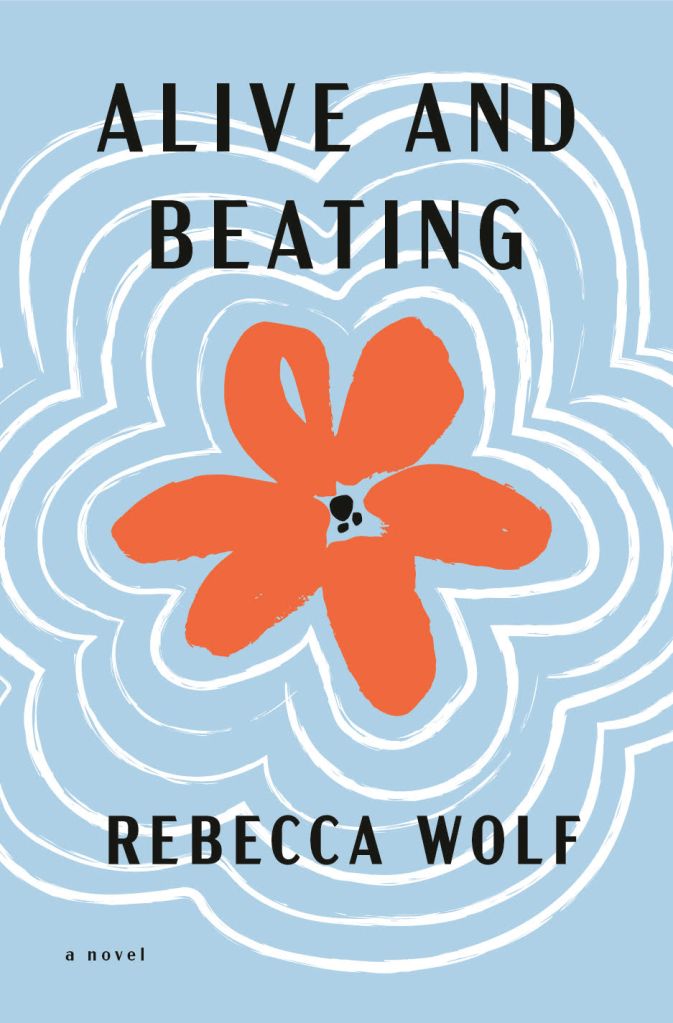
Alive and Beating
- Author: Rebecca Wolf
- Genre: Literary Fiction
- Publication Date: March 11, 2025
- Publisher: Arbitrary Press
Thank you to Rebecca Wolf for sending me a copy of this book in exchange for an honest review.

Inspired by a true story, Rebecca Wolf’s debut novel, Alive and beating, follows six people from diverse backgrounds and neighborhoods throughout Jerusalem, all desperately in need of organ transplants, on the day their lives will forever be changed. In a place where ancient divides often seem insurmountable, these six characters—Leah, a Hasidic young woman; Yael, a daughter of Holocaust survivors; Hoda, a Palestinian hairdresser; David, an Iraqi restaurant owner; Severin, a Catholic priest; and Youssef and Yosef, two teenage boys whose fates are inextricably linked—are united despite their differences by a shared goal of becoming healthy and finding meaning in their lives. Wolf’s masterful storytelling is a testament to the belief that life can be renewed, faith can transcend boundaries, and that at our core, we all share a common humanity.

Reading a debut novel is always exciting—I don’t know what to expect from the author’s writing style, the characters, the plot, even the setting, but I do know that I’m going to get to meet a new world. If it all clicks, I’ve found a new favorite author to support. If not, I can review and pass it along to someone it resonates more deeply with. But when I was given the opportunity to read and review a debut book, inspired by factual events, set in one of my favorite places in the world, I couldn’t pass on it.
I was completely engrossed before I had even gotten to the first chapter, because I was raptly intrigued by the opening two scenes. To start with, the true heroine of the story is only mentioned by name twice in those two opening scenes. We have a visual of who she was in two of the happiest and most alive—the day that she leaves for a semester abroad in Israel with a friend from NYU, and in the last moments of her life, while she is on a bus with her roommate, traveling to the beach for a few days of pre-Passover vacation.
Heads up, there is a suicide bombing and death right up front in the first chapter. The story takes place around the time of the second intifada, when suicide bombings targeting civilians were common (yep, the same intifada kumquats are calling to be globalized). What makes this book remarkable is not how this young woman lived her life, but how one uncommon decision that she made during her life impacted the lives of so many others—because she chose to be an organ donor and happened to die in Israel. Both Jewish and Muslim people have religious prohibitions against desecration of the body, which is widely accepted to include organ donation or autopsies, leading to a shortage of organs for people in need.
Readers are treated into a bit of insight into who she was before switching perspectives into the lives of the very diverse people living in Israel who are in need of an organ. Rather than dividing the story into chapter titles, the chapters are labeled by organ. We get to understand just a little bit about the person who is in need of that organ, and the lives that they live. It is just as easy to slip into the shoes of one character as another, and an insight that feels like a sneak peek into lives that aren’t typically seen by a casual observer, yet each character still feels genuine and well-rounded.
Among the many things that I enjoyed about this novel, one that stands out is the way that Wolf manages to boil people down to their bare essence when they’re defined by the need for an organ transplant. Each organ transplant candidate has been forced to sideline their dreams as a vital part of their body slowly begins to fail. It isn’t difficult to empathize and find identification in some part of the story of each individual character, and as someone who has become disabled in the last decade, I can identify with the sense of frustration in being limited by your own body. Wolf humanizes each character (despite naming the chapter after the organ) by helping readers see that no matter how different these characters are (ranging from ultra-Orthodox [Haredi] Jews to secular Jews, Palestinian Muslims, and a Catholic priest), they’re all the same deep down: each person has a life, something to live for, a purpose they haven’t accomplished, and they are fighting their hardest to hang on long enough for an organ to become available.
As you can imagine, a book set in Israel being published always sets off the trolls, but Wolf did a fantastic job of portraying everyday life for six people who get a second chance at life because someone died. She doesn’t shy away from the difficult topics—starting with a suicide bombing, the idea of organ donation in a society that has viewed it as taboo but are starting to have changing attitudes, the guilt that organ recipients might feel because they’ve benefited from the death of another, the intersection of Jews and Arabs and Christians and Muslims all sharing the same tiny piece of land, approximately the size of New Jersey, and the way each of them have so much more in common than they have differences. She accurately captures the way that the vast majority of the people are able to successfully coexist, while a suicide bombing can create a shockwave of people who are affected. Don’t think that she erases away the difficulties that have affected Israeli society, both in the early days of the country and into more recent days. The story boldly dives into the different treatment that Jewish refugees experienced, depending on where they came from, despite all seeking refuge from discrimination; the tense interactions between Israelis and Palestinians and how that can sometimes explode into something catastrophic through one poor choice; and the way neighborhoods in Jerusalem are segregated (not mandated), so the Haredi Jews all live in one area, secular Jews live in another area, Palestinians in their own communities, etc, yet all of these different people and groups cross paths regularly.
Overall, this is a gripping and realistic read, and the fact that it was inspired by real events during her own best friend’s semester abroad, where she was killed by a suicide bombing, donated her organs, and how this one brave act allowed not only people in need of organs to benefit, but changed the way that Israeli society looked at organ donation. I loved how we are introduced to each character and get to spend some time in their life with them to get to know who they really are and what their health is preventing them from doing. We know that they are the one the initial character’s organs will go to, but the story wraps up with a sense of not being finished. This isn’t in a bad way, but it allows us to fill in the blanks for the characters in a way that feels right to us. I typically despise books with open-ended conclusions, but in this case, the ending takes us full circle, to the initial character who set off the chain of events, and has one more thing to say at the end of the story, and that is what gives it a sense of closure—she knows about the lives that have been changed as a result of her death, and it left me in awe of the book. And just when I thought it couldn’t get any more meaningful, the author writes a note about her friend who inspired this story, and it made this book even more meaningful. This is a strong debut, with beautiful writing and that special way with stories that allows you to personally connect with each of the different characters and feel as though you are experiencing the events right along with them. I can’t wait to see what else Rebecca Wolf writes next, and she’s the newest author on my auto-buy list.
Disclaimer: This post contains affiliate links, and I may earn a small commission at no cost to you if you purchase through my links.
Categories: Book Review
 Leah's Books
1 reply »