
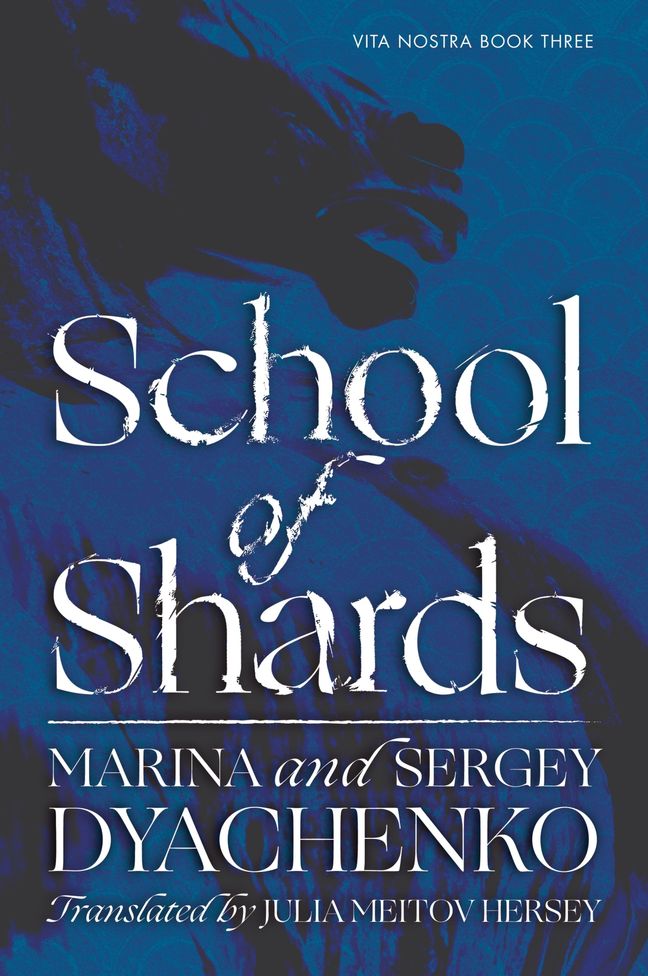
School of Shards
- Author: Marina & Sergey Dyachenko
- Genre: Fantasy
- Publication Date: June 17, 2025
- Publisher: Harper Voyager
- Series: Vita Nostra #3
Thank you to NetGalley and Harper Voyager for providing me with access to this ARC in exchange for an honest review.

The haunting final chapter of the modern classic Vita Nostra trilogy. The Dyachenkos’ magical dark academia novel brings the story of Sasha to a revelatory climax as she learns to take control of her powers and reshape the world…or destroy it forever. Beautifully translated from Russian by Julia Meitov Hersey.
The Institute of Special Technologies teaches students just one thing: the magic that allows them to become parts of speech, and in doing so, transforming into a specific piece of grammar (a verb, or an adjective, or an article) so they will be able to shape the world around them. As the new provost, though, Sasha is facing an enormous the students in the world she just created, her “world without fear,” are unable to master the curriculum. Whether it’s the magic or the natural order of things, what they need to learn and become—Speech—is the basis of the material world.
And if she can’t teach it, Sasha knows that matter will soon cease to exist.
To protect the world, Sasha must collect fragments of her former reality. Only three people carry these fragments within her younger brother, Valya, and the Grigoriev twins, Arthur and Pashka, the sons of her former lover, Yaroslav Grigoriev. Sasha must lure these three to the Institute and make them learn—and understand—at any cost.
But she knows how difficult the path is, even more so from the other side of the teacher’s desk. Forced to act ever more ruthlessly, Sasha also notices the faster the world around the Institute changes. It is a vicious circle.
And one she must break.
To do so, she will have to shape reality again, one in which communication doesn’t break down and Speech once again needs to evolve and grow and flourish.
Sasha has already given up so much in pursuit of this dream—often her nightmare—and she might be asked to make one more sacrifice so that the world and Speech might live on.

I remember when the wonderful woman behind Aquavenatus first suggested that I read Vita Nostra, the first book in the series, back when it was the only one translated from their original Russian into English by the incredibly talented Julia Meitov Hersey. Fast forward to now, when the final book has been completed and translated, and the whole series still blew my mind as much as they did the first time, maybe even more so since I seem to understand it more each time I’ve read the books. This book closes out the series in the Dyachenko’s unique style, leaving me mind-blown. Sergey Dyachenko passed away during the writing of this novel, and it was dedicated to him and their daughter. 💕
It’s hard to write this review, because this book and the series overall (since I did a quick audio reread before jumping into this one) is one of the most unique books that I have ever read. It doesn’t quite fall into one genre, bridging fantasy with science fiction, speculative fiction with the darkest of dark academia settings, and these books are equally difficult to quantify in a review format.
I’ve had an up and down relationship with Sasha, the main character. She goes through immense changes over the course of the trilogy, and that definitely contributed to how likable she was to me. Her personality is significantly different in this book, as she switches roles from student to teacher. She was much more forceful and demanding, toeing the line towards tipping into being overly controlling, without any progress being made by her students. I struggled with her actions in this book, and found it harder than ever before to connect with her. It has taken me multiple days to try to organize my thoughts about the book, and still don’t feel like I have fully wrapped my head around this book.
Now that I’ve had the time to think about it, it does make sense that I had a harder time connecting with her as she progressed in her studies and finally became a teacher at the mysterious Institute of Special Technologies, she became less human and more a part of a huge, complex plan known as The Great Speech. It is now her job to turn her students from humans to parts of grammar, but the education process isn’t working the same and Speech is at risk.
Sasha works with a cast of characters, from familiar professors to students, and while there are some new faces in major side roles, the familiar ones are showing a completely different side as Sasha’s subordinates rather than her educators. It was intriguing to see how Sasha’s interactions have all changed so much, as she literally transforms herself completely. She has immense power in her role as Password, and it was fascinating to see this world now that I’ve read the earlier books multiple times. Rather than being an observer during Sasha’s education, we now see how the teachers view the transformation process.
Both Sasha and Kostya now have taken over the roles that Farit Kozhennikov and other recruiters, as Sasha has now become desperate to collect pieces of herself that she has left behind in her past, and bring the three people with shards of herself to the school so they can learn—the twin sons of her former lover, and her half-brother, now grown up—and stabilize the universe. But Sasha’s power as Password is too strong, and her alteration of reality throws off the balance of the world as they know it unless she can get these three young men to not only learn, but to understand the process and save Speech and maybe their world.
There were so many different threads running through the book that did get wrapped up, but it ultimately felt a little anticlimactic after all the mind-bending nature of the trilogy as a whole and the high stakes in this book. But I have fallen in love with this series thanks to a rec that a friend made, and shows how well she knows my reading taste. This book was a masterpiece of translation on the part of Julia Meitov Hersey, who shows her ability to convey the complex concepts and beautiful writing from Russian to English, and the novel showcases that talent to the fullest. As far as it being originally a Russian novel, the structure of the books are quite different than what I’ve become used to from American and other Western literature, yet they still carry forward the grand tradition of Russian literature, from classics to modern day. I can’t recommend this series highly enough, even if I finished the first book completely confused. This is a series not to miss, even if I felt like the end was a little bit of a letdown from the high expectations that I had developed after reading the first two books.
Disclaimer: This post contains affiliate links, and I may earn a small commission at no cost to you if you purchase through my links.
Categories: Book Review
 Leah's Books
2 replies »