
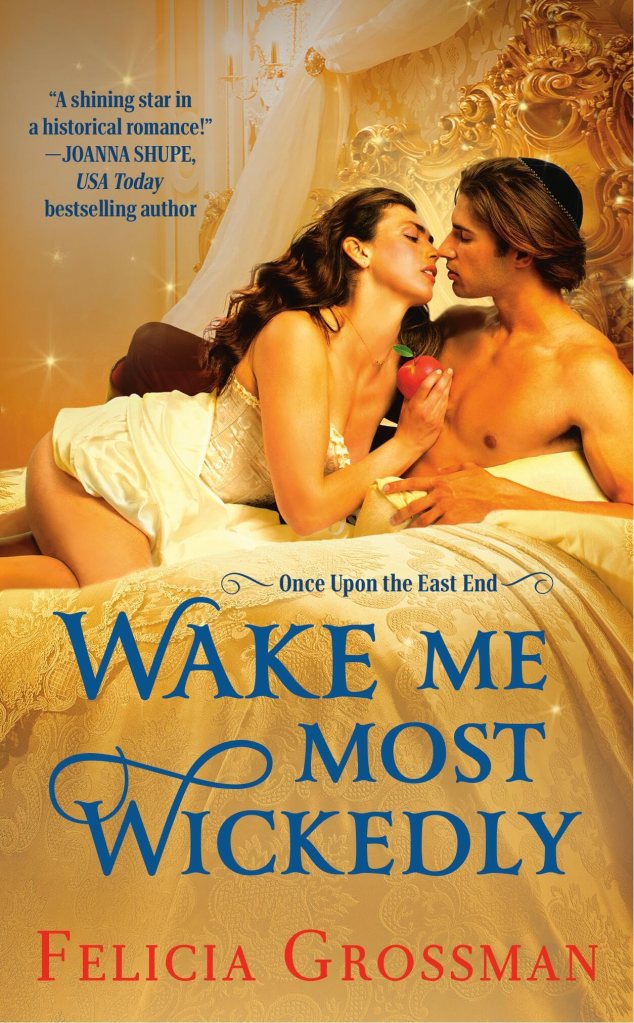
Wake Me Most Wickedly
- Author: Felicia Grossman
- Genre: Historical Romance
- Publication Date: April 9, 2024
- Publisher: Forever
- Series: Once Upon the East End #2

Solomon Weiss has little interest in power, but to repay the half-brother who raised him, he pursues money, influence, and now—a respectable wife. That is, until outcast Hannah Moses saves his life, and Sol finds himself helplessly drawn to the beautiful pawnshop owner.
Forever tainted by her parents’ crimes, Hannah sees only a villain when she looks in the mirror—no one a prince would choose. To survive, she must care for herself, even if that means illegally hunting down whatever her clients wish. So, no matter how fair or charming she finds Sol, he belongs to a world far too distant from her own.
Only neither can resist their desires, and each meeting weakens Hannah’s resolve to stay away. But when Hannah discovers a shocking betrayal in Sol’s inner circle, can she convince him to trust her? Or will fear and doubt poison their love for good?

I came upon Felicia Grossman’s historical Jewish romances when I got a copy of the first book in this series, Marry Me by Midnight, and immediately fell in love with her stories and how she represents the Jewish community in her gender-swapped Cinderella retelling. It was simple to snap up this as an audiobook from Libby, without even having to read the description. I knew this was loosely connected to the first book, and was curious to see where Grossman would take this story.
It’s only in recent years that I’ve discovered explicitly Jewish stories appearing in mainstream novels. When I was growing up, Jewish representation was hard to find—usually only in translated tales from Yiddish or in Holocaust stories. Now, I’ve found some incredible Jewish stories and authors in so many different genres: romance, fantasy, historical fiction, and mystery to name a few. If you are looking for any recommendations, feel free to comment and ask for some in your favorite genre. I’ve found that reading books with good representation about marginalized groups is a great way to learn more about others.
In this novel, Grossman takes us back to the Regency-era Jewish community in 19th century London. Before reading this, I didn’t know much about British Jews, but through MMBM and some nonfiction reads I’ve learned that there has been a long-standing Jewish community of Sephardi Jews, and that it included some very affluent people, some of whom held high positions in society. In this book, Hannah Moses is an Ashkenazi Jew who is outcast from the Jewish community because of her parents’ actions, and she is exclusively focused on taking care of and providing for her younger sister Tamar, so she can have a better life. Hannah carries a lot of guilt about the situation which led to the transport of her parents to the penal colony of Australia, and has fully devoted herself to improving Tamar’s circumstances. Meanwhile, Hannah runs the pawnshop that her parents owned, and at times resorts to less than legal activity.
Solomon, on the other hand, was raised within Jewish society by his half-brother Frederick, and feels indebted to him. As a result, he chases material success that he has no interest in, but his place in Jewish and British society means he is also pushed into a search for an appropriate wife. Hannah isn’t anywhere on the radar as an appropriate wife—she is lower in socioeconomic status, separated from the Jewish community, and there is also her Ashkenazi-ness, which is viewed negatively in the predominantly Sephardi community.
I love all kinds of fairy tale retellings, especially when they’re subtly incorporated into other genres like this book. Snow White isn’t usually my favorite fairy tale, but the way Grossman incorporated it in a gender-swapped and quiet way allowed this story to have a lot of conflict and tension and kept it moving along at a nice, steady pace. The dynamic between Hannah and Solomon was well-done, although it had some elements of insta-love to it initially. However, the dynamic between sweet, cinnamon roll Solomon and older, jaded Hannah was full of genuine chemistry and witty banter that was highly enjoyable.
It is obvious that this is a well-researched historical series, accurately portraying the division between Sephardi and Ashkenazi Jews in Regency London society, as well as antisemitism from outside the community and how it affects the characters. Speaking of characters, they’re complex and realistic, even the side characters, and typically work to move the plot forward through their own role in the story, whether it is Tamar, Frederick, or even Aaron from the first book.
Overall, this was a highly enjoyable read. The writing transformed my surroundings into 19th century London, as I was transported by the story and the talented narration of Justine Eyre, who is especially skilled in the various accents while also pronouncing the difficult sounds of Hebrew and Yiddish words correctly. Although there was a lot of repetitive back-and-forth between Hannah and Solomon, there wasn’t so much that it became tiresome. Other than that and the initial feeling of insta-love, the book was fantastic, and I’m looking forward to the third book coming out next year. Luckily, each of these read well as standalone romances, although I love seeing characters from the first book appear.
Disclaimer: This post contains affiliate links, and I may earn a small commission at no cost to you if you purchase through my links.
Categories: Book Review
 Leah's Books
1 reply »