
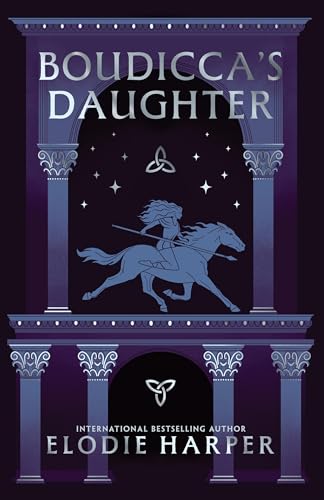
Boudicca’s Daughter
- Author: Elodie Harper
- Genre: Historical Fiction
- Publication Date: September 2, 2025
- Publisher: Union Square & Co.
Thank you to Union Square & Co. and Orbit for sending me a copy of this ARC in exchange for an honest review.

The riveting new novel about the fearless daughter of a Celtic queen, from the acclaimed author of The Wolf Den Trilogy.
Boudicca was an infamous warrior, queen of the British Iceni tribe, and mastermind of one of history’s greatest revolts. Her defeat in c. 60 CE by the conquering forces of the Roman Empire spelled ruin for her people, yet still Boudicca’s name was enough to strike fear into the hearts of her enemies.
But what of the woman who grew up in her shadow—her daughter Solina—who has her mother’s looks and cunning and her father’s druidic gifts, but a spirit all her own? Solina’s desperate bid for survival takes her from Britain’s battlefields and sacred marshlands to the glittering facades and treacherous politics of Nero’s Rome, where she must decide what it truly means to be Boudicca’s daughter.

In recent years, I’ve found the intersection of the Roman Empire and the tribes of Britain to be a fascinating area to learn more about. Unlike other books of the period that I’ve read, this book specifically looks at the story through the perspective of the British Tribes, decentering the Roman gaze that has written the history. Additionally, I had heard of Boudicca and her daughters, but knew very little about any of it beyond the basics. The fact that Boudicca’s daughters seem to only appear in the historical record when referred to their rape and aren’t even referred to by name allows Harper to work her magic with this historical fiction novel and still produce a novel with her usual feminist flair.
When it comes to feminist historical fiction, I was introduced to this concept with Harper’s most recent series, The Wolf Den Trilogy.was a fascinating look at Pompeii through the eyes of an enslaved woman bought by a brothel owner and forced into sex work. She demonstrated her ability to create complex characters forced into morally gray situations with empathy while keeping the story engaging.
The pacing was a bit slow in the beginning, which I actually found myself appreciating because it gave me time to adjust to the dynamics and context of the setting and characters. Years ago, I watched a series called Britannia, set in 43 CE, and it showed the way that the Roman Empire and its soldiers had perfected the art of taking new land and absorbing it into the empire. The overarching message was that ultimately they would do whatever they had to so they could continue with their massive conquest. The British tribes gave them a hard time; fighting using guerrilla tactics on familiar lands. Boudicca had two daughters with King Prasutagus, king of the Iceni. When he passed, he left his kingdom divided between his two daughters and Roman Emperor Nero.
Within British tribes like the Iceni, women held positions of power and fought in battles. The patriarchal society of the Roman Empire and the instability of Emperor Nero ensured that Prasutagus’ will was disregarded and the Iceni kingdom was taken by force. In an effort to break the spirit of the Iceni people, Boudicca was publicly flogged and her daughters were raped. Rome expected this to cow the Iceni, but instead, Boudicca drummed up support from her people using the scars on her back and the tales of the humiliation her daughters were subjected to. It led to a devastating rebellion, possibly the most devastating the empire had to face. Ultimately, Boudicca was defeated in battle; her younger daughter died during battle; and her older daughter Solina was enslaved and taken to Rome by General Paulinus, the man tasked with putting the rebellion down.
At first, we get to learn the dynamics and structuring of the Iceni tribe, and the story is seen through a distinctly Iceni lens. The rebellion happens relatively early on, with much of the story focusing on Solina’s experiences as a captive and her exposure to Rome as an outsider. Solina was an innately empathetic character for me. She’s a very complex character, torn between wanting to please her mother and instead failing because she is more like her father and has druidic gifts instead of her sister’s battle prowess like that of their mother.
Harper doesn’t shy away from the difficult topics in this story. When a story involves brutal battles and enslavement, it isn’t going to be the easiest read, but I was pleased with how sensitively she portrayed the main character in The Wolf Den trilogy, and her circumstances. She does the same with this story, and its themes of battle, brutality, sexual assault, social disgrace, colonization, guilt, and grief are well portrayed and never shy into exploiting the trauma. Additionally, she doesn’t sugarcoat the brutality demonstrated by Boudicca against the Roman cities she sacks.
Once Solina arrives in Rome, there’s a huge culture shock. As she gets to know Paulinus better, she struggles with her complicated feelings for him. There’s a romance that develops, and while it gave me the ick to see the imbalance in power dynamics in the relationship, her own emotions offer a better view of their relationship. Understandably, she also has a lot of guilt and shame over developing feelings for the man who killed her mother and led to the death of her sister and so many Iceni. She is also isolated from any other British slaves, and finds herself wondering if she is the only Iceni left.
Needless to say, I went into this with some high expectations. Most of them held up, and I finished my read knowing more than I started with about the time. I would have liked to see more even pacing—the beginning was slow and the ending felt a little rushed as well as unrealistic to me, although I did love how it ended at the same time. Boudicca’s daughters were basically erased from the historical record aside from mention of them being brutalized and sparking a rebellion, and we don’t even know what their names were or what happened to them. Harper’s take on their fates was satisfying and intriguing, and I couldn’t help but find myself rooting for Solina to have a happy ending. Even the nature of the romance that develops between Solina and Paulinus lends itself to a nuanced discussion of colonialism, enslavement, and sexual violence, and Solina is genuinely torn by her powerful emotions for her oppressor. Overall, this is another powerful addition to the growing cache of feminist-leaning historical fiction from various periods, comparable with authors like Alice Hoffman, Alix E. Harrow, and Pat Barker. If you’re interested in historical fiction with strong female leads, this might be just the book for you.
Disclaimer: This post contains affiliate links, and I may earn a small commission at no cost to you if you purchase through my links.
Categories: Book Review
 Leah's Books
Nice review, Leah. I’m glad that you enjoyed this one overall and learning something from it. I have also heard of Boudicca, but don’t know much. Not sure if this is for me or not.
LikeLiked by 1 person
Thank you! I love reading historical fiction – it always teaches me something new. I haven’t read it yet, but PC Cast came out with a book called Boudicca not too long ago. I can’t say enough good things about Elodie Harper’s books though.
LikeLiked by 1 person
I’m doing When Are You Reading again this year, so will keep this one in mind for one of the centenaries.
LikeLiked by 1 person
Ooooh, that sounds really cool!
LikeLiked by 1 person
I’ll be posting my sign up soon, with the link. Take a look Leah, it might be one you want to try.
LikeLiked by 1 person
I’ll definitely check that out. Thank you!
LikeLiked by 1 person