
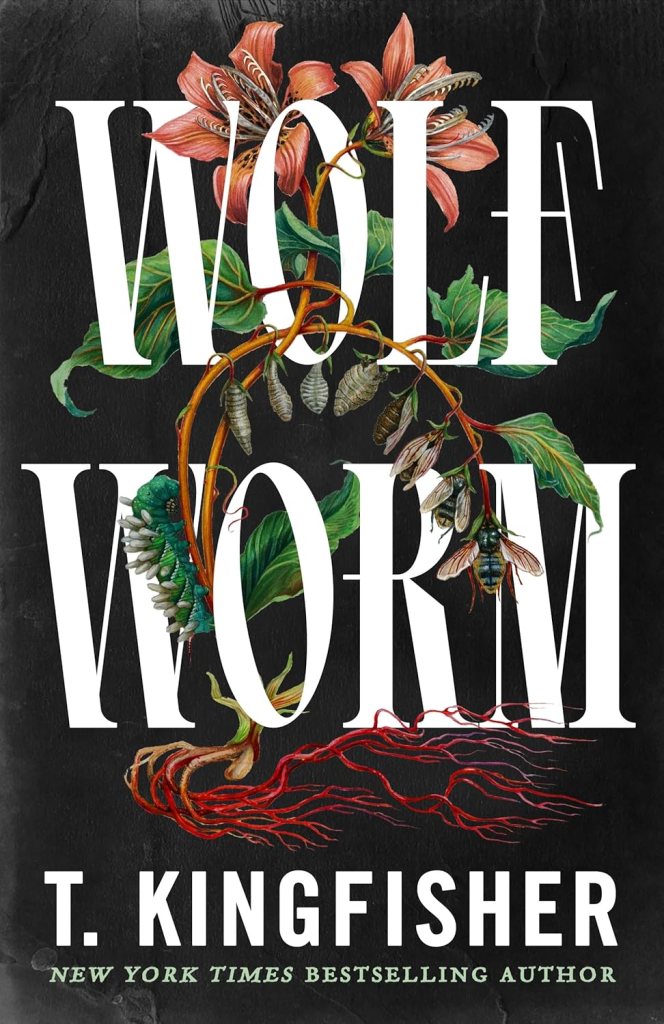
Wolf Worm
- Author: T. Kingfisher
- Genre: Horror
- Publication Date: March 24, 2026
- Publisher: Macmillan Audio
Thank you to NetGalley and Macmillan Audio for providing me with a copy of this audiobook in exchange for an honest review.

Something darker than the devil stalks the North Carolina woods in Wolf Worm, a new gothic masterpiece from New York Times bestselling author T. Kingfisher.
The year is 1899 and Sonia Wilson is a scientific illustrator without work, prospects, or hope. When the reclusive Dr. Halder offers her a position illustrating his vast collection of insects, Sonia jumps at the chance to move to his North Carolina manor house and put her talents to use. But soon enough she finds that there are darker things at work than the Carolina woods. What happened to her predecessor, Halder’s wife? Why are animals acting so strangely, and what is behind the peculiar local whispers about “blood thiefs?”
With the aid of the housekeeper and a local healer, Sonia discovers that Halder’s entomological studies have taken him down a dark road full of parasitic maggots that burrow into human flesh, and that his monstrous experiments may grow to encompass his newest illustrator as well.

I am a huge fan of T. Kingfisher’s work, and she’s the only author who writes books classified as ‘horror’ that I will always read. Her writing is fantastic and the immense creativity blows me away, along with the bits of sarcastic humor, so I had high hopes for this one. Honestly, I get really skeeved out by insects and worms, which made me a bit nervous reading a book called Wolf Worm, and I wasn’t completely wrong.
Like many of Kingfisher’s books, this one is a genre mash-up of horror, fantasy, and historical fiction with hints of a mystery to uncover. This structure kept things fascinating as well as unpredictable, and Kingfisher is a master of the unexpected twist. Since my undergraduate degree was in biology, a lot of this was familiar to me, until Kingfisher completely took things in a different direction.
If you find reading about insects difficult, like me, you might have a hard time with this one. The story hinges around a type of parasitic insect known as a botfly. I learned about these during a class trip to Costa Rica, and even saw a deer who was infected. WARNING: This might be disturbing to sensitive readers. A botfly deposits eggs into the skin of a mammal, where the egg develops into a maggot that feeds on flesh before hatching out of the skin. This is gross enough to learn about, and my whole class spent two weeks wearing pants tucked into our socks and long sleeves everywhere. It was bad enough to see a deer with botfly larvae under its skin, none of us had any desire to experience it firsthand.
This parasite was at the center of the story. Sonia is a talented young illustrator, and has been working with her naturalist father illustrating plant life that he studied. Once he passed away, Sonia is on her own and has to find a new job. When she’s hired to work for the mysterious Dr. Halder to illustrate his large collection of insects, she’s thrilled to move into his manor in the woods in North Carolina. Keep in mind, the story takes place in 1899. When Sonia arrives, she is transported the 10 miles to the manor by a man from the town, who spends the entire ride telling her about his religious convictions and that the devil is in these woods, and he has seen her. This shakes Sonia a little, but she’s a tough cookie.
Sonia quickly befriends the cook, her husband, and a local healer, and as she works, more questions arise. What happened to Dr. Halder’s wife, who previously did the illustrations for him? What does blood thief mean, and why are they in the woods? Why are the woods unsafe to walk in? As Sonia embeds herself into daily life at the manor, not only do more questions keep coming up, she finally gets some of them answered.
I love Kingfisher’s choice to put a woman who thinks in a thoroughly modern way into a novel set around the turn of the 20th century. It prevents her from adopting the ‘damsel in distress’ persona, and she’s wonderfully scientific minded. Sonia is clear-headed, rational, and likable, and I loved seeing her grow as an independent woman over the course of the story.
This could easily have been a five-star read, but for me it was a little too skeevy, and I spent a good portion of the last half of the story feeling itchy and worried a bug was on me (there were no bugs on me). But if you don’t get the same kind of reaction when reading about parasitic insect larvae burrowing into living hosts, this might just be a five-star read for you. That was really the only thing that made the book a bit difficult to read.
I listened to the audiobook and Mary Robinette Kowal did an outstanding job. She made Sonia feel like a really believable person who I would want to befriend. She told the story beautifully, and did the best possible job I could have asked for, giving a range of vocal tones and accents.
Overall, this was an outstanding read and lived up to the high standards I come to expect from Kingfisher. It gave me vibes from A House with Good Bones, and I found it fascinating to see how a similar idea could diverge into two such different stories. Despite the fact that my skin was crawling for about half the book, I couldn’t put it down and was basically MIA for two days while reading. Kingfisher is still at the top of her game, and this book makes me even more excited to browse through her backlist and any future books.
Bottom line: Kingfisher is in peak form with this book full of twists, turns, surprises, and characters you can’t help but love (and a few that are awful), but this is a book not to miss (unless you’re very terrified of bugs).
Disclaimer: This post contains affiliate links, and I may earn a small commission at no cost to you if you purchase through my links.
Categories: Book Review
 Leah's Books
The author is going on a Book Tour for this upcoming release! I’m hoping have read and reviewed this book before I attend it!
LikeLiked by 1 person
OOOOOH! I love Kingfisher. When is the book tour?
LikeLiked by 1 person
She’ll be at The Strand on Thursday, March 26th!
LikeLiked by 1 person
OOOOOOOH! I want to go with you!
LikeLiked by 1 person
Buy your ticket now before they sell out!
LikeLiked by 1 person
This sounds like a good book for the right reader, but not something that I could read.
LikeLiked by 1 person
It definitely isn’t for everyone, like I said, I was so itchy while reading it!
LikeLike