
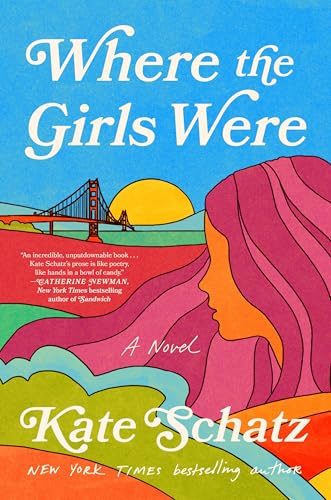
Where the Girls Were
- Author: Kate Schatz
- Genre: Historical Fiction
- Publication Date: March 3, 2026
- Publisher: The Dial Press
Thank you to NetGalley and The Dial Press for providing me with an ARC of this book in exchange for an honest review.

In this electrifying and heartfelt historical coming-of-age novel, set against the tumultuous backdrop of 1960s San Francisco, a pregnant teenager reckons with womanhood and agency after being sent to a home for unwed mothers.
It’s 1968, and the future is bright for seventeen-year-old Elizabeth “Baker” She’s the valedictorian of her high school, with a place at Stanford in the fall and big dreams of becoming a journalist. But the seductive free-spirited San Francisco atmosphere seeps into her carefully-planned, strait-laced life in the form of a hippie named Wiley. At first, letting loose and letting herself fall in love for the first time feels incredible. But then, everything changes.
Pregnancy hits Baker with the force of whiplash—in the blink of an eye, she goes from good girl to fallen woman, from her family’s shining star to their embarrassing secret. Sent to a home for unwed mothers, Baker finds herself trapped in an old Victorian house packed with a group of pregnant girls who share her shame and fear. As she reckons with her changing body, lack of choice, and uncertain future, Baker finds unexpected community and empowerment among the “girls who went away.”
Where the Girls Were is a timely unearthing of a little-known moment in American history, when the sexual revolution and feminist movement collided with the limits of reproductive rights—and society’s expectations of women. As Baker finds her strength and her voice, she shows us how to step into your power, even when the world is determined to keep you silent.

One of my favorite eras to read about is the 1960s. The cultural revolution that was occurring, the turbulence surrounding the Vietnam War, and all the changes that were happening around the world are like catnip to me. Reading about maternity homes sounded like a good way to learn more about what used to happen to unmarried women who found themselves pregnant before Roe v. Wade passed. Especially since it was overturned, people have been concerned about the lack of bodily autonomy that is allowed to women, so I figured it might be time to figure out what the options these young women had available to them.
All of this sounded really intriguing, but I honestly struggled with the book all the way through. There were a lot of things that left me feeling unconnected from the book, and led me to take a long time to finish this one. Each time I put the book down, I found myself finding approximately 75 things to do instead of picking it back up, and I kept hoping it would eventually become a more enjoyable read. Unfortunately, it didn’t have a better ending than I was expecting, and I should have DNF’d it earlier on.
Let me start with the things that I did like. First of all, Baker was a fantastic character. She is a study in juxtaposition as the valedictorian of her high school class, and an all-around overachiever, yet finds herself pregnant after a quick dalliance with a guy she meets through her cousin. Her cousin May is part of the counterculture movement, which Baker doesn’t exactly feel is her own scene. She had a plan for her life, and found herself living a completely different reality. Her character is intelligent, curious, friendly, and well-rounded, even as she is quite naïve to the changing world around her.
The story highlights the tight-laced social aspects of 1960s society as it butts up against the coming changes. Despite her obvious intelligence, she has a complete lack of understanding of how her body works, along with the mechanics of conception and pregnancy. She is a textbook ‘good girl’ and this book has the potential to turn her into an lesson for other girls.
At first, it took Baker a bit of time to understand the mess she had gotten herself into, and weigh out her different options, of which there are few. The only ones that seem available to her are a clandestine, dangerous (and illegal) abortion or ‘going away,’ a polite euphemism for maternity homes. These were houses where pregnant, unmarried women are given a place to stay throughout their pregnancy until they give birth. In theory, these sound like good places. But in reality, these girls were given absolutely no autonomy over their bodies, and were forced into signing paperwork they might not have wanted to, so that the maternity home could adopt those babies to ‘suitable’ homes.
This is where the already-slow pace of the book became positively glacial. Baker goes to the home and isn’t allowed out of the house at all, since it isn’t far from where she lives and could conceivably be recognized, exposing her parents’ claims that she has gone to Paris for the summer as a lie. She’s even given Paris-themed postcards to send, and while the girls in the home are taken on a weekly outing, Baker is prevented from going outside at all. The house is old-fashioned and stuffy, and it’s a boring place. There are school classes for the girls who haven’t graduated, and aside from the weekly outing, the other highlight is their weekly latch-hook rug group.
At this point, there really isn’t much going on. Baker has a lot of internal struggles about her future, and especially the baby. There are two girls to each bedroom, and they range in age, backgrounds, and circumstances, aside from the fact that they are young, healthy, white, and pregnant. When it comes to the girls who live in the house, quite a few of them feel interchangeable and unmemorable, as though their characters weren’t fully developed, with the exception of a couple of them.
I found myself wanting to learn more about Baker’s roommate Michelle than Baker herself. She was a big personality and there was so much I wanted to learn about her, as opposed to basically having to slog through nine months of Baker’s inability to have a say in her own life and being stuck in her head with the circular thinking and her focus on what happens to the girls when they ‘go over,’ another polite euphemism for giving birth. I felt especially frustrated for Baker in having no idea what was going to happen to her throughout this pregnancy, along with the amount of time they have where there is absolutely no mental stimulation—she loved to read and journal, and finds herself limited in what she can do, so she invents a sort-of mystery for herself to solve to occupy her mind.
Overall, I had been really looking forward to this read and found it to be more of a letdown than anything else. The exceptionally slow pace of the story makes it hard to stay engrossed, since not much actually happens when a girl is confined to a house for the entire time she’s visibly pregnant. It’s easy to look at this story through a modern lens, and doing so not only drew parallels to the current state of bodily autonomy for women in the US and other places around the world, but it makes it clear how traumatic this type of experience is, especially for girls who are given no information or even preparation until they go into labor. Even then, they were sedated through the labor and not even given a chance to see their baby before being adopted out. I was outraged about the intense shame these girls are made to feel for getting pregnant, even though there are no safe options if they aren’t educated about their bodies and their pregnancies. I was astonished at how poorly prepared they were and the way the girls were not encouraged to get too friendly with each other. The story does include some trigger warnings, including forced drugging, multiple mentions of illegal abortions, an allusion to rape, suicide, gaslighting, and on-page depictions of the many ways in which women had no bodily autonomy unless they stepped into dangerous territory. And while I was hoping to like the very last part of the book more than the rest, nothing really happened until the last 15%, and even then, the ending was a completely unsatisfying open one, where I spent weeks of my life reading this book only to have no idea how it ended because there wasn’t really an ending to be had.
Bottom line: This is one to skip, unless of course you like a book that moves slower than the timer on a cardio workout, and leaves you wondering ‘why did I read all of that if there wasn’t even going to be an actual ending?’
Disclaimer: This post contains affiliate links, and I may earn a small commission at no cost to you if you purchase through my links.
Categories: Book Review
 Leah's Books
Well, in theory the idea behind it sounds cool! Is historical fiction your go-to? I saw another historical fiction review of yours.
LikeLiked by 1 person
I do enjoy historical fiction, but I read a lot of fantasy and some mysteries too. Is historical fiction your go-to?
LikeLiked by 1 person
No, but Kristen Hannah is killing it with Women’s historical fiction.
LikeLiked by 1 person
I only read one of her books, but there are a bunch of them on my TBR.
LikeLiked by 1 person
Read The Nightingale and The Women👌🏾
LikeLiked by 1 person
I loved The Women!
LikeLiked by 1 person