
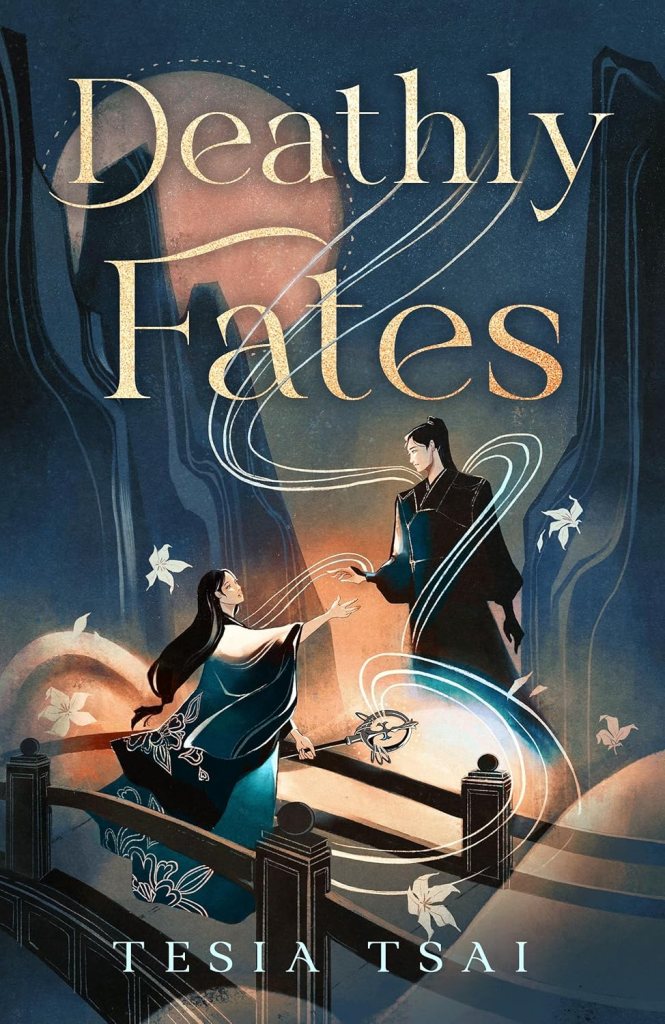
Deathly Fates
- Author: Tesia Tsai
- Genre: YA Fantasy
- Publication Date: April 14, 2026
- Publisher: Wednesday Books/Macmillan Young Listeners
Thank you to NetGalley, Wednesday Books, and Macmillan Young Listeners for providing me with an ARC of this book/audiobook in exchange for an honest review.

A sweeping debut inspired by the Chinese folk practice of necromancy, Deathly Fates is perfect for fans of Descendant of the Crane, The Bone Shard Daughter, and A Magic Steeped in Poison.
As a corpse-driving priestess, a holy servant paid to guide the deceased home, Kang Siying has never feared death. But when her beloved father collapses due to his declining health, Siying realizes that even she is not free from the cruel grasp of mortality. Desperate to provide her father with the medical aid he needs, Siying accepts a dangerous job that promises a generous commission, and travels to a hostile state to retrieve the corpse of a missing prince.
But the moment Siying places her reanimation talisman on the dead prince’s head, rather than make the corpse obedient to Siying’s commands, the talisman brings the prince back to life. Worse, he won’t stay alive for long―not unless he absorbs enough qi, or life force, to keep his soul anchored to his body.
In return for a reward worth twice her original commission, Siying agrees to aid the frustratingly handsome prince in finding and purifying evil spirits for their qi. But as they journey across the countryside, encountering vengeful ghosts and enemy spies alike, they gradually uncover dark secrets about the prince’s death―secrets that could endanger both Siying’s father and their entire kingdom.

I am always intrigued by books that incorporate elements of the folklore and mythology of different groups, especially those of diverse cultures that I’m not as familiar with. In recent years, I’ve seen books inspired by non-European cultures, and it is wonderful to be able to get that different view. If there’s one thing I learned from reading books like this it is that each culture has their own way of telling a story, and it might not all be set up the way I’m used to, but there is so much value in these stories. I know I would have loved to see a book about Jewish folklore so that I could have had representation outside of Holocaust stories. But I digress: Let me get to my review.
The audiobook is narrated by Katharine Chin, who did an outstanding job. Her voice is pleasant to listen to, and she pronounces the various Chinese names and other words in a way that sounds authentic to my non-Chinese speaking ears. I really enjoyed her narration, and she was able to transport me right along with the characters.
Centering around a psychopomp priestess, Kang Siying works to guide the deceased into the afterlife. Her father was also a priest who guided the dead home, much like Charon’s purpose in Greek mythology. But when his poor health gets worse and he collapses, Siying accepts a lucrative job offer to be able to provide her father with treatment that could save his life, but it turns out to be more dangerous than she knows.
I really enjoyed Siying’s character. She’s got her moral compass set firmly, and she takes her job very seriously. Even when she has to travel to an unwelcoming and dangerous country to guide home the corpse of a prince who has gone missing. She’s a bit of a grumpy character, but that didn’t surprise me. As someone whose occupation deals with the dead, I would think that makes things difficult to have a sunny disposition. I did enjoy her darker, sarcastic, and intense personality traits, especially when compared to Prince Renshu. Ren is a second prince, and has no aspirations to the throne—he’s more than happy to leave it to his older brother, while he has less constraints on his time and behaviors.
As a younger son, Ren doesn’t have much responsibility on his shoulders, so he tends to be a bit more light-hearted, much more optimistic, and the sunny to Siying’s grumpy. After going missing, it’s revealed that the corpse of Prince Ren that she is tasked to bring home isn’t all dead—he’s partly alive.
Siying’s job involves placing a magical talisman on the head of a corpse, which reanimates it and makes them obedient to her commands. Except when she puts the talisman on Ren’s head, it brings him back to life…mostly. He needs to refill his qi to stay alive, but to do that, he either has to take it from someone else, or have Siying purify vengeful ghosts so he can absorb the cleansed qi. This throws the two of them together on a journey that becomes increasingly dangerous, and the outcome requires their cooperation. I loved how the connection between these two characters goes from reluctant allies to a romance, and the way things felt like they were changing and connecting more in a way that was natural. However, I wasn’t shipping the romance between them as much as it felt like a really close friendship. You know, the kind where you have that witty banter and people always mistake you for a couple because you know each other so well but there’s no romantic spark.
Aside from the relationship between Siying and Ren, I also enjoyed learning more about Chinese folk tales of necromancy and how they were explored in practice. The way Siying is responsible for bringing the dead home and how she is able to utilize talismans to complete her job, along with the way ancient Chinese concepts such as filial piety guide her actions. The story is fast-paced and full of action, with our couple heading all over the map.
Overall, this was a great and really enjoyable read. I loved the fast pace and couldn’t wait to start reading again as soon as I could. The way Chinese folklore about necromancy was woven through the story was done beautifully, and I am now fascinated by this type of folklore. However, there were a few issues I came across while reading which prevented this from being a 5 star review. While Siying and Ren are well-rounded and fully developed characters, the side characters are one-dimensional in comparison. The romance felt more like a friendship to me, but I did love both Siying and Ren and their dynamic. It did have the overused trope of ‘needs to take a journey and complete tasks to save the world,’ making this a bit predictable, since I’ve read so many fantasy novels that follow this formula. And the fast pace makes it easy to fly through the read, yet the ending still felt rushed in a way. Needless to say, none of these factors really affected how much I enjoyed this book.
Bottom line: A wonderful dive into Chinese necromancy folklore with a bit of romance, a lot of snark, and a pace that makes the story fly. I can easily recommend both versions of this one as well.
Disclaimer: This post contains affiliate links, and I may earn a small commission at no cost to you if you purchase through my links.
Categories: Book Review
 Leah's Books
I enjoy learning about folklore.
LikeLiked by 1 person
Folklore is endlessly fascinating to me!
LikeLike