
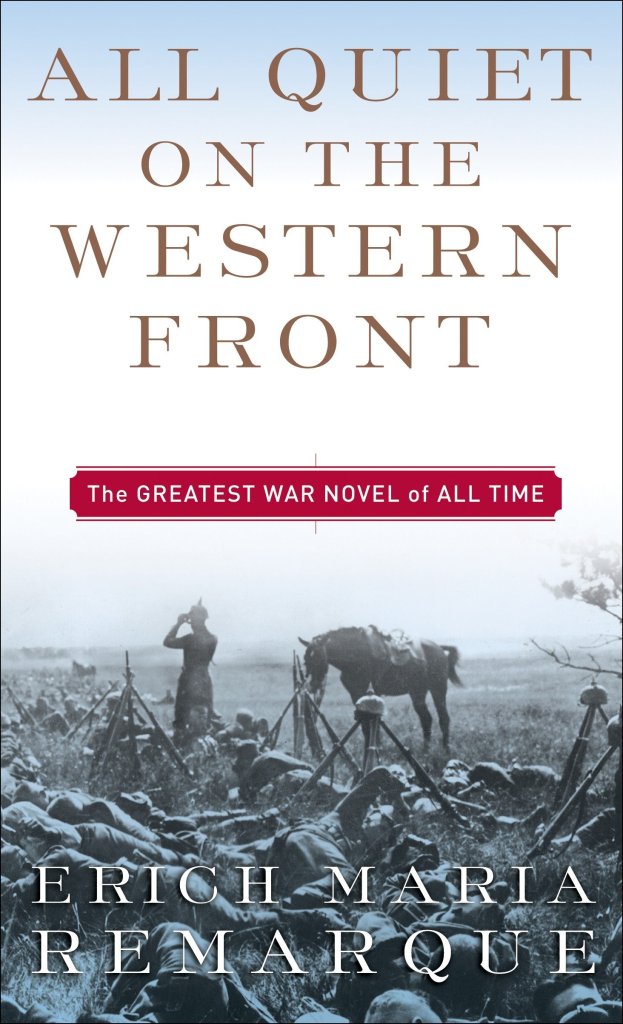
All Quiet on the Western Front
- Author: Erich Maria Remarque, translated by Maria Tatar
- Genre: Historical Fiction
- Publication Date: March 6, 2026
- Publisher: Penguin Classics
- Series: The Road Back #1
Thank you to NetGalley and Penguin Classics for sending me a copy of this book in exchange for an honest review.

Galvanized by youthful idealism and patriotic fervor, nineteen-year-old Paul Bäumer and his schoolmates enlist in the German army at the onset of World War I. But soon their dreams of heroism shatter beneath the first shells of the bombardment, as they find on the battle front not the glory they were promised but savage brutality.
The most influential war novel of all time, All Quiet on the Western Front has sold more than twenty million copies, been translated into more than fifty languages, and been adapted into three acclaimed films. In his Nobel Prize lecture, Bob Dylan included it among three books that have left an impression on him since elementary school: “This is a book where you lose your childhood, your faith in a meaningful world, and your concern for individuals. . . . I put this book down and closed it up. I never wanted to read another war novel again, and I never did.” In this brilliant new translation, the distinguished Harvard professor Maria Tatar draws on her lifelong engagement with German literature to give a new generation of readers an English version that comes closest to the lyrical tragedy of the 1929 original. It compels us to see with fresh eyes the abject horror of trench warfare, and to feel with a quickened heart the unbreakable bonds of friendship forged among Paul and his fellow soldiers as they fight not just for their country but also for their own survival. At a time when we are more divided than ever, Erich Maria Remarque’s classic novel reminds us that enemy soldiers who’ve been demonized by the rhetoric of war actually have much in common, giving it the potential to generate principled outrage about the senselessness of war for another hundred years.

I’ve had my eye on this book as one I have wanted to read for decades, but somehow just never got around to it. The majority of my reviews are for new books, although I do like to try to incorporate backlist books as well. Those paths crossed when I was able to review a new edition of the 1929 classic. There is a new translator, and she’s able to keep in mind how relevant this book has remained, especially with all the conflicts currently occurring around the world. So I was obviously thrilled to receive a gorgeous new hardcover copy (as well as the ebook) so I was able to bring the story with me if I had to go somewhere.
I deliberately took my time reading this one for two reasons. The first is because I didn’t want to rush through the story, preferring to let the message absorb slowly. For the second, it was because this is such an emotionally heavy story that I needed to work in some lighter reads to switch back and forth. But it wasn’t trauma porn or romanticized, the way some war novels can be. Instead, this book’s power is that it is universal—it is a striking condemnation of war while also pulling at the reader’s heartstrings for these innocent young men forced into the war. I ended up having to take a day or two after finishing the book to organize my thoughts, and I can already tell that this is going to be living rent-free in my head for the foreseeable future.
Centering around Paul Baümer and his military cohort, a group of young men just out of high school. He’s in a unit with some of his former classmates and some other men in the unit, led by Katczynsky (Kat) a man who is only a few years older than they are, but is far more worldly. It’s easy to let these guys into my heart. They’re typical guys in their late teens, so they act in a way that applies to 18 year olds around the world. Except what was supposed to be a time where they were starting their lives is the time they enlist in the German Army and find themselves literally in the trenches on the Western Front, located in France.
This novel is visceral and gripping, and it strips away the romantic notion of soldiers at war in a way that can only telegraph Remarque’s own personal history as a soldier in WWI. His prose is direct, sharp, and spare—he only uses as many words as he needs, with every scene furthering the novel’s message. And even so, it is beyond easy to picture myself right in the trenches with these young men. His description of a poison gas attack and the thoughts running through Paul’s mind are incredibly vivid:
“Cautiously, with my lips applied to the mouthpiece, I start to breathe. And now I can see the vapor slithering along the ground and sinking into all the hollows. Like a big, soft jellyfish, it settles down into our shell hole and lolls around in it. I nudge Kat. It would make sense to crawl up over to higher ground than to stay here, where the gas is collecting. But no chance of that. A second bombardment begins. Now it feels like it’s not just the guns that are roaring—it’s as if the earth itself is erupting.”
The casual brutality they experience is unimaginable, and they rely on each other not only for support, but also for protection. When you’re in a war, you want people who will have your back that you can literally trust them with your life, and that is what these guys do. The German word for this type of bond has no direct translation, and is referred to as Kameradschaft, since the translator chose to keep the word in German in her translation. It’s a bond deeper than camaraderie, friendship, family, or a spouse. Paul describes it this way:
“This is brotherhood on a grand scale, with a flash of the camaraderie found in folk songs, the team spirit forced among convicts, and the desperate solidarity found among those condemned to die…”
Following a timeline in Paul’s thoughts, we see the men in bootcamp, followed by different stations including along the front lines. There are flashbacks to scenes at other times in the army, and it demonstrates what that bond of Kameradschaft really looks like. Once enlisted into the army, a soldier is never alone; not even while using the latrines, which are long, communal latrines with no privacy. In particular, they face immense bullying in basic training from Corporal Himmelstoss, who runs the training in the barracks. As a civilian, Himmelstoss was a postman, but his entire personality changes in wartime, once he gets some power over others. This group is forced to deal with Himmelstoss running them ragged, until they stop fearing the threat of his position as an officer, and that’s when they get the chance to exact revenge on him.
“We became tough, cautious, ruthless, vicious, hardened, and that was a good thing too, because we’d been missing exactly those traits. If we’d gone straight to the trenches without this kind of training, then most of us would have gone mad. This way, we were prepared for what was in store for us.”
While the story is focused on Paul’s thoughts and how he changes over the course of the book, there are times when he and his fellow soldiers find small pockets of time where they can escape from the circumstances around them and simply exist, enjoying their life in moments snuck in here and there. Each of the men in his cadre has a fully developed character, and they all function to move the story along. Despite the author’s tendency to mention his former classmates by first or last name (Albert Kropp for example), while others are only referred to by their last name (Tjaden, Katczynsky), yet I never got these men mixed up in the reading.
Once they were headed back to the front, Paul begins to consider how this war will affect not only his life, but those of his entire generation on both sides of the battlefield, and how war turns them into “human animals,” impacting the rest of their lives. These mild-mannered, silly young adults are pushed into a situation where they are required to become killers, with no concern for what could happen to the soldiers who manage to survive this horrific war.
“Albert spells it out. ‘The war has ruined us for everything.’
He’s right. We’re no longer young. We’re not aching to take the world by storm. We’re on the run. We’re fleeing from ourselves. From our lives. We were eighteen years old and just beginning to love our lives and the world. Then we had to shoot right at that world. The first shell was a direct hit to our hearts. Now we’re cut off from action, from struggling and growing. We’ve lost faith in all those things. We believe in war.”
When Paul finds himself on leave at his childhood home, he struggles to understand the disconnect between his life before he enlisted and after he’s seen on the front lines. He realizes that the older soldiers have something to return to from before the war—wives, children, occupations, while the younger soldiers, like Paul and his cadre, hadn’t even gotten to start their lives so they have nothing to look forward to coming home too. I’ve heard this from a family member who was captured in WWII and was sent to a concentration camp with his company of Allied soldiers, so this sentiment rings true.
“All at once, an alarming sense of isolation starts to take shape in me. I can’t find my way back to the past. I’m locked out. No matter how much I plead and how hard I try, nothing changes, and I’m sitting here like a condemned man, sad and indifferent, while the past turns away from me. At the same time, I’m afraid of summoning up the past too often, because I know what could happen. I am a soldier, and I have to hold on to that fact.”
Despite this book centering on the German army during WWI, granting universality makes it relatable to anyone who has been a soldier or had close ties to a soldier. Since the war is fought with firepower (guns, mortars, hand grenades) at a distance, the bayonets and knives they are armed with offer a chance to actually see the combatants on the other side, the French, British, and even Russian soldiers, up close and personal. However, this also shows Paul how similar they are: each of them is doing what they have to do in order to survive, although he struggles mightily with a hand-to-hand death of an enemy soldier as his duty wars with his moral compass. It’s only once he has become a hardened soldier, a veteran of the front lines and trench warfare, that he sees the true nature of war, which serves up the youngest adults as cannon fodder for political aspirations.
“How pointless words, deeds, and thoughts are in the face of all of this! Our thousands of years of culture must be useless if they can’t stop these rivers of blood from flowing or end the existence of a hundred thousand forms of torture. It’s only in a military hospital that you can see exactly what war is.”
Overall, I can understand why this book is referred to as the most influential war novel of all time. It’s powerful without being melodramatic, emotional without feeling forced or corny, gory without being overdone, and it is interspersed with scenes of young men just being young men, although now their joking now veers into gallows humor. Their occupation as soldiers defines who they are during war, with fears of having to integrate back into a whole new civilian life they don’t know what to expect from. At the same time, Paul pushes himself not to think too deeply about what could occur in the future. With their lives on the line at all times, they don’t give themselves the chance to talk about or even think about a future they may not survive to reach, so instead they live in the moment, appreciating each positive as it comes because there are so many negatives in their lives. Allowing readers to put themselves in the shoes of these soldiers from more than 100 years ago lets us develop a sense of empathy for soldiers who are mere pawns, and to develop our own informed opinion on war and soldiers. I can’t help but think that this is incredibly timely as ever more soldiers are needed to fight in endless wars. I couldn’t help but think that the world might be a better place if wars between nations were fought like they are in Alexander Darwin’s The Combat Codes, where knights are appointed to fight one on one to solve conflicts, rather than requiring a whole generation of soldiers to be lost.
“You can adapt to almost everything, even being in the trenches.”
Bottom line: If you read only one book about war, let it be this one. It’s a fast read with a powerful and emotional punch, and it earned it’s status as a classic.
Disclaimer: This post contains affiliate links, and I may earn a small commission at no cost to you if you purchase through my links.
Categories: Book Review
 Leah's Books
What an excellent review, Leah. I am trying to read a couple of classics every year and I think maybe I should give this a try. I did see it on NG and will check. I would like the updated book that you read. I like that you commented that all soldiers go through the same thing, no matter what the nationality.
LikeLiked by 1 person
I especially liked that the author wrote them in a way that makes this feel universally accurate. Make sure to get the translation by Maria Tatar – that’s the version that I read and I thought she did a wonderful job. This is worth the read.
LikeLiked by 1 person
Thank you Leah, war is such a terrible thing. It is probably time that I reread this.
LikeLiked by 1 person
It really is an awful thing, and it unfortunately feels even more relevant now with all the war going on around the world.
LikeLike
I read this book in high school and I still remember it. Not only because of the ending, but also because it was interesting to read a war book about our (U.S.) opponent’s perspective. Excellent review. However, this was the first book in a series?! Now, I’m intrigued!
LikeLiked by 1 person
Thank you! Yes, I noticed on Goodreads that there are two more books in the series, and now I am so curious about them.
LikeLiked by 1 person
I’m sure the rest of the series is as poignant and as tragic as the first book.
LikeLiked by 1 person
Absolutely. Remarque was an incredibly talented writer – it’s been a long time since a book hit me the way this one did.
LikeLike