
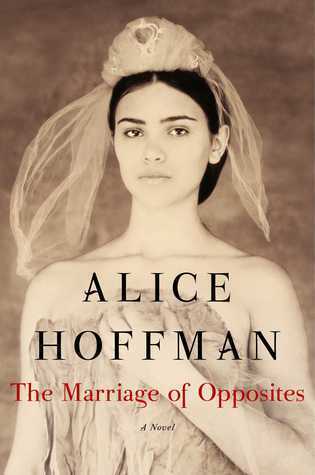
The Marriage of Opposites
- Author: Alice Hoffman
- Genre: Historical Fiction
- Publication Date: August 4, 2015
- Publisher: Simon Schuster Audio

From the New York Times bestselling author of The Dovekeepers and The Museum of Extraordinary Things: a forbidden love story set on the tropical island of St. Thomas about the extraordinary woman who gave birth to painter Camille Pissarro; the Father of Impressionism.
Growing up on idyllic St. Thomas in the early 1800s, Rachel dreams of life in faraway Paris. Rachel’s mother, a pillar of their small refugee community of Jews who escaped the Inquisition, has never forgiven her daughter for being a difficult girl who refuses to live by the rules. Growing up, Rachel’s salvation is their maid Adelle’s belief in her strengths, and her deep, life-long friendship with Jestine, Adelle’s daughter. But Rachel’s life is not her own. She is married off to a widower with three children to save her father’s business. When her husband dies suddenly and his handsome, much younger nephew, Fréderick, arrives from France to settle the estate, Rachel seizes her own life story, beginning a defiant, passionate love affair that sparks a scandal that affects all of her family, including her favorite son, who will become one of the greatest artists of France.
Building on the triumphs of The Dovekeepers and The Museum of Extraordinary Things, set in a world of almost unimaginable beauty, The Marriage of Opposites showcases the beloved, bestselling Alice Hoffman at the height of her considerable powers. Once forgotten to history, the marriage of Rachel and Fréderick is a story that is as unforgettable as it is remarkable.

I’ve discovered a love for Alice Hoffman books after reading a copy of The Dovekeepers that my mom gave me. I moved onto the Practical Magic series, but haven’t read the last book yet. But whenever I’m browsing library audiobooks, I will always jump on an available copy of one of her books, because they’re basically guaranteed to be enjoyable. The only downside is how much I struggle to write reviews for the books I love, and this issue inevitably crops up in each one of my reviews for Hoffman’s books so far. For this one, I had no idea who Camille Pissarro even was before reading.
One thing that always stands out to me about her books is the way she weaves in Jewish (especially Sephardic) tradition and history, offering great representation of various communities. In this case, the story centers on a Jewish family who had fled the Spanish Inquisition to St. Domingue (Haiti) and then to St. Thomas, where they were able to practice freely and even have their own community, as long as they don’t make too much of a fuss and call the attention of the Danish, who were in control of the island at the time.
I loved how she incorporated the close-knit, small Jewish community into the story, since they communally play such a big role in the events that happen. St. Thomas isn’t a big island and the Jewish community is tiny, so their opinions matter as far as being accepted, much like the people in other mid-19th century polite societies. Adhering to the norms and mores are important for many communities, especially in that time period.
Rachel Pomié is an only child, born to a father who operates a successful shipping business. Her mother has taken in an orphaned boy, and he is raised as a brother to her but he doesn’t seem to have the same level of maturity as she does, because Rachel demonstrates the kind of wisdom and ideas that you find in people that are older and have more life experiences while Aaron makes the same kind of mistakes young men do everywhere—I’m pretty sure that guys in their late teens and early twenties act pretty similarly anywhere you find them. Rachel and her mother don’t get along very well, and her mother chalks this up to Rachel’s streak of stubborn and defiant behavior. She finds herself turning to the maid, Adelle, for support and encouragement that she doesn’t get from her mother. Adelle’s daughter, Jestine, is about the same age as Rachel, and these two young women are best friends. However, since Rachel and her mother do share some traits, this makes for an even more difficult relationship between these two.
In the 19th century in the Dutch colony of St. Thomas, women weren’t allowed to inherit property or own a business. In order to help save her father’s business, she dutifully obeys her parents and marries a widower who is significantly older than she is, and has three young children. Rachel steps into the role beautifully, and was prepared for her life to be dictated by her mother, the Jewish community on the island, and the man she eventually marries. Instead of traveling to Paris with Jestine, Rachel is forced to defer her dreams to be a wife and mother. It isn’t long before she has three more children, only for her husband to die, leaving her with six children depending on her. Since women can’t own a business, and Aaron is deemed not responsible enough, it falls to her husband’s relatives to appoint a male to run the business, and her in-laws in France send her husband’s nephew Frédéric, to take over.
The format of the story changes here. Initially, the story is told through Rachel’s perspective alone. Once Frédéric reaches St. Thomas, the point of view is split between Rachel and Frédéric, allowing readers to see the instant connection between these two, and how deeply it hits each of them—it’s not exactly insta-love, instead it is more like meeting someone who has an almost magnetic pull. Despite the lack of blood relation between Rachel and Frédéric, and the fact that he is technically her step-nephew, any relationship between these two is viewed within the community as incest. However, when has family/society disapproval ever worked to keep two star-crossed lovers apart? In this case, it certainly doesn’t, and Rachel is willing to risk ostracism from the Jewish community to be with Frédéric. She has to fight an uphill battle to get married to Frédéric and to even have their children recognized in the community.
Switching things up again, I was sure that because of the title of the book that it was going to stay focused on Rachel, which would have been fine with me, since I knew nothing about Camille Pissarro going into this read. Camille is the youngest of Rachel and Frédéric’s children, and is her clear favorite. The third part of the book changes the pattern and switches the focus to Camille (he went by his middle name, as opposed to his given name of Jacobo) and his journey to adulthood.
I struggled with that last part of the story the most, since I was already invested in Rachel’s story and the timeline with her contemporaries. So when it switched to the sullen and stubborn teenage Camille, I wasn’t sure I was going to like where it went. Rachel changes a lot over the course of the book, however she seemed to regress—despite not being given control over her own future and wresting that power back for herself, she repeats the same pattern with Camille. She doesn’t agree with him becoming an artist despite his passion for painting and his innate talent, and fights with him about it. Also, I found it a little upsetting to see how Rachel clearly plays favorites among her many children, and couldn’t help but wonder how that impacted her children’s lives to see if it was similar to how her mother’s favoritism towards Aaron affected Rachel herself. I was disappointed to see how closed-minded she got with Camille, despite him behaving like she did at his age.
As to the time (mid-19th century) and place (the Caribbean), some really heavy topics came up. Enslavement wasn’t something that the Pomié family engages in because of their religious views, but there are instances of enslavement in the book. It is difficult to tell who is enslaved or not, since they all seem to be treated as humans with inherent value in the book, even though this isn’t necessarily the case under the surface. When Aaron fathers a baby with Jestine, he is sent away to France. Jestine has to deal with her own painful loss, and I hated how that all went down, even if it all made sense for how the story went. There are some major trigger warnings in the story, including racism, enslavement, miscarriage, death, antisemitism, and facing the consequences of defying one’s family and/or society.
I was much more invested in Rachel’s story, but I also noticed that she seemed to regress at times—as a teenager, she seems to have an awful lot of wisdom that I wasn’t expecting to find in such a young woman with no life experience, while her older years show this trend in reverse. She had such great insight into relationships at a young age, but this isn’t something I’d expect from a young woman who has probably never been alone with a male she isn’t related to before. That kind of wisdom typically comes only with hard-earned lessons and a sprinkling of silver hair, not from a naïve and relatively sheltered teenager. Another thing I noticed was that there’s a lot of fuss about Camille, but the other ten children basically disappear from the middle of the story, and I’m so frustrated with Rachel for having Camille be her obvious favorite which makes her other children be less favored. Understandably, Camille is her baby and I think a lot of mothers are a bit more protective of their youngest child, but there is clear favoritism towards Camille.
The different parts of the book wasn’t a smooth transition—it felt jarring and almost as though we were just getting vignettes of family scenes as opposed to a linear story progression. Transitioning from Rachel’s POV to her whirlwind and forbidden romance with Frédéric wasn’t as abrupt of a change as the switch from Rachel’s story to that of Camille, but switching to Camille’s part of the story was abrupt, and not what I was expecting from the last part of the book.
Overall, this was a really good read, even if there were a few things that kept it from being an amazing read for me. First of all, I really liked the character growth of many of the characters, including Rachel, Camille, and even some of the other side characters. The actions of the Jewish residents are policed within the community to avoid the attention of the Danish authorities, since they are a community of refugees and understand the importance of lying low to avoid a problem. I found it a fascinating story, and while I didn’t know anything about the ‘father of Impressionism,’ I do have a healthy appreciation for the style and artists that followed in his footsteps. But ultimately, I found this to be a fascinating family saga that kept my attention locked throughout the entire read. Although the pacing was a bit uneven, and I clearly liked some sections of the book more than others, I was engrossed and none of these factors truly took away from the read for me. And I especially loved that Hoffman highlighted that the synagogue in St. Thomas purposely had sand floors so they never forgot where they came from.
Bottom line: A great read, featuring star-crossed lovers in a beautifully rendered tropical setting that will pull you in and not let you go.
Disclaimer: This post contains affiliate links, and I may earn a small commission at no cost to you if you purchase through my links.
Categories: Book Review
 Leah's Books
1 reply »