
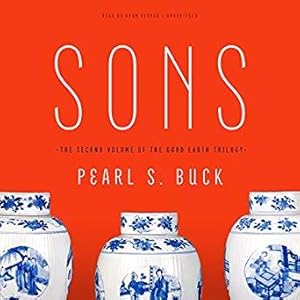
Sons
- Author: Pearl S. Buck
- Genre: Historical Fiction
- Publication Date: July 13, 2010
- Publisher: Oasis Audio
- Series: House of Earth #2

The second installment in Pearl S. Buck’s acclaimed Good Earth the powerful story of three brothers whose greed will bring their family to the brink of ruin
Sons begins where The Good Earth ends. Revolution is sweeping through China. Wang Lung is on his deathbed in the house of his fathers, and his three sons stand ready to inherit his hard-won estate. One son has taken the family’s wealth for granted and become a landlord; another is a thriving merchant and moneylender; the youngest, an ambitious general, is destined to be a leader in the country. Through all his life’s changes, Wang did not anticipate that each son would hunger to sell his beloved land for maximum profit. At once a tribute to early Chinese fiction, a saga of family dissension, and a depiction of the clashes between old and new, Sons is a vivid and compelling masterwork of fiction.

After discovering that The Good Earth is part of a trilogy (don’t judge me for not knowing until now—we didn’t have Goodreads when I was a kid), I had to follow up and check out the following two. I’ve been amazed at Buck’s ability to write such vivid characters and settings, and I was fascinated to learn that she had grown up to missionary parents and spent her childhood and some adult years in China, which imbues her stories with an authentic feel.
I listened to a later version on audiobook, narrated by Adam Verner. He did a fantastic job of breathing life into the characters, and resurrecting a way of life that has since passed into the category of ‘history.’ He made the characters feel even more distinct with different pitch and tones of voice for each one.
Our original series protagonist, Wang Lung, is now an old man and has returned to the small house he originally grew up with, leaving the finery of his town life and his wealth behind him, so that he could return to the one thing he truly valued above all riches: the land he farmed which brought him from poverty to wealth. However, he passes early in the story, and it becomes clear that his sons did not inherit his love of the land. At heart, Wang Lung was always a farmer, a man of the earth, and nothing changed that for him, especially in the end. He maintained wealth without losing his humility and basic values, but his most positive traits did not get passed down to his sons.
The three sons of Wang Lung aren’t differentiated by names, and I don’t even know if they had a first name, since I believe Wang is the family name. Instead, his sons are Wang the landlord, Wang the merchant, and Wang the tiger. And despite Wang Lung extracting a promise from his sons that they won’t sell the land, Wang the landlord and Wang the merchant don’t exactly follow through on that promise. Wang the tiger is off being a warlord and managing his growing army, and shows very little connection to the rest of his family.
In my opinion, this was a much weaker book than The Good Earth. I didn’t find any of the three sons to be likable people, and the wives aren’t even given names, possibly because they didn’t have them, or possibly because they play such a small role in the story. The only women who are named are Lotus, Wang Lung’s aging concubine and Pear Blossom, the young woman who went from Lotus’s slave to an honored position in Wang Lung’s house—she is tasked with taking care of Wang Lung’s ‘poor fool,’ the aging daughter with a developmental disability. Despite the brothers trying to entice Pear Blossom to move into the town, she prefers to stay in the small hut where The Good Earth started with the unnamed daughter.
The only character that I actually liked in the reading was Pear Blossom. She is loyal to Wang Lung, has a fear of younger men, and I got the feeling there was some kind of trauma in her background. Rather than adopting the trappings of wealth that she is entitled to, she continues to live on the land and doesn’t value material things the way the other women in this story do. Speaking of other women, they each play such a tiny role in the story—we hear about the conflicts between wives and the growing need for space, and see how the women can subtly exert influence. Yet Pear Blossom is the only female character who has any degree of autonomy over her life, and I loved seeing that especially in the time the story was written, when Chinese women were expected to behave in a specific way and be submissive to their man.
When it comes to autonomy, the Wang sons are having difficulty. Wang the tiger is off being a warlord, and has very little to do with his family outside of attending events he is required to be at, and not always then either. He’s the most well-rendered character in the story, and while I didn’t always agree with how he thought and his actions, he does show a softer side. His right-hand man and most trusted advisor is a man disfigured by a severe harelip, and in a nod to societal norms at the time (the story was published in 1932), he was just referred to as ‘the harelip’ or ‘the man with the harelip’ and no given or family name was provided. As his power grows, Wang the tiger realizes the need for family he can rely on, and demands that his brothers each send him one of their sons. This sparks the idea in him that all he is missing is a son, and this is what pushes him to take a wife. However, he doesn’t seem to have any attraction towards the women and simply does his duty to procreate.
Both Wang the landlord and Wang the merchant are unhappy with their lot in life, despite the fact that the farming land is the source of the family’s wealth. Instead, they begin to sell off bits and pieces of land to finance their increasingly wasteful and extravagant costs. As for Wang the tiger’s land, he encourages his brothers to sell it and provide him with the money so he can pay his men. It isn’t long before they sell off a significant amount between the three of them, and it forces a reckoning for each of them. Environmental conditions make the land less profitable when there are droughts and flooding, but the Wang sons are divorced from the land enough so that this doesn’t actually affect them directly in a significant way.
The heart of the story juxtaposes the decay of morals and family values in the Wang family with the older ways of life that Wang Lung and Pear Blossom adhere to. Additionally, the setting of the story occurs during a period of major changes in Chinese society—many women are seen without bound feet and some are actively rebelling against the old ways, allowing women to have a bit more of a say over their future partner, although not to the extent that we do in this day and age. Based on the time period, this story occurs on the brink of revolution—transitioning from the age of warlords to Communism, and I can’t help but think how ironic it was that the Wang sons have all turned their back on the agricultural roots of their family even as the field of agriculture would be used to fund modernization efforts under Communism.
Overall, this book seemed to struggle with ‘second book syndrome.’ The pace is a lot slower, and large parts of the story dragged on. I’m hoping that the third and final book in the series is just as good as the first one was. Buck has a simple and direct writing style, making it easy to follow the story, unlike many classic novels that are written in a less understandable way. Maybe this is because she was used to hearing stories told in Chinese structures, but whatever it is due to, Buck is a fantastic writer and does justice to Chinese storytelling, which I’ve read for many years. I did struggle with the fact that there isn’t a single woman in the story portrayed as beautifully as O-lan in the first book, and found their characters flat and easy to mix up since they weren’t named at all. Although the pace was a bit up and down and I had difficulty connecting to the characters, it’s easy to see that the changes in the Wang family, especially in the behavior and thoughts of Wang the tiger, reflect the changes occurring within the country.
Bottom line: This is a slower-paced novel than the first book, with a lot more underdeveloped characters, although it was still interesting to see how Wang Lung’s sons changed so much from their father and ancestors.
Disclaimer: This post contains affiliate links, and I may earn a small commission at no cost to you if you purchase through my links.
Categories: Book Review
 Leah's Books