

Top Ten Tuesday used to be a weekly post hosted by The Broke and the Bookish, but was moved to That Artsy Reader Girl. “It was born of a love of lists, a love of books, and a desire to bring bookish friends together.” This is definitely something I can understand and want to participate in.
It’s Tuesday, and you know what that means—time for another Top Ten Tuesday post! This week’s prompt comes from Cathy @ What Cathy Read Next, and I’m already excited to hop around and see what everyone comes up with. It’s ten things I loved about [insert book title here] and we get to choose any book and talk about ten things we loved about it.
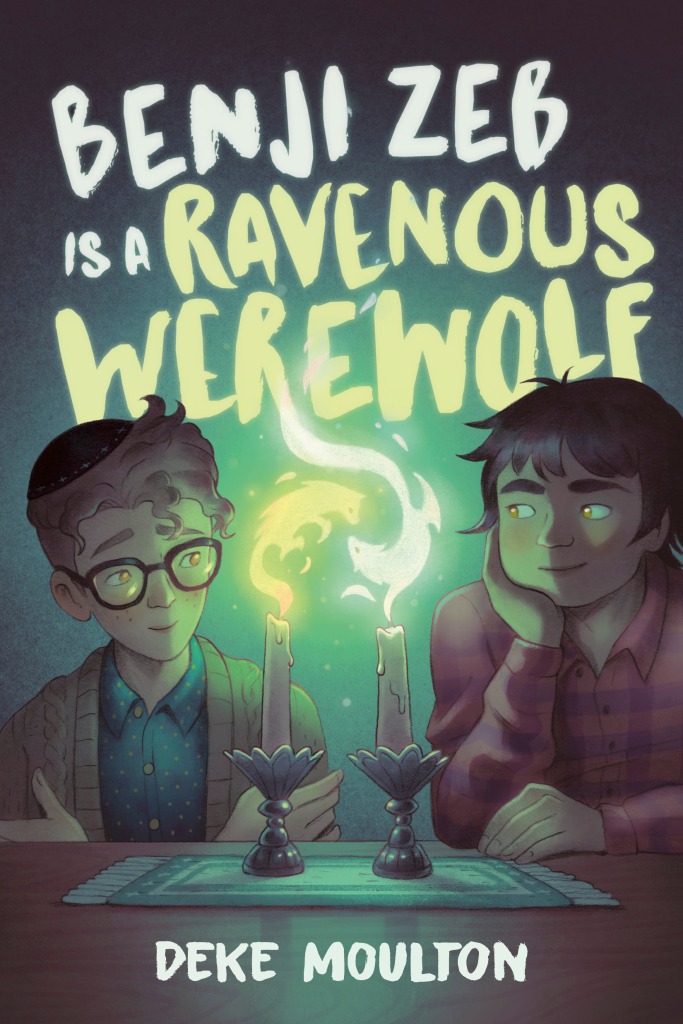
Much like any other book hoarding reading fanatic, I have a really hard time picking just one favorite book, and considered picking a few books and giving you several things I liked about each, but figured that would be too close to what I normally do each week. So after a lot of deliberating, I decided to gush about a book I read recently, so it’s fresh in my mind, and share ten things I loved about Benji Zeb is a Ravenous Werewolf by Deke Moulton. Here’s ten things I loved about this book:
- Audience. It’s written for middle grade readers, and it’s appropriate for them, but feels appropriate and enjoyable for older readers too.
- Universality. The message in this story is one that we all need to hear right now. It’s all about finding commonality amongst our differences, and working together to learn from each other and about each other, rather than giving in to hate.
- Identification. As a Jewish reader who was raised somewhere between Orthodox and Conservative, I really struggled to feel seen in books. Seeing characters who kept kosher, observed holidays and Shabbat, and often had to explain these “weird” things to my non-Jewish peers (and often still do except they no longer call them weird), I got a lot of identification between these pages.
- Queer representation. I love seeing queer representation in books, and seeing it in MG books is wild—the idea of a kid who might be questioning or wondering if anyone else feels that way too seeing themselves in the pages of a book and knowing they aren’t alone makes me so happy.
- Mental health representation. The anxiety representation that Deke put into this book is amazing, and it isn’t just a side note. Benji’s anxiety is a major part of his daily life, and it plays a major role in his story. But what makes the representation so incredible is that Benji has some coping skills that he’s found to use that help, and readers get to see him put them into action. The author shares their experiences with anxiety, but more importantly, offers resources for help.
- Jewish representation. Like the other kinds of representation in the story, it’s all authentic because it’s OwnVoices. The author discusses so many aspects of being Jewish that it’s hard to touch on them all, but so many of them feel relevant: the diversity of Jewish people; our connection to our ancestral homeland of Israel; a wonderful merging of the different cultures developed in diaspora; our holidays and the amazing connection we have both to Jews around the world and Jews from thousands of years ago, in that we all pray and observe the same way; and the darker side, the antisemitism that we’ve faced over the history of our existence, which keeps changing and evolving.
- Fascinating plot. I found myself so caught up in the story that I flew through it. The story centers around a group of werewolves who live on a kibbutz, or communal village, and wolf sanctuary, and are facing a threat. At the same time, Benji is also getting to know his old crush and current bully in a whole new light, just as Caleb is getting to know Benji in a completely different light too.
- Found family. This is hands-down my favorite trope, and the idea of a kibbutz is the epitome of found family. People who live on a kibbutz operate like a family, where meals are eaten communally, work is divided up evenly, and while family units live independently, everyone acts and is treated like a family member. Plus, Caleb eventually gets folded into the family as well. What’s not to love about that?
- Diverse representation. Deke has a gift for writing representation without it feeling forced. Among the people on the kibbutz, there are Jews who come from Iraq, India, Israel, and Eastern Europe. Caleb is biracial, mixed Chinese and Caucasian, and his struggles between integrating the two halves of his identity are discussed in the book, especially in the context of facing racism and xenophobia.
- The sheer diversity in languages used! It’s no surprise to learn in the author’s note that they were an Arabic linguist in the army, because they clearly have a talent with languages. I counted Yiddish, Hebrew, and Russian used amongst the people living on the kibbutz, and Caleb speaks Chinese (not sure if it was Mandarin or Cantonese) with his grandparents. But the fact that between the two of them, these characters can understand four languages in addition to English is really impressive. A lot of people don’t even seem to understand one language lately.
So did I pique your interest in my new favorite book? Or do I need to provide more reasons?
Disclaimer: This post contains affiliate links, and I may earn a small commission at no cost to you if you purchase through my links.
Categories: Top Ten Tuesday
 Leah's Books
I used a novel I’ve read recently too! Seemed like the easier route, and a good ne too since I’d have needed to reread an all time favorite. 🙂
LikeLiked by 1 person
Oh how awesome! It’s fun to use a recent read because everything is so fresh in my mind. And rereading a favorite always lets me know something I didn’t catch before.
LikeLike
I love it when a book for young teen or people in general has a universal theme/message that is timeless. That is the sign that a book has that something special.
LikeLiked by 1 person
That’s it exactly! That’s what made me want to share this with everyone!
LikeLike
Leah, it sounds like you found a book that checks all the boxes! It’s so excited to see more diversity in books, and authors sharing what they wished they could have seen in books when they were younger.
Pam @ Read! Bake! Create!
https://readbakecreate.com/reasons-i-love-listening-to-audiobooks/
LikeLiked by 1 person
Thank you! It really is something special when the diversity just flows naturally, and the books are really designed to speak to the readers on an individual level.
LikeLike
This sounds like a great read!
LikeLiked by 1 person
Thank you, it is!
LikeLike
This sounds really good and I love diverse books with found family trope.
LikeLiked by 1 person
It is really good! I’m also a sucker for diverse books with found family, so this one hit the spot.
LikeLiked by 1 person
I love when a middle grade book appeals to an adult as well. It’s a great way to talk to your kids. Also, I agree on both the mental health and queer reps. Kids are exposed to things and ideas a lot sooner than they used to be, and they ought to be able to find answers or representation earlier, too.
Here is our <a href=”https://www.longandshortreviews.com/miscellaneous-musings/top-ten-tuesday-ten-things-i-loved-about-waiting-for-spring/“>Top Ten Tuesday.<a/> Thank you!
LikeLiked by 1 person
I totally agree with you on this. No one talked about queerness and mental health when I was that age, and it wasn’t a good thing. I think that talking about this stuff more is a good thing when it’s done appropriately, and this book does that well.
LikeLike
A lovely list of reasons. I love the cover too.
Have a great week!
Emily @ Budget Tales Book Blog
My post:
LikeLiked by 1 person
Thank you! I adore this cover!
LikeLiked by 1 person
Some covers are so eye catching!
LikeLiked by 1 person
I’ve never heard of this one, but it sounds like a lot of fun. I’ll definitely have to check it out. I’m glad you enjoyed it so much! 😀
My TTT
LikeLiked by 1 person
I’m so glad to hear that you’re going to pick this one up! It was a fun read but it also had a great message to it.
LikeLike