
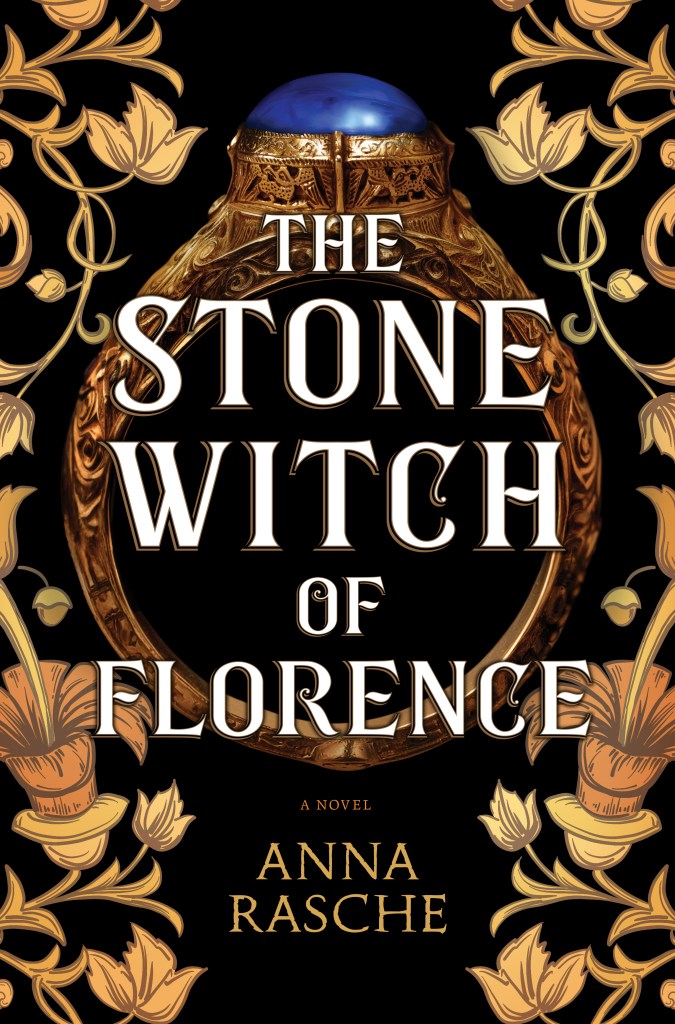
The Stone Witch of Florence
- Author: Anna Rasche
- Genre: Historical Fiction
- Publication Date: October 8, 2024
- Publisher: Park Row
Thank you to NetGalley and Park Row for providing me with an ARC of this book in exchange for an honest review.

Ancient sorcery. Magic gemstones. Only one woman can save a city in ruins…
1348. As the Black Plague ravages Italy, Ginevra di Gasparo is summoned to Florence after nearly a decade of lonely exile. Ginevra has a gift—harnessing the hidden powers of gemstones, she can heal the sick. But when word spread of her unusual abilities, she was condemned as a witch and banished. Now the same men who expelled Ginevra are begging for her return. Ginevra obliges, assuming the city’s leaders are finally ready to accept her unorthodox cures amid a pandemic. But upon arrival, she is tasked with a much different she must use her collection of jewels to track down a ruthless thief who is ransacking Florence’s churches for priceless relics—the city’s only hope for protection. If she succeeds, she’ll be a recognized physician and never accused of witchcraft again. But as her investigation progresses, Ginevra discovers she’s merely a pawn in a much larger scheme than the one she’s been hired to solve. And the dangerous men behind this conspiracy won’t think twice about killing a stone witch to get what they want…

We all know that there are quite a few topics that I never tire of reading about, and for some reason, I’ve always been fascinated by the Black Plague, and seeing a book that combines both mystery and magical realism during this period, I couldn’t wait to start it. Once I had a nice cup tea and a cozy throw blanket, I was comfy and ready to read. Which worked out beautifully, because I didn’t want to put this one down.
It’s no surprise to see that the author is a gemologist and a jewelry historian, and she puts that knowledge to exceptional use in this story. I had no idea how heavily gemstones played into the beliefs of 14th century Italy, especially when it came to the healing properties attributed to gemstones. As someone who has dabbled in crystals for a while now, these healing properties are still attributed to crystals and gemstones. The magic system wasn’t really explored, other than explaining how the healing qualities of gemstones can be harnessed by someone with a gift … in this case, Ginevra di Gasparo.
Ginevra was a fascinating character. Despite knowing that she needs to keep her gift a secret, she has an innate sense of the Hippocratic oath, and is driven to save every life that she can. As a young woman, she wasn’t as concerned about consequences of using her gift to heal people, and her abilities came to the attention of the Church, she was labeled a witch and forbidden to enter the town of Florence again. But when she is summoned to Florence after ten years of banishment, she thinks that they’re ready to rely on her talents to help save Plague victims. However, that isn’t the task that is given to her, but she has a lot of motivation to complete their task so that she could be pardoned and even clear the road towards her becoming an actual physician. This is Ginevra’s goal, despite the fact that women were not typically physicians at this point in time.
With a decade between the past and present versions of Ginevra, there’s a lot of maturing that she underwent. Ginevra goes from the idealistic young woman with rose-colored glasses to a more adult version of herself, with more patience and more cynicism after living more life. She is pushed into choosing who she can save while balancing her own life and safety by the closed minds of the era, particularly those involved in church management, who maintained immense amounts of control over the daily lives of the people of the region.
We get a view into how quickly and easily social order breaks down in the presence of a mysterious plague, similar to what we’ve seen in our own lives during the COVID pandemic, but much worse. Medieval people had no knowledge of how the plague was spread, how to stop it, and even where it came from. As such, the church was able to consolidate influence over the population by explaining the plague as coming from God, and that the way to combat it is prayer and the holy relics the churches maintain. But when facing a disease that is spread by close contact with infected people, with a death rate of about 60%, rapidly killed people after infection, and a history of affecting the vast majority of people it came in contact with. Obviously, we know today that the plague isn’t caused by a lack of attention to prayer or cured by relics, but back then, it must have seemed like a visitation by a harsh and judgmental god.
Since the plague killed so widely and so quickly, clergy and physicians were getting sick from visiting ill people in the community, they stopped making it a habit to visit and pray with sick people. Additionally, with more than half of the population getting sick and dying, there wasn’t anyone left to do anything about it. Social order broke down almost as quickly as the plague killed—no one was worried about consequences, stealing from the rich and indulging themselves with luxury food and clothing, while enterprising peasants saw a chance to move their social station, charging extortionate prices to remove the dead.
There are plenty of church politics that play out in the story, and this is important because at the time, Italy was the center of the Holy Roman Empire, and consequently, the church had even more influence over basically every aspect of life. Ginevra finds herself caught up in these same church politics when she is told she needs to find out who is stealing the priceless relics from churches in Florence, rather than saving the life of the sick. Naturally, being a healer at heart, she can’t quite turn her back on the sick, and saves the life of a woman named Lucia, who becomes quite the sidekick in this story. However, there are other cases where she can’t provide the help that she needs, and seeing how deeply she reacts to all of these situations really showed a side of Ginevra that demonstrated all the growth she experienced in her decade of banishment.
While Ginevra and Lucia try to track down the relic thieves, it places them directly in danger. These two women rely on all the resources between them, including their wits and brains, to navigate the dangerous place their city has become, along with facing down threatening criminals who have no fear of consequences. I loved seeing how brilliantly they brainstormed solutions and ways to track down who is behind the thefts, while seeing a whole new side to the city they love.
I found this to be a fascinating read, although at times the pacing was a little inconsistent. However, it was full of incredibly detailed research, allowing me to feel as though I was walking through the deserted and dangerous streets of Florence right beside Ginevra, and couldn’t wait to find out what she would discover next. Granted, there were a few times in which I struggled to stay focused on the story, but seeing the way that Rasche wove in her knowledge about gemstones and medieval jewelry history to the plot, giving us just enough magic to not make things over the top, this was well worth the read. You’re most likely to enjoy this book if you like historical fiction, books featuring the Black Plague, magical realism, gemstones, and medieval mysteries.
Disclaimer: This post contains affiliate links, and I may earn a small commission at no cost to you if you purchase through my links.
Categories: Book Review
 Leah's Books
The Black Plague was such a tragic and interesting chapter of history. There have been a few books written about what history might look like if 99.99% of people in Europe died from it instead of 50%.
LikeLiked by 1 person
It’s fascinating to me because of how tragic it was. I can’t even imagine what it must have been like to be shut up in your house while everyone is dying around you, and not even have a phone to call anyone or stay updated!
LikeLike