
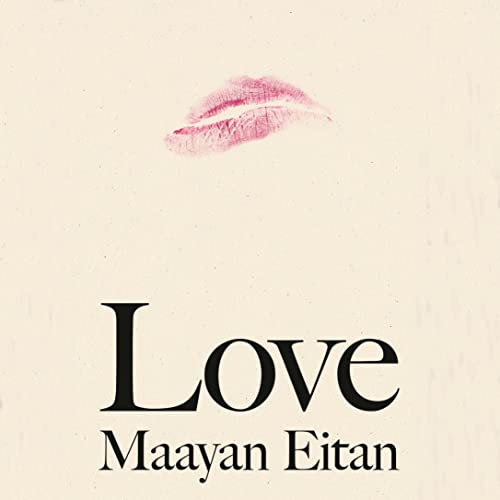
Love
- Author: Maayan Eitan
- Genre: Literary Fiction, Short Stories
- Publication Date: March 7, 2022
- Publisher: Penguin Random House Audio

Love is a fever dream of a novella about a young sex worker whose life blurs the boundaries between violence and intimacy, objectification and real love. Startlingly intimate and lyrically deft, Maayan Eitan’s debut follows Libby as she goes about her work in a nameless Israeli city, riding in cars, seeing clients, meeting and befriending other sex workers and pimps. In prose as crystalline as it is unflinching, Eitan brings us into the mind of her fierce protagonist, as Libby spins a series of fictions to tell herself, and others, in order to negotiate her life under the gaze of men. After long nights of slipping in and out of the beds of strangers, in a shocking moment of violence, she seizes control of her narrative and then labors to construct a life that resembles normalcy. But as she pursues love, it continually eludes her. She discovers that her past nights in cheap hotel rooms eerily resemble the more conventional life she’s trying to forge.
A literary sensation in Israel, Maayan Eitan’s incendiary debut set off a firestorm about the relationship between truth and fiction, and the experiences of women under the power of men. Compact and gemlike, this is a contemporary allegory of a young woman on the verge.

I’m always curious about the circumstances and decisions that lead people to the life they have now. Maybe I’m just really nosy, and like to wonder about the thoughts of others. It’s probably why I found myself in a career where I got to work as a therapist to people with severe, persistent, mental illness. Another thing I am always interested in is reading translated fiction. While the locale may be unfamiliar and I may not understand the life that people are in, I can always identify with an emotion somewhere in the story.
This was a book that I had originally requested to read as an ARC (and got denied), now that I’ve read the audiobook, it feels like a blessing in disguise. I enjoyed this a lot more as an audiobook than I probably would have as a visual read. I’ve been working on learning Hebrew for a while now, and one of my favorite thing about the narrator, Gilli Messer, is that she is (or at least sounds like) a native speaker of both English and Hebrew. There is no trace of an accent when she speaks English aside from when she says a person’s name, and then the Israeli accent is there, if you listen to it.
More than a handful of books that I have read are described as ‘fever dreams,’ but I didn’t really understand the term until I read an Ottessa Moshfegh book. This one is also described as a fever dream, and the label fully applies to this. The story is told through the eyes of an female, Israeli sex worker named Libby, and rather than a novella, this felt to me like a novella-length series of interconnected stories forming a narrative. However, the shorter format left me wanting more.
Have you ever read a book that made you feel like there was some kind of hidden depth to it that was just out of your reach, no matter what you did? I encountered a lot of this when reading assigned literature (especially classics) in high school and college, where every chapter, paragraph, sentence, and sometimes words have to be thought about in a complex fashion that only the teacher seemed to be capable of. The books that I felt like I could love if I was only smart enough to ‘get it,’ because I don’t make a habit of slowly analyzing any book I’m reading unless it is an instructional book or a proofread.
Libby is the kind of woman who could be anyone—in fact, in one chapter, she introduces herself, and the descriptors she uses to describe herself show her to be just a regular woman, a woman who has been abused, a woman who is forced into prostitution by circumstances beyond her control, someone who works to be able to afford drugs to feed their addiction. By doing so, Libby is therefore easy to identify with no matter what your own life experiences are. Through this deliberate technique, Eitan deftly unties all the predetermined beliefs we have about sex workers.
Through these chapters, readers are given snippets of a view into Libby’s life; who she is aside from her profession. Our society often assigns a value to individuals determined by their profession, and nothing else changes it. As someone who is disabled, I’ve seen the other side of this. Have you ever noticed that within minutes of meeting someone, the question ‘so what do you do?’ Inevitably comes up? Unless you have a desirable, socially acceptable profession, there is an absolute awkward pause in the conversation when people ask me that question and I say ‘I’m disabled.’ I can only guess that like my response, people who are sex workers might get the same kind of look and pause that I do, where I can see my value get lower in the eyes of some people.
Eitan’s unvarnished and no-holds-barred prose made me think, and again I find a translated novel from a country literally anywhere in the world, and there is some tiny connection I can make to a character in nearly any book. It made me think even as it kind of made me feel like there was something I wasn’t understanding, as if being just a little smarter would help me understand a deeper meaning. But I relaxed and enjoyed this for what it was, and I did wind up thinking it was a brilliant topic, and wish I could have learned more about Libby in a longer book.
Disclaimer: This post contains affiliate links, and I may earn a small commission at no cost to you if you purchase through my links.
Categories: Book Review
 Leah's Books
1 reply »