
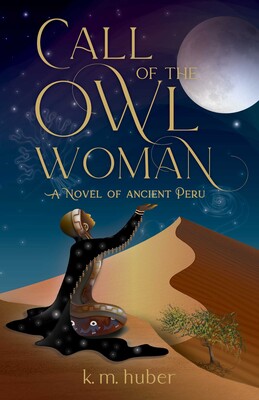
Call of the Owl Woman
- Author: K.M. Huber
- Genre: YA Historical Fiction
- Publication Date: May 13, 2025
- Publisher: SparkPress
Thank you to K.M. Huber and SparkPress for sending me an ARC of this book in exchange for an honest review.

Call of the Owl Woman is a gripping coming-of-age story set in a land of prolonged drought where cunning sorcerers and brutal priests vie for control and Water Guardians, like Patya’s father, are threatened. Even as the world around her collapses, perhaps because it is collapsing, Patya begins to discover her own power—and the destiny that awaits her.

There have always been certain places around the world that I’ve been fascinated with, and one of those is South America. While I can save up and (eventually) go to South America and see it for myself, I’ll never get an inside look into the ancient peoples of the region and fully see their culture. With this book, Huber transports readers directly to ancient Peru and the society that created the mysterious Nazca lines.
It’s no secret that the history of South America has been turbulent—with the Andes mountains thrusting up through the Earth’s crust, rocked with earthquakes, and at the mercy of their own climate and political struggles from eons ago until the present day. Patya comes from a long line of healers, although instead of learning to be a healer, she much prefers to paint the pottery the medication and herbs are stored in. Her father comes from a long line of Water Guardians, who help to find water, build canals and irrigation, and keep the gods happy.
The author did her research, and it shows. World-building is outstanding in the novel, and I finished reading with a sense that I had a better understanding of the people who created an artistic marvel that can still be seen from outer space. Huber paints a picture of an enduring people who are struggling to make sense of forces beyond their control. As earthquakes rock their village with increasing frequency and a worsening drought, the need for Water Guardians is essential. There is so much in this book about the family systems, society, and beliefs of the Nazca people, as well as taking readers along on some ritual ceremonies. (Note: The spelling of this tribe has altered over time from Nasca to Nazca due to the lack of a letter Z in Quechua, an indigenous language of the region, and then Spanish colonization changed the dominant language.)
At first, it took me a while to really get into the book. It moves slow at first, probably because of the sheer volume of information in it to allow readers to have a decent grasp on the complex peoples of ancient Peru. There’s a glossary of terms in the back, since not all of them can be guessed through context, and I struggled for an embarrassingly long time to figure out what these words were before discovering the glossary. I was intrigued by the story, but it felt like there was so much time setting the scene that the actual action felt kind of rushed, even though I can also see this working out similarly in real life—the action isn’t evenly paced in our lives, right?
One of the strengths of this book is the way everything is relayed to the reader—the author vividly describes the scenes, and is another great example of showing instead of telling. I really enjoyed learning about the Nasca people and how they explained their origins, their world, and really had a strong land-based religion. It names the deities of each of the directions and elements with animals that play an important role in their world and especially their ecosystem, such as Jaguar, Condor, Owl, and Orca. There are stories told through song, and we are taught about these deities by Patya recalling songs or her learning.
Aside from the increasingly frequent earthquakes that hit their village, they live in a desert valley that is also increasingly receiving less water. And of course Patya discovering her path in life isn’t a simple one. She’s making a tough journey from child to woman, and does have a strong sense of spirituality, taught by her beloved grandmother who passes away at the beginning of the story. It was early in the book that I began to wish I could get an audiobook copy to hear how to unfamiliar words and letter combinations should have been pronounced, but I just guessed as best I could, same as I do with anything including Welsh words.
The power dynamics play out beautifully throughout the book, from early on right up to the end. Her mother and grandmother are healers who host ritual ceremonies, her father holds the essential task of finding and protecting water sources to keep the valleys green, and her youngest brother has proven his ability to locate water as well, while her uncle is the tribe leader. The social structure in their tribe seems to involve cooperative work between tribe leaders, including priests, healers, and Water Protectors, in an ideal situation. Instead of viewing the successes of Patya’s family as a success for the tribe, Achiq views them as a threat to his desire for power and tries to undermine them and their social standing whenever he can. He is often seen to be scheming with Patya’s uncle Weq’o, making concessions to village members who have something to offer them, whether it is power, status, or wealth. I would have liked to see more fully-developed characterization from the villains, who felt uniformly evil with no redeeming characteristics at all, and somewhat flatter than the protagonist, her family, and allies, who were well-rounded and realistic characters.
Although it took me a while to find my stride with this book, I never wanted to DNF it. I was curious about what would happen to Patya and her family, and empathized with her right from the start. Her emotional turbulence seems synced with the disturbances in her world, and winds up being yet another way that Patya is in touch with her abilities and the world around her. The author beautifully portrayed several different ritual ceremonies throughout the book, and I was fascinated learning how they interacted with their spiritual world, led by people who have special talents. Patya’s coming-of-age ritual ceremony occurs as well, and I was fascinated by the use of psychedelics to facilitate communing with the spirit world.
Overall, this is a standout book. Despite the slow start and unfamiliar letter combinations (how am I supposed to pronounce Kuyllay without researching Quechua?), I was pulled into the story more and more as I continued to read. It felt as if I was under the effects of psychedelic cacti along with Patya as she takes on growing responsibility for her grandmother’s role as shaman, and the author has immense talent in creating realistic characters as they grieve, face challenges, and have to compromise to keep the good of the tribe as a priority over their own egos, even if the antagonists feel less complex than the protagonist and those around her. There’s a beautiful map, a glossary, and factual information about the Nazca people, the unique geography of desert coast on the south side of the continent featuring rivers carrying water from the Andes to the Pacific Ocean allowing the Nazca to harness that water through canals and irrigation systems and keep their farms blooming, and an author’s note. While the author herself is not South American, her husband is from Peru, so she has both a desire to both learn more about and honor the people of ancient Peru. Living there brought the people to life for her, and in this book, she’s brought these people to life for us, even if it is at the tail end of nearly one thousand years of their civilization.
Disclaimer: This post contains affiliate links, and I may earn a small commission at no cost to you if you purchase through my links.
Categories: Book Review
 Leah's Books
This sounds lovely. When I get a book with names I can’t pronounce, I end up making up my own words for them!
LikeLiked by 1 person
Yes, I do this too! Luckily most of the names were pretty easy to sound out, like Patya and Tachico.
LikeLiked by 1 person
This sounds like a great read!
I once read a book that had a character named Even in it. I’ve never seen it anywhere since then.
LikeLiked by 1 person
It took a long time to get going, but once it did I couldn’t put it down. It’s worth the wait, plus I never felt anything but excited to have the time to pick it up and read a bit more, instead of those where things move slow and it’s a struggle to pick it back up.
Even is a really cool! I think a lot of these unique names are pretty cool overall. At sleepaway camp in the 80s, I met a girl named Ryan, which was super unusual for the time. Now I have a friend with a daughter named Ryan.
LikeLike