
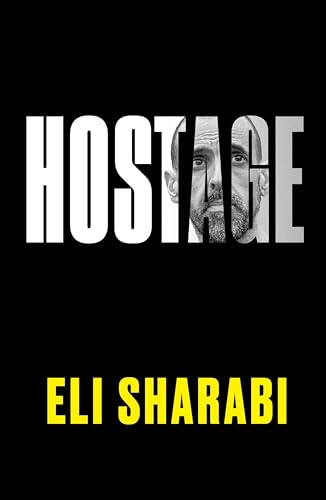
Hostage
- Author: Eli Sharabi
- Genre: Nonfiction/Memoir
- Publication Date: October 7, 2025
- Publisher: Harper Influence

In a raw and unflinching memoir, Eli Sharabi, a survivor of 491 days in Hamas captivity, recounts the harrowing ordeal of his abduction from Kibbutz Be’eri on October 7th, 2023, the loss of his wife and daughters, and his unyielding resolve to survive.
“I refuse to let myself drown in pain. I am surviving. I am a hostage. In the heart of Gaza. A stranger in a strange land. In the home of a Hamas-supporting family. And I’m getting out of here. I have to. I’m getting out of here. I’m coming home.”—Eli Sharabi
On October 7th, 2023, Hamas terrorists stormed Kibbutz Be’eri, shattering the peaceful life Eli Sharabi had built with his British wife, Lianne, and their teenage daughters, Noiya and Yahel. Dragged barefoot out his front door while his family watched in horror, Sharabi was plunged into the suffocating darkness of Gaza’s tunnels where he endured 491 days in captivity. As war raged above him, Sharabi held onto the hope that he would be reunited with his loved ones.
In the first memoir by a released Israeli hostage, and the fastest-selling book in Israel’s history, Sharabi offers a searing firsthand account of survival under unimaginable conditions—starvation, isolation, physical beatings, and psychological abuse at the hands of his captors.
Eli Sharabi’s story is one of hunger and heartache, of physical pain, longing, loneliness and a helplessness that threatens to destroy the soul. But it is also a story of strength, of resilience, and of the human spirit’s refusal to surrender. It is about the camaraderie forged in captivity, the quiet power of faith, and one man’s unrelenting decision to choose life, time and time again.
Reminiscent of Elie Wiesel’s Night and Laura Hillenbrand’s Unbroken, Hostage is a profound witness to history, so that it shall be neither forgotten nor erased.

I’ve mentioned more than once that my father was a survivor of the Holocaust, and he would talk about his experiences at home and with others, increasingly as he got older and Holocaust deniers became bolder. Listening to his story of survival made something very clear to me as I got older and began to understand my father as a man, especially once I began working in mental health—he was able to survive some of the most extreme trauma by divorcing himself from emotions. When every cell is focused on survival, there isn’t much time or energy left for feeling emotions. As I was reading this, we were anxiously awaiting the news that the last hostages in Gaza were released under the terms of the existing ceasefire. The living hostages have been released, but the deceased hostages are being released slowly, with a maximum of excuses.
I wasn’t sure what I was getting into with this—I’ve read many Holocaust memoirs, but this is a whole new rodeo and Sharabi breaks new ground with his memoir of 491 days in Hamas captivity, in the heart of Gaza. I knew I needed to read this book, although October 7, 2023 was a horrific day for Jews in both Israel and the diaspora around the world. Much like the day September 11, 2001 has personal meaning for me, so does the October 7th attack. I have family in Israel, and being part of such a small minority group means that an attack on one of us is an attack on all of us. Despite not knowing any of the hostages personally, the names are familiar in our household and feel like they are family to us.
Eli starts retelling his story from the morning of October 7th, at his home in Kibbutz Be’eri, a community not too far from the Gaza border. Awakened by sirens, they head to the family’s bomb shelter—a shelter designed to keep the family safe from rockets, not a terrorist infiltration. Eli somehow keeps his wits about him and switches his emotions off when terrorists enter the house. Having spoken about it beforehand and made the decision not to fight back, Eli is forced onto a motorbike and brought to Gaza. When he left, his wife and two daughters were shouting ‘British passports!’ to show that they weren’t just Israeli, but also citizens of England. Convinced that they wouldn’t knowingly harm his wife and daughters, he immediately focuses on getting back home to Lianne, Noiya, and Yahel.
Coming from a Yemenite/Moroccan Jewish family, Sharabi was fluent in Arabic, and could understand everything that the terrorists were saying. He was able to speak to them, and effectively communicate with nearly all of the other hostages he was kept with, except one—a Thai worker. Even so, he still tried to put others at ease to the best of his abilities, and even took on a parental role when interacting with other hostages. Sharabi was able to identify the exact moment when his thinking changed, after being kidnapped.
“There is no more regular Eli. From now on I am Eli the survivor.”
His entire being was fixed on returning home to Lianne, Noiya, and Yahel. Hamas terrorists knew that his family had been murdered and used that to psychologically torture him; telling him that his wife and daughters were on television advocating for his release turned out to be the very thing that kept him going throughout his grueling 491 days of physical and psychological torture and intentional starvation while his captors freely ate in front of them.
Eli is able to relay his traumatic experiences with candor, using short, snappy sentences. He was initially kept in a house in Gaza for 52 days, but then was dragged down into the bowels of Gaza’s terror tunnel system. He was kept with other hostages some of the time, allowing him to mentor them and give them motivation to survive. Hersh Goldberg-Polin, who was kept with him for part of the time, gave him a quote he used regularly:
“He who has a why can bear any how.”
That is exactly how Sharabi endured beatings, torture, psychological torture, isolation, unimaginably unsanitary conditions, and starvation: by focusing on returning home to his family. He only found out they were dead when he was released and back in Israel, along with learning what had happened to Hersh Goldberg-Polin, Ori Danino, and Almog Sarusi. Additionally, Sharabi’s brother Yossi was also taken hostage to Gaza, where he was later murdered.
I was concerned about the content, but Sharabi really focuses more on the strength that got him through, that indomitable spirit that pushed him to survive and not give up. Readers are given enough detail that we can imagine ourselves with him in the hot tunnel with open sewage, no food, and no water, struggling to breathe. He said it was his worst fear, going into the tunnels of Gaza, but he didn’t have a choice in remaining in the tunnels for the rest of his captivity.
It wasn’t until Sharabi’s well-publicized release arrives that I broke down—knowing that he endured for almost 500 days for his wife and daughters, only to learn that they were killed on that horrible day. He discusses his complex feelings about his Hamas captors, knowing that they are his enemy and want to eliminate the Jews around the world (see the Hamas charter article 7), yet also knowing that they are the only thing that is standing between them and the mobs of Gazans ready to tear him limb from limb with their bare hands. It isn’t Stockholm syndrome, more of a knowledge that although Hamas terrorists are the ones who put his life at risk, he needs them around to ensure his safety, especially during his abduction to Gaza amidst the chaos of October 7th, and particularly as he is being released and forced to participate in an outrageous ‘ceremony.’
Overall, this is an outstanding memoir and an important read. It isn’t easy, but it is essential to know about these events so we can celebrate the survivors and honor the murdered, and the audiobook is only about 5 hours (about 200 pages or so). Sharabi’s emotions start to show up again once he is freed, grieving his wife, daughters, brother, and all the friends from within his community, as well as those murdered in the tunnels. Instead of trying to put the past behind him, Sharabi has tirelessly advocated for other hostages to be released, even seeking out the family members of hostages he was with while being kept hostage. Now that the living hostages have been freed, Israelis and Jews around the world have shifted our attention to getting the remaining deceased hostages back to mourn. It will only be then that we can move on from this and start to rebuild shattered lives and communities. I can only hope that Sharabi’s iron will and unshakable steadfastness will serve him well in the future. I’m not sure how people can come back from something like this, but as a people, Jews are resilient and strong. We’ve overcome everything life and antisemites have thrown at us, and we still stand together. It’s the way we come together in hard times, rather than letting the world separate us, that has worked to ensure our survival in a world where hate rises in every generation.
Disclaimer: This post contains affiliate links, and I may earn a small commission at no cost to you if you purchase through my links.
Categories: Book Review
 Leah's Books
Well done this must have been a hard book for you to read.
LikeLiked by 1 person
Thank you. It wasn’t easy, but it was written really well.
LikeLike