
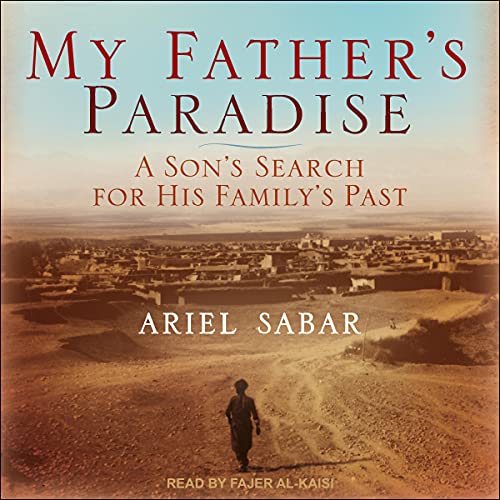
My Father’s Paradise: A Son’s Search for His Jewish Past in Kurdish Iraq
- Author: Ariel Sabar
- Genre: Memoir
- Publication Date: August 21, 2008
- Publisher: Tantor Audio

In a remote corner of the world, forgotten for nearly three thousand years, lived an enclave of Kurdish Jews so isolated that they still spoke Aramaic, the language of Jesus. Mostly illiterate, they were self-made mystics and gifted storytellers and humble peddlers who dwelt in harmony with their Muslim and Christian neighbors in the mountains of northern Iraq. To these descendants of the Lost Tribes of Israel, Yona Sabar was born.
Yona’s son Ariel grew up in Los Angeles, where Yona had become an esteemed professor, dedicating his career to preserving his people’s traditions. Ariel wanted nothing to do with his father’s strange immigrant heritage—until he had a son of his own.
Ariel Sabar brings to life the ancient town of Zakho, discovering his family’s place in the sweeping saga of Middle-Eastern history. This powerful book is an improbable story of tolerance and hope set in what today is the very center of the world’s attention.

This book came to my attention when an online Jewish book club nominated this for the month. I was intrigued by the idea of learning more about another aspect of Jewish history and culture, especially in the oldest Jewish diaspora group. The Iraqi Jewish community dates back to the 6th century BCE of the Babylonian exile and has roots in the Assyrian exile 2 centuries earlier.
As the descendant of immigrants who followed a similar geographic path, I was curious to learn more about this specific group of diaspora Jews who have retained traditions from thousands of years ago, including keeping the ancient language of Aramaic alive. A small, isolated pocket of Jews lived in the mountainous areas of northern Iraq, and their communities were integrated with Muslim and Christian neighbors to the point where Muslim neighbors would bring them gifts of bread to celebrate the end of Passover, and Jewish neighbors would forego smoking cigarettes during Ramadan, when smoking is not allowed. The communities of Kurdish Jews were humble and mostly illiterate, maintaining an oral history throughout the millennia and practicing their customs in a way that reflects the community’s experience yet doesn’t stray far from the overall community to become unrecognizable.
Violence had been increasing in the larger cities, while this group was spared due to their isolated location, they weren’t immune to the fears spreading through Jewish communities. After the Farhud, a days-long span of a pogrom of Baghdad’s Jews spurred by Nazi and Arab Nationalist incitement, these Kurdish Jews felt increasingly less safe and ultimately fled Iraq en masse during the 1950s. They made their way to Israel, where the fortunes of the family changed drastically. However, to do so, they had to give up Iraqi citizenship and sign a document that they would never return to Iraq.
In the small town of Zakho, the family was known for working with fabrics and the last name is derived from the Aramaic word for dyeing fabrics, later changed to the more Israeli sounding ‘Sabar.’ When they went to Israel, the family struggled against a racist system, poverty, and learning how to adapt to a new place in a different country—made even more difficult for illiterate older adults like the author’s grandparents. While they had a difficult time adapting to and integrating into their new home, the oldest surviving child of 12, Yona Sabar is encouraged to attend school and get an education. He does, and captures the attention of a linguistics professor who studies Aramaic, thought to be a dead language. Discovering a native speaker of the language sets a chain of events into motion that lead to the future of the Sabar family, all told through the eyes of Ariel.
I loved the way that Ariel isn’t afraid to be candid. When sharing a multigenerational family memoir like this, it almost feels like reading a fictional story, yet I am also familiar with the lure of wanting to learn more about our own family history. In this case, Ariel shares the family history he has witnessed along with that which has been recounted by his elders and those who knew them. It’s so easy to picture a young Ariel embarrassed by a father who is so different from that of the people he knows at a time when conformity is prized because I’ve also been embarrassed at times by my own father who became a refugee and then eventually came to America, yet never lost his heavy accent and Old World ways.
What appealed to me most in this story didn’t come about until much later in the book. The family history is really interesting, and kept me hooked, but the real lure was watching family history unfold through the eyes of Ariel and seeing how his views of his father changed over time. It also dives into how their relationship morphs as Ariel grows into an adult with his own child, and pushes him to get to know his father better, which ultimately led to this book.
Overall, this book was fascinating in so many different ways. The family dynamics and how those change between generations, the history of Kurdish Jews from Iraq and their unique practices, watching history unfold in the background of family upheaval and minor dramas, and seeing the historical importance of this group of Jews but also the impact this family has had on those around them—in the field of linguistics and as a family of complex and unique individuals.
Bottom line: A nonfiction family saga that reads like a fictional family saga, this book will give you all the feels and shouldn’t be missed.
Disclaimer: This post contains affiliate links, and I may earn a small commission at no cost to you if you purchase through my links.
Categories: Book Review
 Leah's Books
1 reply »