
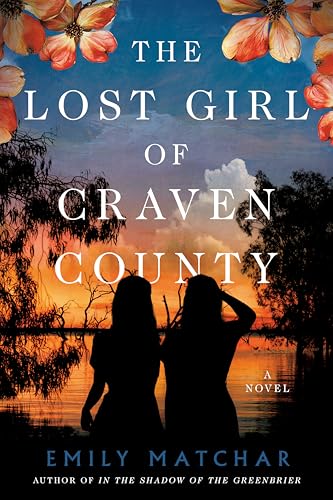
The Lost Girl of Craven County
- Author: Emily Matchar
- Genre: Historical Fiction
- Publication Date: April 14, 2026
- Publisher: G.P. Putnam’s Sons
Thank you to NetGalley and G.P. Putnam’s Sons for providing me with an ARC of this book in exchange for an honest review.

A decade into the Great Depression, Millicent Green is a twenty-five-year-old “old maid” living with her marriage-obsessed mother and domineering older brother in the stiflingly small Jewish community of New Bern, North Carolina. Smart and prickly, she’s struggling to find her place in the world following the loss of her beloved younger brother, and with him, her dreams for the future.
One humid August day, Millie is sent to run an errand and discovers a young woman unconscious on the ground. This mystery woman, mute and without identification, will upend Millie’s life. Together, they set out on a quest that will lay bare some of the twentieth century’s most shameful episodes.
From a historic river town to the hinterlands of rural North Carolina, The Lost Girl of Craven County delves into the impossibility of burying secrets forever. It’s a story of love, loss, and—above all—the indelible, world-moving power of female friendship.

I read another book by Matchar previously, and I loved how she represented a Southern Jewish community while exploring historical events that are new to me. This book sounded so intriguing that I quickly became engrossed in the story, which was nothing like I was expecting, and in the best possible way.
In the late 1930s, Millie is 25, unmarried, and doesn’t seem to have much of a desire to wed, to the dismay of her mother who is obsessively focused on getting Millie wed as soon as possible. She lives with her mother and her overbearing, unlikable brother in New Bern’s Jewish community, which isn’t big so it gives small-town vibes. Two major historical events occurred during the story—the tail end of the Great Depression and the looming threat to European Jews with Hitler in power.
They live in a close-knit Jewish community, but it felt like their practices were more assimilated. That makes sense, because Jewish people weren’t always welcomed or free to practice safely in some Southern communities at that time. Even so, there were two important tenets of the Jewish faith that they did incorporate consistently. One of them is speaking up for social justice—Millie and her family treat Black people the same way they do white people and other Jewish people. Additionally, as a family who has more than enough while many people go without, first her younger brother Auggie and then Millie herself would deliver packages of food to the hobos who rode the rails, even marking the mailbox with a special symbol that let hobos know this was a safe place.
There are some pretty heavy themes in the story, and grief and loss is a major one. Millie was very close with Auggie, and when he passed away her life spiraled out of control, leading to her leaving college and affecting her marital prospects. She’s also unwilling to lower her standards. She’s smart, kind, and generous, although she can be a little prickly at times. She also gets along well with her sister-in-law, Fannie, who had left Germany while she could, and still has family living there. It adds a heavier layer of what Jewish people experienced at the time, even those outside of Europe.
I have to admit that I loved Millie right from the start. She’s a girl after my own mind, and I really enjoyed watching her stay true to herself regardless of what anyone else thinks. The family’s pickle factory led to the family’s financial success even through the Great Depression, while Millie’s best friend who is a guy has a steady job working at the train station, and I loved how they were written—it felt so realistic when I think about my own friendships, and I could also empathize with the fallout of a broken friendship that Millie experiences. But perhaps the thing I loved the most about Millie is how she doesn’t think and just acts kindly towards everyone around her, including family and friends, members of the Jewish community, and even a soaking wet mute girl she finds behind a pickle barrel.
The main plot centers around who this girl is, and what happened to her. I enjoyed how things unfolded with this character, Cecilia, and the way Millie was so kind and caring. While her brother is suspicious of this visitor as I would have expected, I was surprised to discover that her mother was on board with helping people in need. While the family isn’t very religiously observant, they do embody two major values in Judaism—charity and tikkun olam, the concept of repairing the world by doing good deeds. And the Green family is overflowing with these traits.
Overall, this was a really enjoyable read, and the plot unfolded in a way that I was constantly being surprised. It took on a shameful episode in American history that involves eugenics, and I was just as outraged as Millie and Cecilia at how this practice was being implemented among poor, rural communities. The pacing was a bit slower in some parts, although there was a lot going on. There are many characters who are introduced over the course of the story, and at times I struggled to integrate characters because they just appear with little explanation. However, I really enjoyed seeing the friendship blossom between Millie and Cecilia, and how it grew into a genuinely strong female friendship. The book dealt with some very heavy topics and the author discussed them in a sensitive and natural way, with themes ranging from grief, loss, isolation, mental health, eugenics, and yet another shameful episode in American history.
Bottom line: An enjoyable read exploring female friendship, loss, grief, and a hidden history of eugenics, all done in a sensitive way, while still representing a long-standing Jewish community in the American South.
Disclaimer: This post contains affiliate links, and I may earn a small commission at no cost to you if you purchase through my links.
Categories: Book Review


2 replies »