
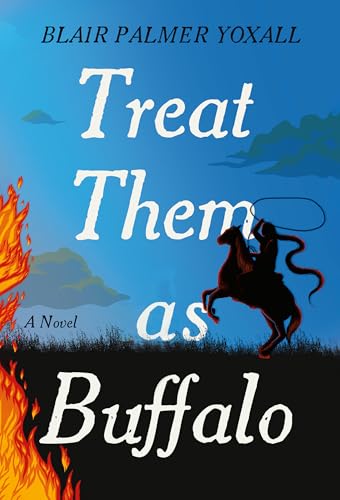
Treat Them as Buffalo
- Author: Blair Palmer Yoxall
- Genre: Historical Fiction
- Publication Date: May 5, 2026
- Publisher: Algonquin Books
Thank you to Algonquin Books for sending me an ARC of this book in exchange for an honest review.

An electrifying anti-Western from an exciting new Indigenous writer. As teenage boys begin to disappear from a Great Plains Métis community, a young man attempts to uncover the evil force lurking out of sight.
In 1885, Nikons “Niko” Eriksen spends his days playing buffalo hunter, even though it’s been many years since a member of his tribe has seen the once-ubiquitous animals. But when beloved Cousin goes missing, things start to fall apart. With law enforcement refusing to investigate the disappearance, the community members take matters into their own hands, rallying around the leadership of sawn-off-shotgun-slinging rancher Kate McCannon.
Kate and the resultant coalition of freedom fighters strike back against the Mounted Police as they investigate the boys’ disappearance and take their futures into their own hands. But violence continues to haunt Niko, and boys continue to disappear. As he leaves his boyhood behind and draws closer to finding Cousin, Niko’s investigation points to a harrowing revelation about his own heritage, which heels closer to violence than any boy would wish to know.
Inventive, punchy, and cinematic, Treat Them as Buffalo delivers a gripping portrait of a young man coming of age before his time.

This book sounded so interesting, and offered a chance to see inside the Métis community in the 19th century. I’ve read a couple of books about Métis people in the present day, but was really drawn in to this historical fiction. Set in 1885 in Saskatchewan, it touches on the conflict between the Métis community and the government, which I knew nothing about and was looking to learn a bit more.
I really took my time reading this one, and fully immersed myself in the story. The very first paragraph caught my attention when I featured it for a First Lines Friday post, and I couldn’t wait to start reading. Even though buffalo hasn’t been seen in a generation, Niko and his cousin love to play buffalo hunter. On the way back, the winner gets to ride the pony while the loser has to walk home. But when Cousin disappears in the blink of an eye, all Niko hears is his cousin imploring him to run.
Naturally, when someone goes missing, especially a child, you’d expect the authorities to help, but in this case they aren’t willing to investigate. This means that the Métis community can only rely on themselves, and organize searches for not just Cousin, but some other boys who have gone missing recently. This part made me furious, because I would expect one missing child, let alone multiple missing children, should be a main priority of the authorities.
The story provides a lot of insight into the family structure of the Métis and half-breed communities—and half-breed is used by the author to describe the historical community that defined themselves that way, rather than the insulting tone that term has taken on in the present day. There are very strong matrilineal bonds in the families—Niko lives with his great-grandmother (Chapan), his mother (Nimama), his aunt, and his cousin. There are some men in the community, but most of the families in this book are raised in a communal setting surrounded by strong, female leaders. It makes sense later in the story when they join up with Kate McCannon and her ‘Pussy Posse’ to protect Niko and find the missing boys.
I really loved how the family and community bonds were portrayed, especially as the tension ratcheted up throughout the course of the story. There are some Métis words used, and there is a glossary defining most of the words, but not all. I felt like I was missing something by not being able to understand some of the words, but ultimately I was able to connect to the story.
The pacing is a little slow in the beginning, but this story is more of a meander than a race, so I didn’t mind. As I mentioned earlier, I took my time with this story, partly because I didn’t want to miss anything, but also because it has some dark themes. The community, including family members of Niko’s, often find themselves facing adult issues before their time, and this is even reflected in a quote that sums things up pretty well:
“Nimama looked sternful. But a tad sympathetic. Part of her remembered what it was like being a kid living a grown-up life.”
Grammatically incorrect language, such as ‘sternful’ and ‘we was walking,’ is used throughout the story, reflecting the way that Niko and the people around him speak, and it only made me feel closer to Niko and his family. I had no trouble connecting with Niko, and was fully invested in the story right from the start. The slower pace of the story allowed Yoxall to really delve into character development and portray a community facing ongoing threats.
Obviously, anyone familiar with Indigenous American/First Nations history is aware of how poorly they were treated by caucasian settlers. A community who has historically relied on buffalo hunts to survive but has no more buffalo to hunt faces a loss of a major food source. It was fascinating to see the kind of foods they ate and the knowledge they passed down, even as their way of life was slowly dying out. I’m sure the Métis community has also faced racism, genocide, violence, and more, leading to an ongoing trauma that has also been passed down to younger generations. Naturally, the heavier themes, including being ignored by police when seeking help, violence, reference to sexual assault, and broken family structures are all handled in a realistic yet sensitive manner, along with the way the Métis are adjusting to a new way of life that is different from their traditional ways.
Overall, this was a fascinating look into Métis history as well as a gripping story that held my attention from start to finish. I loved how Niko was the narrator, and readers get to see all of these events through the eyes of a boy facing adult situations and concerns. The writing is spare and beautiful and conveys a lot without being flowery. It really felt like I was in the head of a twelve-year-old boy trying to understand events that would be difficult for adults to process, and it all made me feel so much more attached to this kid. Niko watches and listens more than he speaks, but I especially loved all the positive female representation in the book—Niko’s great-grandmother, his mother, his aunt, and the women of the Pussy Posse are all protective of Niko and everyone in the community. It also portrays the betrayal Métis feel when one of their own has joined the Mounties (RCMP), and how they act towards him. This was an absolutely wonderful read, and I can easily recommend it to other readers. I’ll be looking forward to checking out more of Yoxall’s books.
Bottom line: A unique and intriguing read focusing on the Métis community through the eyes of a boy facing adult challenges with their traditional way of life and a spate of missing boys. It’s got heavy themes throughout, particularly institutional racism and sexual assault, but also incredible Métis and female representation.
Disclaimer: This post contains affiliate links, and I may earn a small commission at no cost to you if you purchase through my links.
Categories: Book Review


This sounds like a book I need to add to my TBR right away!
LikeLiked by 1 person
You absolutely do – it was incredible! I’m glad I’m the one who introduced you to it. Can’t wait to see what you think!
LikeLike
I received an ARC of this book, too. I am hoping that this book delves more into the treatment of Indigenous individuals during the 19th century. I’m not surprised that little is known about their mistreatment, but recent novels are presenting what’s been “erased” into narratives of truth.
LikeLiked by 1 person
It does get into that a little more – the Métis people were pretty insulated at that point, and there’s a sharp difference between how the French and British are presented and treated compared with how the First Nations characters are portrayed. Except it’s clear to see that this time, the French/British/Mounties are portrayed as the savages while the Métis are a loving, supportive community.
LikeLiked by 1 person