
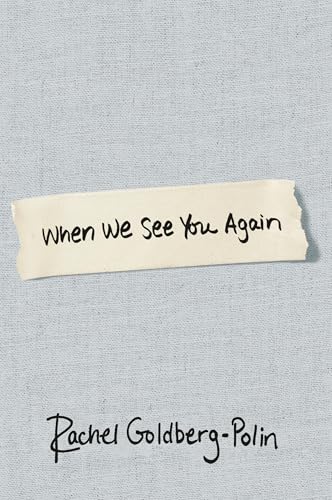
When We See You Again
- Author: Rachel Goldberg-Polin
- Genre: Memoir
- Publication Date: April 21, 2026
- Publisher: Books on Tape

A searing portrait of a mother’s grief and strength in the wake of unthinkable tragedy.
Once upon a time, I was meandering down the road of life with my husband, Jon. It was a regular and beige life, and it worked. It was a warm beige. We felt, and were, blessed and lucky. Normal.
On the morning of October 7th, 2023, Rachel Goldberg-Polin’s beloved twenty-three-year-old son, Hersh, was stolen from a music festival billed as a celebration of unity and love—and, in that moment, her life was forever separated into The Before and The After. Over the next eleven months, she and her husband, Jon, would work tirelessly—in public and behind the scenes—to secure the hostages’ release, to breathe some humanity into the situation while they were experiencing relentless emotional and psychological torment. The power of her raw and fervent pleas soon made her the face of the hostage crisis. And when Hersh and five other captives were executed after surviving 328 days of violence and cruelty, she would also become the face of its ultimate cost.
In When We See You Again, Rachel pours her pain, love, and longing onto paper, giving voice to the broken among us, and reminding us that even when the world feels choked with darkness, light exists in a different way. How do we find it? Her own experience has been extreme, but at its essence, this is a universal story of trying to live with grief. It is a story of how we remember and how we persevere, of how we suffer and how we love.
“There are days when I break completely,” she writes. “I have cried for an entire day straight. I didn’t think it was physically possible, but the weeping never let up. That is a very long time to cry. I kept hoping I would run out of tears. And then there are days when there is a whisper of sun. Not out there in the sky. In me. In us.”

This is such a difficult book to review, not only because it is such an emotionally heavy topic, but also because there was so much that Goldberg-Polin shared about herself and her family, as well as her son Hersh. But I’ve seen Goldberg-Polin give speeches around the world, and was absolutely blown away by her eloquence even in the depths of her grief. And this book only increased my admiration for this strong woman and her family.
Since it’s Jewish American Heritage Month, I wanted to highlight this book, because after finishing, I realized that this is the kind of book everyone can benefit from reading. As an American Jew, and especially as the daughter of a Holocaust survivor, I firmly believe that bearing witness is an essential part of being. My father raised me in the safety of America, but things have changed drastically, and I can only say that I am glad my father isn’t alive to see what has happened to our world after October 7, 2023.
That specific date will forever live in my memory. I was on a cruise on the Danube River in Austria when we turned on the news one morning and saw mass chaos in Israel and heard that a rave was overrun by terrorists. I knew my cousin had been at that rave, and was frantic to find out if she was okay. Luckily, she got home safely, even though some of the people she had gone with were taken as hostages into the tunnels of Gaza. I can remember so many details of that morning, just like when I think back on the day of September 11, 2001.
The vast majority of Jews are also Zionists, which simply believes that Jewish people should have the right to self-determine in their ancestral homeland. The meaning of the word has been twisted by so many people that it is hard for a tiny population of 15 million Jews, or 0.2% of the worlds population, to be heard. This is especially pertinent when there are antisemitic social media accounts pumping out misinformation to follower counts that far exceed the number of all Jewish people around the world.
Everything changed after October 7th. I have been fortunate to have a great group of supportive friends, some Jewish and others non-Jewish, who have let me share my fears and process grief with them. When 251 innocent Israeli people were violently kidnapped and held hostage in the dank, airless tunnel system running underneath the Gaza Strip, my family grew by 251 people. And so did that of many Jewish families. I knew them by name, by photo, by propaganda videos, and the anguished longing of their parents, children, sisters, brothers, significant other, and the rest of their loved ones was a psychic wound that was unavoidable. Posters were created and put up everywhere. Marches were held.
Through the length of his captivity, one woman distinguished herself by speaking on behalf of her beloved son, Hersh Goldberg-Polin. Rachel and her husband Jon spoke anywhere and everywhere they could in an effort to get their son back. He was a dual citizen of Israel and America, and it was thought that his American citizenship would make it easier to get him back. And when I saw that Rachel Goldberg-Polin had written a book about her experiences, I knew I had to read it.

I won’t lie—this is a heartbreaking, emotionally devastating book. When discussing the abuse, kidnapping, injuries, and the journey through grief as this family waited to get their son back alive, there were parts where my eyes were just leaking, and other parts that had me saying ‘oof’ like I had just been punched in the gut. But there are also funny moments, happy moments, and moments of love shared throughout.
Initially, Rachel describes her own early life and her journey towards spirituality, but then she segues into what can only be described as a celebration of Hersh Goldberg-Polin. He was her firstborn son and she joyfully shares all the wonderful (and not-so-wonderful) things about her ‘forever boy’ as she calls him, since he’ll remain 23 years old forever. She talks about how Hersh was as a baby and as a child, and his relationship with his two younger sisters. Hersh wanted to travel the world, and had a ticket to leave for Goa, India, only weeks after the Nova Festival. Instead, that task now falls to his mother to do on his behalf.
The family dynamics, the nuances of Hersh himself, and their life sounded idyllic. He visited them before heading to the Nova Festival, and then headed on to the Nova party, a festival of peace and celebrating nature and the most joyful holiday in the Jewish calendar, Simchat Torah, the day the Jews received the Torah. I reveled in hearing about how kind and caring Hersh was; the way he went through life with a smile and a desire to make friends; and was an avid traveler.
Then came the day everything changed. The rave was close to the Gaza Strip border, so when paragliders and masses of Hamas, Palestinian Islamic Jihad, and terrorist-adjacent participants invaded Israel, rockets started going on and paragliders could be seen in the sky. The party was shut down, and the masses of participants fled by any means possible. Hersh, his best friend Aner, and a ton of other people had tried to hide in a tiny roadside bomb shelter. However, it was designed for protection from rockets, and didn’t have a door they could close. Terrorists threw grenades into the shelter, where Aner would catch them and throw them back out of the shelter. When one detonated before he could throw it back, he was killed and Hersh took over. Except the terrorists shot an RPG into the shelter, which severed Hersh’s dominant left are just below the elbow. They were thrown into the back of pickup trucks, driven into Gaza, and subjected to masses of people cheering on Hamas and other terrorists. Since the terrorists had come prepared with GoPros, raw footage was available—there is video of Hersh being kidnapped, bloody and with bone protruding from the stump of his left arm.
This was the end of the ‘before’ and the introduction to the ‘after’ for the Goldberg-Polin family. Nothing could be the same, knowing that her son was abducted, tortured, and being held in a Hamas tunnel. Seeing all the hostage releases that occurred early on, it became clear that they were starved while their captors feasted, held in the most unsanitary and inhospitable place, where they were chained and kept in the dark about much of what was going on outside of Gaza. Hersh only received medical care for his arm when he had lost so much blood he was unconscious.
The Goldberg-Polin family knew nothing about any of this until much later. Throughout this ordeal, Rachel shares her family’s efforts to rescue Hersh. She only learned more about what Hersh went through when some of the released hostages had been kept with Hersh for a period of time, and told her how he kept up the spirits of the group. He even found a way to get a single book from his captors because he was an avid reader. Ultimately, he was kept with 5 other hostages, who became known as ‘The Beautiful Six.’
While dealing with the immense terror, fear, grief, and anger, Rachel still set this all aside and spoke with any and everyone who might have been able to help. She doesn’t name any names, but ultimately, her efforts came to naught. Hersh was held in captivity by Hamas terrorists for 328 days. Chained. In an airless tunnel. Lacking basic hygiene, no nutrition, nothing but the five other captives to occupy his time. After they were murdered, a video came out of The Beautiful Six lighting a Chanukah candle, saying the blessings, and singing. They managed to find a way to make the unbearable bearable. As the IDF drew closer and rescued four other hostages, The Beautiful Six were brutally murdered, shot in the head at close range, multiple times.
A few days later, their bodies were recovered by the IDF. I can’t imagine the grief this family felt, although you can clearly hear it in her voice, since she narrates the audiobook, with an afterward by her husband, Jon Polin. She has a beautiful way with words, and an ability to channel her feelings into her writing. I could feel her joy when she talked about Hersh teasing his younger sisters, and the amazing person that unfolded as he grew up. I could also feel her pain and frustration when influential leaders wouldn’t help her. The only agency that she did name, was the Red Cross, who refused to visit with hostages, although they do find a way to take pay-for-slay checks to Palestinian prison inmates—this is a stipend that the Palestinian Authority pays to any terrorist who kills Jews, and it gets paid to their family in the event that they die. Calling them out by name, she was the first to tell the Red Cross that they were doing a wonderful job of being an Uber service from the Gaza Strip back to the Israeli border for released hostages but does absolutely nothing for the hostages who were still alive and suffering. ICRC has a long history of not helping Jewish people, and this only furthers that belief.
While this is a heavy story and I had to have a cozy read to fall back on if this got too overwhelming, it is also a human, emotional, hopeful, and occasionally funny story. But I found that was spoke to me the most was how Rachel and her family gained strength from the teaching of Judaism. When a Jewish person dies, we believe that they go to Olam Haba, or the world to come. This is where we are reunited with our loved ones who have passed, and leads directly to the title of this book—in Judaism, death isn’t a final separation from our loved ones. This life is just a journey into the next one. And that’s a really powerful idea that does make the grief a little more bearable.
I don’t have children, so I don’t know what if feels like to give birth, to watch your child grow up and become their own person. But Rachel shared her own experiences so eloquently, I can see why she was invited to speak in so many places. Yet she also talks about her grief—the days she couldn’t stop crying, the times she was unable to engage in the life around her, and the idea of knowing that before her son died, he was chained, abused, and starved to the point where the sheet over his body was nearly flat.
In Judaism, we are required to bury the dead within 24 hours of passing, except on the Sabbath or holidays. Having a living child kidnapped and held hostage is a horrible form of grief, but knowing they were brutally tortured, starved to emaciation, and then killed intentionally at close range is a whole other type of grief. Rachel doesn’t talk about the stages of grief—she talks about her return to life, although a much different life than the ‘before.’ She’s wise and kind, sweet and caring, and a mama bear who would fight anyone to protect her children, although she wasn’t able to protect Hersh.
Overall, this was an outstanding book, even if I cried while listening to some of it. Rachel is an outstanding writer, finding the words to describe the indescribable feelings they were going through. Hearing about what an incredible person Hersh was, it made me both devastated and furious that the world turned their backs and let this young man and so many other hostages die in captivity while refusing to condemn the actions of Hamas terrorists. Jewish thought teaches us that inside each person is an entire world. If we lost this much potential when Hersh was murdered, imagine how many other things the world will miss out on because of the 1200 people who were murdered and those who were killed in captivity. This book is both a celebration of Hersh’s life, and a condemnation of how he was killed and the world leaders and NGOs who did nothing to release the hostages. I experienced a full gamut of emotions while reading, but this was one of the most powerful books I have ever read, right along with Hostage by Eli Sharabi. If you read one nonfiction read this year, make it this one.
Bottom line: An incredibly powerful book, the raw emotions and the experiences of what the hostage families and loved ones are shared candidly by Rachel, along with some gems from Jewish teachings that not only gave her comfort, but have the ability to educate and instill some more compassion. Don’t miss it, even though it’s painful to read at times.
Disclaimer: This post contains affiliate links, and I may earn a small commission at no cost to you if you purchase through my links.
Categories: Book Review


1 reply »