
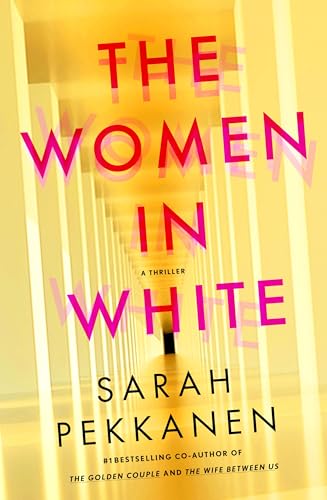
The Women in White
- Author: Sarah Pekkanen
- Genre: Historical Fiction
- Publication Date: August 4, 2026
- Publisher: St. Martin’s Press/Macmillan Audio
Thank you to NetGalley, St. Martin’s Press, and Macmillan Audio for providing me with an ARC of this ebook and audiobook in exchange for an honest review.

The newest next thriller from #1 Bestselling Author Sarah Pekkanen combines a decades-old mystery with spine-tingling paranormal elements in this twisty novel of the seen and unseen.
Extrasensory perception.
The Gift.
A Sixth Sense.
Or something else….
In 1964, four remarkable young women at a prestigious university became the subjects of parapsychology experiments by a visionary scientist. On the cusp of a historic breakthrough, the women mysteriously vanished and the program was erased from history. Decades later, Riley Bell, newly divorced and desperate for a fresh start, accepts a caretaker job for an elderly widow named Betty. Riley steps into a home that is frozen in another era – no microwave, television, or cell phones, and Betty has never heard of the internet. Why has Betty lived in such profound isolation for so many years, and why does she need Riley now? As the story unfolds across two timelines – Betty’s 1960s era of 5 o’clock martinis and high-stakes experiments, and Riley’s quest to uncover the truth about the missing women – old secrets rise to the surface. And the only way to survive is to confront the mystery that has lingered for sixty years.

I have always found the 1960s to be a fascinating era. There’s something about seeing a society in flux during a cultural revolution, and that is what the 1960s were in America. I’m always so intrigued by reading how society used to be and seeing how it has changed so dramatically.
As part of an incredibly tumultuous era within the US and in global interactions, there is so much to learn about the 1960s. And I learned what I could in the best way I know how: by reading books set in the era. This one has two different timelines—the four women in the 1964 timeline, and Riley’s perspective in the present day at Betty’s side. It was done really well, although I couldn’t help but notice that the women in 1964 all had a pretty similar voice.
In the present day, we meet Riley—a woman who has recently been divorced after discovering that her husband blew through their all their assets with his gambling addiction. Sleeping in her car and with limited options, Riley responds to a caretaker job for a widowed older woman. But when Riley arrives, the house is right out of the 1950s/1960s Stepford Wives era. The house Betty lives in has no television, microwave, cell phones, or anything other modern amenities. This introduces us to Betty and the isolated, insulated home that she lives in. She’s wheelchair bound, but her mind is sharp as a tack and it isn’t long before we see 1960s Betty.
The 1964 timeline first introduces us to who Betty used to be, and as I got to know her and the other three women I couldn’t help but think of the Stepford Wives. They were expected to keep the house spotless, provide a home-cooked meal every night, run errands, and also look put together with a full face of makeup. On top of that, some of the wives were attending school, but aren’t expected to work outside of the home, so it wasn’t necessary for them to complete a degree but rather to find a husband. Watching these women basically work themselves to the bone while fawning over their husbands, and discounting themselves as not as good as a man simply because they’re women was hard to read, and it made me so glad that things have changed so much since then.
There is fantastic disability representation in this story, just in time for Disability Pride Month. Betty was disabled after a car accident, and while she’s older and wheelchair bound, she’s incredibly independent. I love that she isn’t a damsel in distress type, and has no problem taking care of her own needs, especially since her husband designed the house to ensure that Betty could do everything without needing assistance. It quickly becomes clear that Riley isn’t in Betty’s life to be a caretaker, but to be more of a companion since the loss of Betty’s husband.
While the present timeline moves the story along evenly, the past timeline has a lot of frustrating choices. Initially, the four women become involved with a parapsychology experiment, but things intensify quickly. There are red flags that arise, but the women are too busy stressing about getting dinner on the table, having their husband’s drink prepared when he gets home, and doing other errands that they’re responsible for. It felt a little like the author is beating us over the head with how willingly they adhere to the expected role of a housewife, while deferring everything to their husbands. The women make choices that were there to move the story forward, even if it didn’t make sense to me.
I found the parapsychology experiments to be fascinating. The story centers around a university engaging in MK Ultra experiments, seeking people with the ability to read minds or transmit messages mentally. However, knowing what I do, there isn’t any discussion about the purpose of the experiments, no informed consent was obtained at all, and the researcher and his project become more overbearing and abusive. We can see the effect that it has on the four women over the course of the ‘experiment’ and how deeply it impacts their lives, but I would have liked the four women to sound and feel different from each other. Unfortunately, the internal monologue for each woman sounded way too similar and it was hard to figure out who was narrating without referring back to the start of the chapters.
Overall, this was a great read with a few flaws. I would have liked the 1960s women (and men) to have some more depth, since each of them was flat and didn’t have much that differentiated them. However, the present day timeline features Riley and Betty, both of whom are portrayed as strong, smart, and capable. All the growth both women show in their control over their lives is a main theme in the present day timeline, although I found myself disappointed in the backsliding that occurs at the end of the story. However, I did find myself doing a little research into MK Ultra and the programs that they ran in hopes of being able to win the Cold War. Having grown up at the tail end of the Cold War and learning what I know about our country’s history (think Henrietta Lacks, Tuskegee, Willowbrook, the list goes on), it wasn’t a question that our government would sacrifice its own citizens in an effort for ‘the greater good.’ In my poking around, it seems like the MK Ultra wasn’t successful in their goals, although they did learn how to break a human mind to the point of requiring institutionalization. That doesn’t really surprise me, although this story really put a human face on the experiments, and includes snippets from real historical research notes, making this hit closer to home than simply reading about the experiments.
Bottom line: A fascinating read centering around four women involved in paranormal experiments in the 1960s and the impact these covert experiments had on the women, while making wonderful use of a split timeline, even if the 1960s characters are a bit one-dimensional.
Disclaimer: This post contains affiliate links, and I may earn a small commission at no cost to you if you purchase through my links.
Categories: Book Review


This has all the elements of a book I’d like to read. Looking forward to it’s release.
LikeLiked by 1 person
No matter what she writes about, her books are always a hit with me.
LikeLike
Great review, Leah. I will be reading this shortly. I had never heard of Project MKUltra, so have already started to look some stuff up. My mom and my friend’s moms worked during the 60s, so the wives in the book remind me more of the 50s and The Leave it to Beaver time. I am curious about that past timeline.
LikeLiked by 1 person
Thank you, Carla! I hope you enjoy this, but the wives definitely are more like the wives of the 1950s, far from joining the counterculture movement. And learning more about MKUltra is fascinating – I found some podcasts about it and it is terrifying to know our government was intentionally destroying people’s lives and their very minds. This book left me with a lot to think about.
LikeLiked by 1 person
While searching, I found a study/experiment carried out in Montreal, so once again, the US and Canada were complicit.
LikeLiked by 1 person
Somehow, sadly, that doesn’t surprise me.
LikeLiked by 1 person