
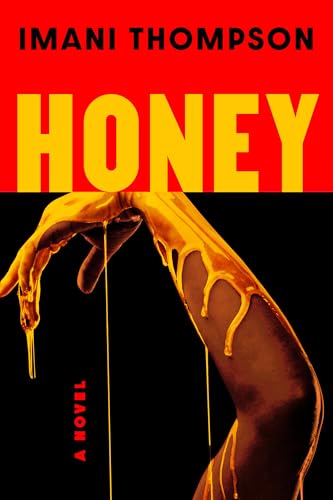
Honey
- Author: Imani Thompson
- Genre: Horror
- Publication Date: May 5, 2026
- Publisher: Random House
Thank you to NetGalley and Random House for providing me with an ARC of this book in exchange for an honest review.

A dark, provocative, adrenaline-rush of a novel about a graduate student who murders bad men and justifies it in the name of feminism, by a bold new voice in fiction
Yrsa is in a funk. She’s bored of her PhD program, bored of her research on Afropessimism, bored of the entitled undergrads she has to cater to. But most of all, she’s bored of the men in her life—especially the bad ones.
When her best friend, Nina, confesses to having an affair with her professor, and that he’s stolen her research, Yrsa is mad. On the quad, Yrsa bumps into the professor and witnesses his death: an unfortunate incident involving his San Pellegrino and a bee allergy. What she sees that afternoon awakens something in her: a taste for murder.
Emboldened, Yrsa decides to chase that high, and soon, no sexist, misbehaving man within commuting distance is safe.
With each murder, Yrsa feels a greater sense of meaning and purpose—finally, her doctoral research feels useful. But how long can killing in the name of feminist and racial solidarity justify her actions? Will her rampage ever assuage her feelings of rage and revenge? And how long until her actions—and buried family secrets—come back to haunt her?

This one sounded really intriguing and unusual, with some aspects that remind me of My Sister, the Serial Killer by Oyinkan Braithwaite. That one was a really interesting and fresh read, so I guess I went into this one with high hopes. There are a few reasons this one wasn’t the hit I had hoped it would be for me, but some of the really clever narrative was enjoyable. Here’s what I thought about this one:
To start with, we meet Yrsa, a British woman of Jamaican descent who is working on a PhD and has become thoroughly disenchanted with her life—she’s stalled in her PhD program, dislikes the students in the classes that she teaches, and is losing focus on her dissertation on Afropessimism. I actually had to look up Afropessimism to understand what it was, but the aspect of her life in academia is familiar to me. There is a sense of entitlement among the undergraduate students, and academia has traditionally been a boy’s club. While progress has been made, academia still has vestiges of misogyny and racism, especially in the more elite institutions.
Yrsa is an anti-hero for sure. She was a difficult character for me to like—she’s prickly, unfriendly, and honestly doesn’t seem to enjoy the company of very many people. In the story, it’s really just a couple of her colleagues and an older woman who serves as a makeshift grandmother to Yrsa, and everyone else really just felt like their sole purpose in the story was to piss Yrsa off. Which doesn’t take much, because she walks around like she’s looking for confrontation. I have a lot of respect for her commitment to her research and her innate intelligence, even if I didn’t actually like her as a character.
Another aspect that I really struggled with was the dichotomy in her character. On one hand she’s brilliant and dedicated, full of self-confidence and a feeling of comfort in her own skin; but on the other hand, she’s manipulative and dishonest about so much that it is nearly impossible to tell what is true and not, making her an unreliable narrator. As a situation arises with a fellow doctorate student and her superior, the blowback lands squarely on the woman’s shoulders and Yrsa is understandably outraged. So was I, but Yrsa seizes the opportunity to flick a bee into the drink of the superior without knowing about a deadly bee allergy that kills him.
This opens up a whole new world to Yrsa, as she actively works to take down misogynistic men to improve society and justifies this as being incorporated into her research. But instead of revitalizing research, it sends her down a terrifying rabbit hole where she increasingly loses sight of her goals and control over her own behavior. She decompensated and became more disorganized as the story goes on, diving further into impulsive and dangerous territory.
While reading this, I couldn’t help but think that there were so many different plot threads that it was difficult to follow along. Yrsa’s story feels singular—she just honestly wants to kill misogynistic men. Yet somehow, despite all her confidence and self-esteem, she clings on to an unfulfilling situationship with a total loser excuse for a man. I can see how this might fuel her rage, but she appears to lack the willingness to take a look at her own behavior and how she plays a role in contributing to these negative situations.
By far the biggest issue I had with this book was reading an entire meandering story about a character I didn’t like only to discover that the end was rushed and unfinished. The pacing was fairly slow for much of the book, but the ending came up quick and left me hanging with way too many questions. Every once in a while I can find a book with an ambiguous ending that I actually like, but I am the kind of person who likes to have at least some plot threads tied up in a neat, little bow. In this case, all I wanted was to find out what was going to happen, and completed my read without actually seeing any resolution.
Overall, this was not an enjoyable read for me. I appreciate the smart nature of Yrsa, her dry British humor, and her self-confidence, but there were far too many aspects that were overlooked. I would have liked to learn more about Yrsa and understand the different factors that led her to the point she’s at in the story. But the pacing was a big issue, with so much of the book feeling like it was meandering only to rush through an ending that wasn’t even an ending at all. Yrsa herself was another struggling point for me—she’s not a likable character to me, and I didn’t love that she completely failed to manage any level of self-examination or awareness. Ultimately this book felt like I wasted days of my life chasing a high from a similar book without all the deeper analysis and complex characterization that made it such a great read for me. Next time, I might just have to reread My Sister, the Serial Killer, which also took on a murderous woman who has had it with her patriarchal society, but dives into greater complexity.
Bottom line: There was a lot I didn’t quite gel with in this story, featuring an unlikable anti-hero, shallow characterization of complex issues, and poorly reasoned ‘justification’ for murder as graduate dissertation research.
Disclaimer: This post contains affiliate links, and I may earn a small commission at no cost to you if you purchase through my links.
Categories: Book Review


Too bad this didn’t work for you, Leah, but we can’t love them all. I am not a fan of horror, so this wouldn’t have crossed my path at all, now definitely not.
LikeLiked by 1 person
That’s what I always say when I finish a book that I didn’t click with – ‘they can’t all be winners!’ This one felt less like horror, but I can’t quite put my finger on the genre that suits it better.
LikeLiked by 1 person