
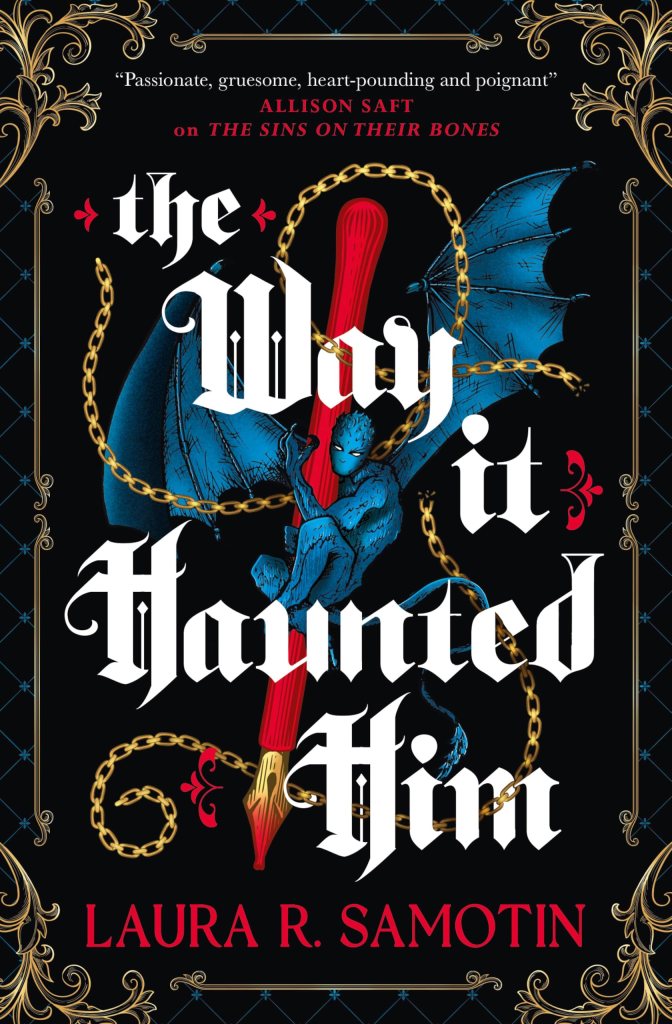
The Way It Haunted Him
- Author: Laura R. Samotin
- Genre: Gothic Horror
- Publication Date: June 9, 2026
- Publisher: Titan Books
Thank you to NetGalley and Titan Books for providing me with an ARC of this book in exchange for an honest review.

A terrifying and powerful dark academia novel about Jewish folklore, grief, and other things locked in the archives. Perfect for fans of T. Kingfisher, Tori Bovalino and Sunyi Dean.
“It’s real. You’ll see.”
Michael Stein arrives at the Schechter Institute for Judaic Studies battered and broken after the death of his boyfriend seven months prior. Blaming himself for the accident that killed him, Michael has come to the Institute to complete his boyfriend’s dissertation as part of his effort at repentance. While Michael’s own past leads him to condemn superstition as a way to mask prejudice and old-fashioned beliefs, his boyfriend’s research argues that the folktales told in the Jewish communities of Eastern Europe were based in truth, and that demons and other creatures walked the earth, wreaking havoc on peoples’ lives.
Instead of the Institute’s infamous archivist, Michael is met by his grandson, Jacob Schechter, who has taken over the archive after his grandfather’s death. A firm believer in the existence of the supernatural, Jacob explains that the archive plays host to a coterie of household demons. Michael insists that he is a skeptic, but strange and frightening occurrences plague his research, causing Michael to question both his sanity and his view of the world.
To cope with his guilt, grief, and the terrifying shadows following him, Michael must reckon with the events leading up to his boyfriend’s death—and his role in it—by trusting the enigmatic Jacob to help uncover the truth. As untangling the mysteries of the past bring Jacob and Michael closer together, their respective secrets threaten to tear them apart. Because Michael is not the only one with darkness on his conscience, and if he and Jacob discover the truth of each other, only one of them may survive the fallout.

I had read Samotin’s debut novel, but haven’t stayed caught up on her works since then. Until now. I saw this book and it had so many of the elements that I really enjoy in a book. Samotin often has very heavy themes arise in her works, but I didn’t love how they were addressed in this book. There are content warnings for self-harm, abuse, and self-esteem, and this book is one of the few where I’ve seen M/M domestic violence portrayed. When I started reading, I was prepared to love this story. Dark academia, Jewish folklore, research, and a romantic angle, but somehow these factors didn’t quite add up for me. There were a lot of aspects that I really loved about the book, but also some that I didn’t love as much, making this a tough book to review.
In recent years, finding books that incorporate Jewish folklore has become more common, but I’ve found some really great books this way. This book focuses on demons rather than a golem or a dybbuk, but I found it absolutely fascinating. One of my favorite parts of the book was discovering how Samotin worked both traditional demons and traditional methods of protection and binding into the narrative. There are small, mischievous demons called mazzikin that inhabit the archive, and there are also larger demons known as sheydim. Amulets for protection and binding bowls play a role in the story, as Michael delves into this type of protective magic to complete his deceased boyfriend’s research.
Michael works as a translator, and after being offered the chance to spend three months at one of the most extensive archives, but it’s in Lithuania. Instead, his boyfriend Nate dies in an accident that Michael blames himself for, so he decides to pass up on Lithuania and complete Nate’s unfinished dissertation on Jewish folklore and protective rituals. And while Nate had believed in this, Michael struggles to overcome his disbelief of demons, making it harder for him to effectively research.
I loved reading about the little mischief caused by the mazzikin—small accidents, common illness, soured milk, and other petty irritations. Michael’s research on the folkloric practices of Eastern European Jews was another source of endless fascination, and it reminded me of the ways that people sought to exert a feeling of influence over events they can’t control, whether it is demons, small annoyances, or life-changing huge events. All of this was woven throughout the story, making it central to the plot rather than feeling like it was stuck in there for casual representation. It was deeply involved in the plot and there are tendrils that touch each subplot, making it feel like genuine representation, in both historical and modern Jews and their behavior.
One of my least favorite things about the book was Michael’s circular thinking and spiral of guilt and shame. Throughout the majority of the book, he has a near-constant inner monologue blaming himself for Nate’s death and convincing himself he doesn’t deserve anything positive. It was understandable once the events were actually revealed, but for nearly 3/4 of the book, the reader is left in the dark as Michael’s thoughts spiral further. When things did become clear, it honestly seemed like such an overblown spiral that he willingly jumped into, although the dynamics of their relationship were another factor that contributed to Michael’s guilt and shame.
Another thing I really liked was the idea of the Schechter Institute for Judaic Studies being located in an old, abandoned synagogue. It lends a holy feel to the story—I always associate synagogues with hushed words, prayers, books, and a place for learning, so it made complete sense to me. It also provides an ideal setup for a place that is inhabited by various minor demons who like to make mischief, sort of like the Russian domovoy and the Fair Folk of the British Isles. The Institute offers a claustrophobic, haunting setting that almost felt like a character itself. There’s personality to it, and if this was a real place, I’d be booking a trip so fast my head would spin. There’s even a resident cat, named after the ‘poop demon’ from Jewish belief, and I couldn’t help but find it amusing.
The pacing was inconsistent. The story started out well, but then slowed to a near-glacial pace in the middle of the book. It might also have something to do with the repetitive thinking, but it felt like quite a bit of a slog. Things move incredibly slow, but the end sped up significantly, feeling rushed and too clean. I was disappointed to see all of these plot lines tied up so quickly and neatly. Especially with all of the heavier themes that arose throughout the reading, I would have liked to see a little more work being done on the issues that contributed to the heavy themes—instead of healing through therapy and work, it feels like Michael just healed miraculously without therapy or any work on his part.
Overall, I was a little disappointed in this book, although there were some things that I really enjoyed. I loved the Jewish folklore and how it was represented in the story, especially since it was a central idea that fed into every aspect of the book. However, the insta-love that arises between Michael and Jacob wasn’t something I really enjoyed. There is a complicated dynamic that develops between the two of them, and not only does it start off super fast, things then slow down to a glacial pace with a slow-burn romance. Maybe I’m biased because I have worked in mental health, but issues don’t usually resolve simply because a new relationship or infatuation starts—they require a lot of introspection and focus along with work to resolve. There are quite a few instances of self-harm and blood, which even got me a little grossed-out despite having a pretty strong stomach. I also found the gore and self-harm to contrast sharply with scenes that were more cozy in nature, like when Michael teaches Jacob how to cook and gave me a sense of literary whiplash. There were some really great aspects of the story, with Jewish folklore and rituals taking center stage, although these ultimately weren’t enough to fully win me over with the inconsistent pacing and repetitive thoughts in Michael’s head, although this one really did have potential.
Bottom line: A really intriguing read about Jewish folklore, inner healing, and secrets we use to break ourselves down, this could have been a favorite, but prepare yourself for inconsistent pacing and insta-love.
Disclaimer: This post contains affiliate links, and I may earn a small commission at no cost to you if you purchase through my links.
Categories: Book Review


Such a shame about this book (we often have similar thoughts when we read the same books). Maybe I should try the audiobook edition?
LikeLiked by 1 person
I know – we do have similar thoughts about books! The biggest problems for me were the glacial pace and rushed ending, and the way it kind of feels like trauma porn. I’m wondering what you think of this one, so tag me in your review!
LikeLike