
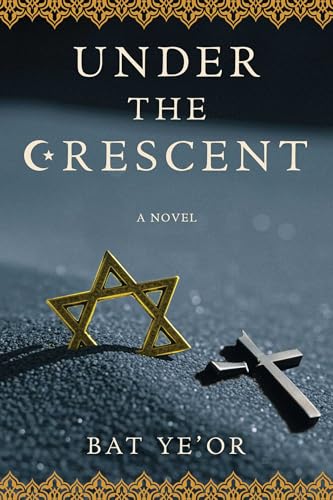
Under the Crescent
- Author: Bat Ye’Or
- Genre: Historical Fiction
- Publication Date: July 14, 2026
- Publisher: Skyhorse
Thank you to NetGalley and Skyhorse for providing me with an ARC of this ebook in exchange for an honest review.
DNF @ 33%.

A sweeping epic of exile, endurance, and truth forgotten.
From one of the most courageous and controversial historians of our time comes an electrifying trilogy of novels—Moïse, Élie, and Ghazal—that bring to life the vanished world of Middle Eastern Jewry and its dramatic dissolution under the rising tide of Arab nationalism and Islamist totalitarianism.
Bat Ye’or—“Daughter of the Nile,” exile of Nasser’s Egypt, and indomitable witness to the historical fate of Jews and Christians under Islam—has spent a lifetime unearthing hidden truths. Her nonfiction has challenged prevailing myths. Now, in this monumental work of fiction, she turns to the intimate and epic, portraying the human faces behind the centuries of dhimmitude—a status of legal and spiritual inferiority imposed on non-Muslims—and the slow, devastating collapse of a civilization.
Spanning the Cairo of the 19th century through the cataclysms of the World Wars to the final expulsion of Jews from Egypt in the 1950s, the trilogy follows three generations of one Jewish family whose members fight—through faith, rebellion, or resignation—to remain anchored in a homeland that steadily unravels around them. At once historical document and literary masterwork, this is a tale of memory and mourning, of identities stifled and voices rising, of lives swallowed by the Nile’s muddy tide and yet luminous in their witness.
With the moral clarity of Aleksandr Solzhenitsyn, the historical rigor of Primo Levi, and the lyrical power of Elsa Morante, Bat Ye’or renders an unforgettable account of the “numberless victims of history” and restores them to their rightful place in our collective memory. This is a story that had to be lived to be told—and must be told to be understood.

This sounded really intriguing, especially because I have been focused on learning more about other diaspora Jewish groups. The author is a nonfiction writer, and I have to admit that I didn’t read the description fully, so I didn’t realize that this was historical fiction. Even so, the story sounded interesting and dovetails with what I’ve learned about Jews living in Arab countries.
Despite how excited I was to start reading this, I’ve been reading it for more than a month and haven’t gotten more than a third of the way into it. Once I began, I was really interested to see what daily life was like for Jews in Egypt. While I am much more well-versed in Ashkenazi history, I have been focusing my learning on other diaspora groups to broaden my understanding. This story really focuses on the day to day life of one family, but it was exceptionally slow-paced.
Throughout the first third of the book, the perspective was concentrated on a single family—that of a carpenter named Shalom, and his son Moses. They live in a poor area of Cairo and the story slowly meanders through their daily life, especially as contrasted to a rich family. The intimate look into daily life under Muslim rule is juxtaposed with larger historical events in the 19th century (and 20th century, but I didn’t get to that part).
Under Muslim rule, non-Muslims such as Jews and Christians were subject to dhimmitude. This is a legally enforced subjugation of non-Muslims, similar to apartheid: they were subjected to heavy taxes and forced into a position where they are afforded less rights under the law. Throughout the story, this is depicted quite clearly, especially when discussing potential changes to dhimmi rule and how that possibility alters the dynamics between non-Muslims and Muslims.
Although I didn’t make it all the way through the book, it touches on a topic that isn’t discussed as often as it should be: Muslim imperialism. There are slaves brought back from traders, other religions are subjected to few rights and protections, and the aim is a caliphate. Most importantly, it clarified that colonialism isn’t exclusively a tool of white Europeans, and that isn’t taught.
Overall, this was a really interesting story, but it was paced far too slowly for my taste. Since I currently have a huge backlog of ARCs, this one is simply DNF’d for now, and I hope to get back to it in the near future, when I have the time to wander slowly through the story of this family and their experiences. I didn’t rate this on my blog, since I didn’t read enough of it to make a determination, but it is a fascinating look at a side of history many aren’t even aware of.
Bottom line: An intriguing and unique story, this focuses on the experiences of minorities under the crescent of Islam and how they were subjugated, but it moves extremely slowly so be prepared.
Disclaimer: This post contains affiliate links, and I may earn a small commission at no cost to you if you purchase through my links.
Categories: Book Review


2 replies »