
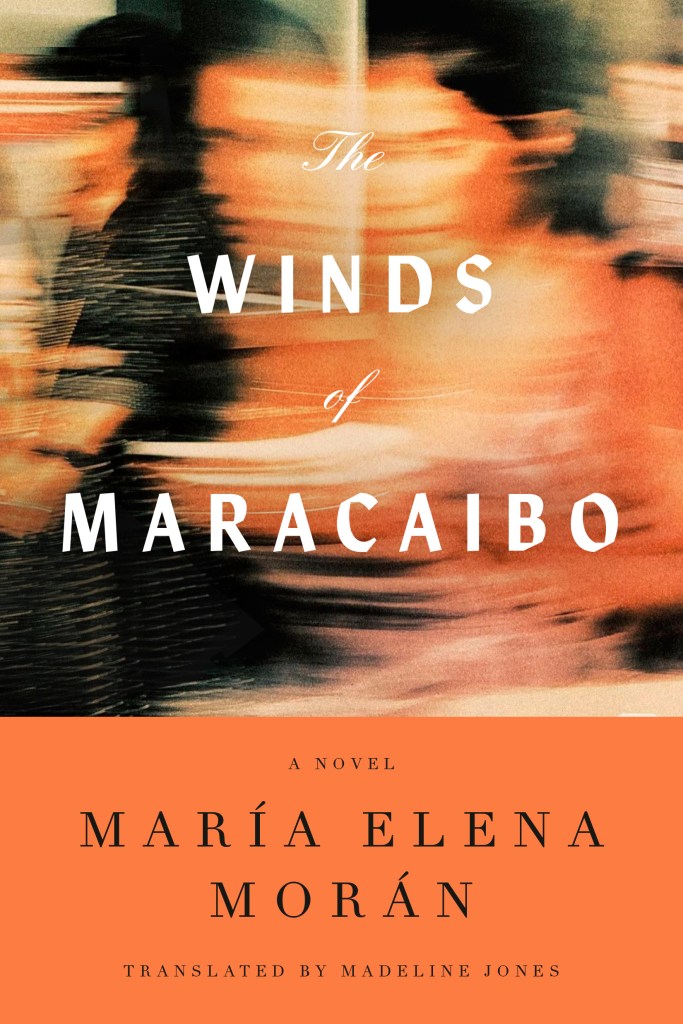
The Winds of Maracaibo
- Author: María Elena Morán
- Genre: Literary Fiction
- Publication Date: July 28, 2026
- Publisher: Knopf
Thank you to NetGalley and Knopf for providing me with an ARC of this ebook in exchange for an honest review.

A propulsive family drama, the story of a woman determined to recover her kidnapped daughter in the ruins of Chávez’s social revolution—the fast-paced English-language debut of an award-winning and bestselling author that brings the Venezuelan migrant crisis to life in lyrical, seething prose, for readers of Elizabeth Acevedo, Jesmyn Ward, and Gabriela Garcia
It was too late, y la ternura no basta—now that she’d tasted the gunpowder, and the gunpowder was bolivariano, revolutionary. And that unthinkable traitor Camilo was using it to blow up her life.
“Elisa left with Camilo.” “Camilo took her out of the country.”
These are the text messages Nina receives while living in the storage room of a university in Porto Alegre, Brazil, where she’s cleaning houses to make money to send back home.
Home is 4,500 miles away, in Maracaibo, Venezuela, where the water never runs on Mondays and there’s yet another blackout. Where a trip to the grocery store costs 220 times the minimum wage.
Home is Elisa, her thirteen-year-old daughter, who loves to run around the house and belt out Queen’s “Don’t Stop Me Now.” Who should be growing, when instead her waist is shrinking. Home is Graciela, Nina’s mother, who lately stays shut up in her room all day talking with her dead husband, Raúl (who’s just as eager to talk back from the grave).
And what the hell does Camilo think he’s doing now, stealing off with their daughter to the United States of America—the one place Nina most assuredly never wants to call home?
Narrated through the voices of Nina and her family, and through the voice of her treacherous ex, Camilo, The Winds of Maracaibo is the heart-racing tale of a mother fighting to get her daughter back across the border, at any cost—a brave and furious reversal of the American Dream and an ode to the Venezuelan women who gave their blood, sweat, and tears to a nation dismantled by the egos of men.

Reading translated literature is endlessly fascinating to me, but what always stands out to me is the way different cultures tell their stories. I’ve learned a lot in my ‘read around the world’ self-challenge, and this book took me to both Venezuela and Brazil on this multilayered family saga.
The book started on a bit of a rocky note for me, as it took me a few chapters to acclimate to the various POVs. Chapters switch back and forth between Graciela, Nina, Elisa, and Camilo, and each is a distinct voice from the others. I also had to acclimate to being in the heads of characters I didn’t necessarily like at first. Elisa was easier for me to empathize with, since she was so young and didn’t have the life experience (or guidance) to fully understand the world around her and the consequences of decisions, both for choices that she made and those that were made for her.
As for the setting, the story is split between Nina’s time in Porto Alegre, Brazil and Graciela, Elisa, and Camilo in Maracaibo, Venezuela; and ventures into the United States. The read is a short one at just over 200 pages and it delves into some really heavy subject matter, so character development is prioritized over a focus on the geopolitical situation in South America. Having a basic understanding of the politics and current events in South America is good to have since there isn’t as much exploration of the situation.
Making the choice to prioritize character development was a smart one. Morán crafts characters who are complex and have a rich internal world, and even manages to include Raúl, the deceased husband of Graciela, and all of the characters are so vastly different that it was easy to follow the perspective jumps without feeling jagged. We see some of the situation in Venezuela that occurred after decades of dictatorship, and how it affects the characters. Electricity cuts, poverty, and limited opportunities all play a role in the story, and it leads to Nina’s stay in Brazil to try and earn money to send back to her family. However, she isn’t having an easy time of it, and seems to be digging herself further into a hole the longer she stays in Brazil. I did get a sense of irony from how miserable she is in a city named Happy Port.
Nina leaves her daughter Elisa in the care of her mother, Graciela. But since the death of Graciela’s husband Raúl, she spends all her time shut in her room conversing with him from beyond the grave, giving the story a taste of the magical realism that South American literature has come to be known for, at least for me. It worked really well in this story, compared to the realism brought to the story with the situation in Venezuela, life under an authoritarian regime, and the lengths people take to try and improve their situation when very few doors are open to them.
Meanwhile, Camilo is Elisa’s father, and he wants to take her away with him to America. Camilo cut ties with both Nina and Elisa when they got divorced, and has been estranged from his daughter for years. There was a turbulent relationship between Camilo and Nina, and she fought against his controlling, abusive nature. Initially, these two were socialist activists, but as Camilo became a politician and gained some power and financial security as Nina and Elisa slide into poverty and are heavily affected by their lack of financial security or opportunities.
The relationship dynamics are outstanding. As Nina is trying to get by and provide more for her family than she was able to in Maracaibo, Elisa at 13 is becoming more resentful of her mother’s absence, clearing the way for Camilo to swoop into her life where he takes Elisa out of the country and brings her to stay with his family members in Texas. He treats Elisa more like a bargaining chip when he manipulates Nina into coming to see him by keeping Elisa away from her, and his relationship with Nina mirrors his political career by controlling her, even after a divorce.
Ultimately, this story winds up centering the relationship dynamics between these different members of a family and does it extremely well. I was impressed with how richly the characters were developed in such a short book, and although some parts of the story felt a little rushed, I found that I much preferred how layered the characters are, and how realistically they were portrayed. The pacing wasn’t as much of a problem for me since I really enjoyed how well-done the rest of the book was. It left me with more of an understanding of Venezuelans and the factors that contribute to their migration away from their country. And while I didn’t always like the adult characters who are central to Elisa’s life, I was able to appreciate the impact they had on each other and watch Elisa learn from these unhealthy situations she is placed in. Her character growth and the bond between Elisa and Nina changes over the course of the book, at least how Elisa views her parents. But overall, this was a really good story and I’ll be keeping an eye out for more of Morán’s writing.
Bottom line: A fascinating look at the complex relationships within one family, this is a fast read and portrays the family dynamics in a multilayered manner, but it helps to have a basic understanding of the recent history and political situation in Venezuela before starting the read.
Disclaimer: This post contains affiliate links, and I may earn a small commission at no cost to you if you purchase through my links.
Categories: Book Review


This is interesting, I don’t know anything about Venezuela.
LikeLiked by 1 person
It’s a really interesting read, with the story focusing more on the characters than the political and economic situation, but it does dovetail with the story.
LikeLiked by 1 person