
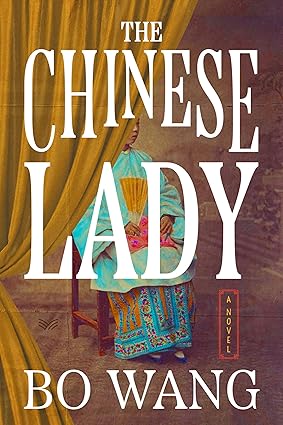
The Chinese Lady
- Author: Bo Wang
- Genre: Historical Fiction
- Publication Date: September 8, 2026
- Publisher: HarperAudio Adult
Thank you to NetGalley and HarperAudio Adult for providing me with an ARC of this audiobook in exchange for an honest review.

As rich in detail and emotion as Amy Tan’s The Joy Luck Club and Lisa See’s Lady Tan’s Circle of Women, but with an exciting structure that reinvents the genre, Bo Wang’s gorgeous and immersive debut historical novel immortalizes the life of the first Chinese woman to be brought to the United States in the 1800s.
Little Sparrow, Julia, Afong Moy, Madame Moy, The Chinese Lady, were her many names . . . but her true name has been lost to time.
In 1834 Afong Moy was brought to New York by two merchants as a live exhibit. Rising to fame as the first Chinese female in the United States, she became an oddity among curios as Americans marveled at the opportunity to observe her astonishing little feet, broken and bound to resemble lotuses.
As the story moves from 1820s Canton to P.T. Barnum’s American Museum, to Gold Rush San Francisco, three women introduce us to her many names. Her mother calls her Little Sparrow and sells her to a captain who sails her to New York. The captain’s wife names her Julia and “graciously” treats her as her own. And when she is shunted off to P.T Barnum, her fellow human exhibitions call her China. Eventually arriving in San Francisco’s Chinatown, she will at long last claim her name and her own story.
Combining archival research and brilliantly imaginative storytelling, Bo Wang masterfully fills in history’s gaps to weave a powerful narrative of survival in the face of hardship, tragedy, and betrayal. Told through the eyes of those around her; mirroring her life as an object on display, until we finally see the world through her own eyes.

I have been really interested in reading about China since I picked up a copy of The Joy Luck Club by Amy Tan as a kid, and that hasn’t changed over the years. In senior year, I did a term paper on foot-binding and how it played a role in Pearl S. Buck’s The Good Earth. I’ve continued to read about China and learn about the history and culture, both fiction and nonfiction, and prioritize books written by authors of Chinese descent. Naturally, the plot summary of this book piqued my interest, and even though I doubted it would be a happy story, the idea of learning about the first Chinese woman in America.
Our culture has made a lot of progress, even if it feels like there is a long way to go, so reading a story about this period in history was a shock. It begins in the early part of the 19th century and opens with a young girl having her feet bound. It describes the process, which sounded absolutely brutal, and I was pushed to confront my own bias about bound feet. To me, they just sound and look so painful, but Chinese people had valued them as a sign of beauty and status for close to a millennium at the time. Tiny feet called golden lotuses were also an opportunity for upward social mobility for women of lower status in the highly patriarchal society of China, so I needed to set aside my Western mindset and consider the idea that this was something the society highly valued as beautiful in those days, similar to the way our society views plastic surgery or anti-aging treatments. However, the most difficult part was revisiting the racist past of American society in the 1800s towards immigrants and people of color.
Told in four parts, each part focuses on one part of the protagonist’s life. Since I listened to this as an audiobook, I want to touch on that first. There are three narrators, Jeena Yi, Cassandra Campbell, and Bahni Turpin, and they knocked it out of the park. It was easy to separate sections of the life of the Chinese lady, and was
The young girl, who is basically called ‘Third Sister’ after her place in the family hierarchy, and referred to as Little Sparrow by her mother Pearl. Having daughters was viewed negatively, because the girls are just raised to pay a dowry for them to be married off. As the third girl her mother bore, she is viewed as more of a nuisance than anything else. Pearl has a low status, but she does bind her daughter’s feet so that she could have a better future. Making poor choices are a characteristic of Pearl’s, and she eventually winds up selling the girl to a “Ghost” or Caucasian man. At this point, she’s brought from her native Canton (now known as Guangzhou) to become the first Chinese woman in America.
Once she arrives in America, she is taken under the wing of the man who bought her and his wife, Margaret. She’s given the name Julia and taught English, but is pushed to model in an Asian-style salon to sell imports from China. Margaret views herself as generous and kind, but she is one of the cogs in a machine that seems designed to exoticize and dehumanize Julia. Margaret’s focus seems to be to Westernize Julia while expecting her to demonstrate immense gratitude to Margaret.
Before long, she winds up renamed as China, the newest attraction in P.T. Barnum’s show. This is where a lot of the dehumanization occurs, not only towards ‘China’ but towards some of the other attractions, especially an enslaved Black woman named Joice. Readers can see the open racism through the treatment of ‘China,’ as people pay to gawk at her 4-inch bound feet and her different looks. It’s clear that this wasn’t a high point in equality and freedom for America, but it was still painful to read about how people are treated like property rather than actual human beings with needs, wishes, hopes, and dreams.
Finally, she takes her life into her own hands for once, and it is here where she is known as Afong Moy, Mrs. Moy, or Madame Moy. This is the section where I began to appreciate who she truly is because it is the first section that isn’t narrated by the woman who is closest to her. However, this is also the first section where we learn about her internal world from her, rather than the external impressions she gives to people who other her and consistently underestimate her.
Overall, this was a really intriguing take on a real historical woman, whose name has been lost to time. It doesn’t seem like much of her real life is known, and I found Wang’s story to be fascinating. I loved watching Mrs. Moy take charge of her life for the first time, and it felt like while others have used her to fill some need, whether financial or emotional, she was finally free to make her own choices and become a successful woman with no one to answer to. However, that doesn’t mean she didn’t face added challenges on the West Coast, and some words and actions of certain characters were tough to read. Nothing is known about her life after she split from P.T. Barnum, and I’m sure things were difficult for her as a minority and a single woman in those days. Wang did such a good job with the story, as did the narrators, even if it was a little frustrating to only see Moy through the eyes of others for 3/4 of the novel. Other than that, I can easily recommend this to readers that like historical fiction or are curious about the beginnings of anti-Asian racism in America.
Bottom line: A really interesting read about the first Chinese woman in America and a fantastic portrayal of her life, although readers aren’t really privy to who Mrs. Moy is until 75% of the book. And if audiobooks are your thing, check this one out.
Disclaimer: This post contains affiliate links, and I may earn a small commission at no cost to you if you purchase through my links.
Categories: Book Review


This sounds right up my street. Great review xx
LikeLiked by 1 person
Thank you! I hope you like it as much as I did.
LikeLike