
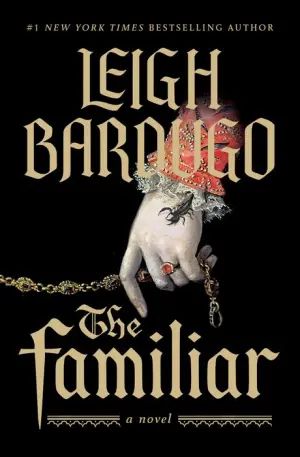
The Familiar
- Author: Leigh Bardugo
- Genre: Historical Fantasy
- Publication Date: April 9, 2024
- Publisher: Flatiron Books

Fate can be changed.
Curses can be broken.
In a shabby house, on a shabby street, in the new capital of Madrid, Luzia Cotado uses scraps of magic to get through her days of endless toil as a scullion. But when her scheming mistress discovers that the lump of a servant cowering in the kitchen is actually hiding a talent for little miracles, she demands Luzia use those gifts to better the family’s position.
What begins as simple amusement for the nobility takes a perilous turn when Luzia garners the notice of Antonio Pérez, the disgraced secretary to Spain’s king. Still reeling from the defeat of his armada, the king is desperate for any advantage in the war against England’s heretic queen—and Pérez will stop at nothing to regain the king’s favor.
Determined to seize this one chance to better her fortunes, Luzia plunges into a world of seers and alchemists, holy men and hucksters, where the lines between magic, science, and fraud are never certain. But as her notoriety grows, so does the danger that her Jewish blood will doom her to the Inquisition’s wrath. She will have to use every bit of her wit and will to survive—even if that means enlisting the help of Guillén Santángel, an embittered immortal familiar whose own secrets could prove deadly for them both.

I have been a huge fan of Leigh Bardugo’s writing since I read the first of her books. I love how she wrote YA fantasy, and was so impressed with how she successfully transitioned into writing adult fantasy. This book was irresistible to me. I pre-ordered it, but in true book blogger fashion, I only managed to read it this week with a buddy, Becky @ Becky’s Book Blog, one of my favorite buddy read partners. You can find her review here, and I recommend checking it out. I always love seeing how differently we write about the same book, which we read together.
Typically, I try to list the genre in a way that reflects the dominant theme of the book. But with this one, it’s equal parts fantasy and history, and Bardugo dove into her own family history as well as conducted a metric ton of research. Let me tell you, it paid off. There were a lot of things that I loved about this story, and Becky and I had such great chats when discussing the book.
The first thing that I noticed about the book is how Luzia is not your typically stunning and brilliant and connected heroine. Instead, she’s most frequently referred to as ‘the scullion,’ and she is described in some highly unflattering terms. I’m used to fantasy where the MC is beautiful, even if she just needs a little magical makeover. Instead, Bardugo introduces Luzia as:
“…the squat lump of a scullion girl who seemed of damp and who was always stumbling about the house with her eyes on her graceless feet.”
Clearly, Luzia is going to need more than a makeover to be described as anything other than a ‘squat lump’ and develop some grace. But I really liked that Luzia wasn’t beautiful. Part of her personality has developed in an attempt to avoid drawing attention, which is why she can kind of blend into the background in the early part of the story. Avoiding notice is not only a good practice as a servant, but as a conversa, someone who chose to convert rather than being burned alive or exile from the Spanish kingdom. Despite being given the choice to convert, conversos/conversas were never fully exempt from suspicion. Throughout the book, we see Luzia going to mass faithfully, and making sure to do things to divert suspicion that she was still Jewish—these small actions probably wouldn’t stand out to non-Jewish readers, but the way she wouldn’t miss a mass for anything other than her employers not allowing her to leave the house or liberally ate ham or pork in public stood out to me as actions that practicing Jews wouldn’t do, and I picked up on how these things jumped out at me as important factors in the story, although my buddy read partner isn’t Jewish and wasn’t as aware of these factors. Luzia’s aunt says this, and it really emphasizes the way every converso was never fully free of suspicion:
“‘Luzia, I might be the holiest and most pious of Christians and it would not be enough for them. Their great religion can make bread into flesh and wine into blood. But they don’t believe that any amount of holy water or prayer can truly make a Jew a Christian.’”
Living on the knife edge of Christianity and suspicion of Judaizing, it isn’t long before Luzia finds her small magical gift exposed, and her greedy, grasping employers shortly have her performing her small parlor tricks for dinner guests. As her employers see her gift as a way to improve their social standing, they don’t realize how much danger they are actually putting Luzia in—the Inquisition didn’t only target Jews, but also focused on Muslims and the vague ‘witchcraft.’ But Luzia quickly catches the eye of the former secretary to the king, and in her he also sees a way to restore his own status.
As Luzia learns to navigate society and increase her own understanding of her magic, she’s aided by Guillen Santángel, the immortal familiar associated with the family of her aunt’s patron, and we start to see how much power and influence Victor de Paredes has. Santángel works with Luzia and helps her, but it shows readers how little she understands her magic. Luzia’s magic stems from refranes, short little verses that are spoken in Ladino, a language that was spoken among Sephardic Jews at the time. While many of the words sound similar to Spanish, they are sometimes spelled differently, and also include loanwords from other areas where Sephardic Jews lived, combining words from old Castilian Spanish, Arabic, Hebrew, and Turkish, altering them from any of the individual languages. However, they’re writing with a Hebrew alphabet, kind of like how Yiddish drew from a variety of local languages and Hebrew, yet it’s written in the Hebrew alphabet.
Luzia is forced to constantly watch her step so that she is viewed as a good Catholic instead of as a conversa, as well as walking through the minefield of demonstrating holy magical power rather than having her talent denounced as witchcraft, or exposing her Jewish nature. The story felt full of tension because of this, but also because of the romantic tension that slowly builds between Luzia and Santángel. Working closely to teach her control and expansion of her magical talent, they form a bond that turns into more. I really liked seeing their relationship grow and evolve.
There were so many times when I was frustrated with Luzia and her naïveté—she’s repeatedly told not to trust anyone, but her good nature makes it difficult for her to see when she’s around people who don’t have her best interest in heart. And she’s in a pit of snakes—no one around her seems to have her best interest in mind, except for Luzia herself, despite how difficult it is for her to see when people have harm in mind. She’s such an interesting character, and she feels as though she’s made up of contradictions: she’s Jewish but also a conversa, she’s got one of the worst jobs available to her but she’s educated in multiple languages, she knows Ladino but can’t quite explain what it is exactly, she can do magic but doesn’t know where it comes from, and she’s learned magic but doesn’t practice witchcraft. She’s surprisingly smart and witty, and is able to find brilliant solutions to problems that arise in the story.
Overall, I really loved this book. Becky and I devoured it, and I chose to listen to part of it as an audiobook, narrated by Lauren Fortgang. I’m sure I could have sounded out the words in Ladino, but there’s just something beautiful about hearing words the way they are supposed to be said, no matter the language. And she did a fantastic job, not just with Ladino and Spanish words, but also with the story. There are some pacing issues with the story—the story is slow-moving and builds as we read, but it doesn’t really pick up significantly until about the last 30% of the story. The end felt a bit rushed to me, but I did love the story and the romance, and everything else about it. This one would be a great read if you: like historical fantasy, are intrigued to learn more about the Inquisition, a sweet, slow-moving romance, and books featuring the experiences of Sephardic Jews during the Inquisition.
Disclaimer: This post contains affiliate links, and I may earn a small commission at no cost to you if you purchase through my links.
Categories: Book Review
 Leah's Books
Brilliant review, Leah as always. I loved buddy reading this one with you and agree with pretty much all of your thoughts!
LikeLiked by 1 person
Thank you! I’m so glad we got to buddy read this one together. Can’t wait to pick out our next buddy read!
LikeLiked by 1 person
This sounds really good.
LikeLiked by 1 person
It was! Have you read any of Leigh Bardugo’s adult novels? I think this was my favorite.
LikeLike