
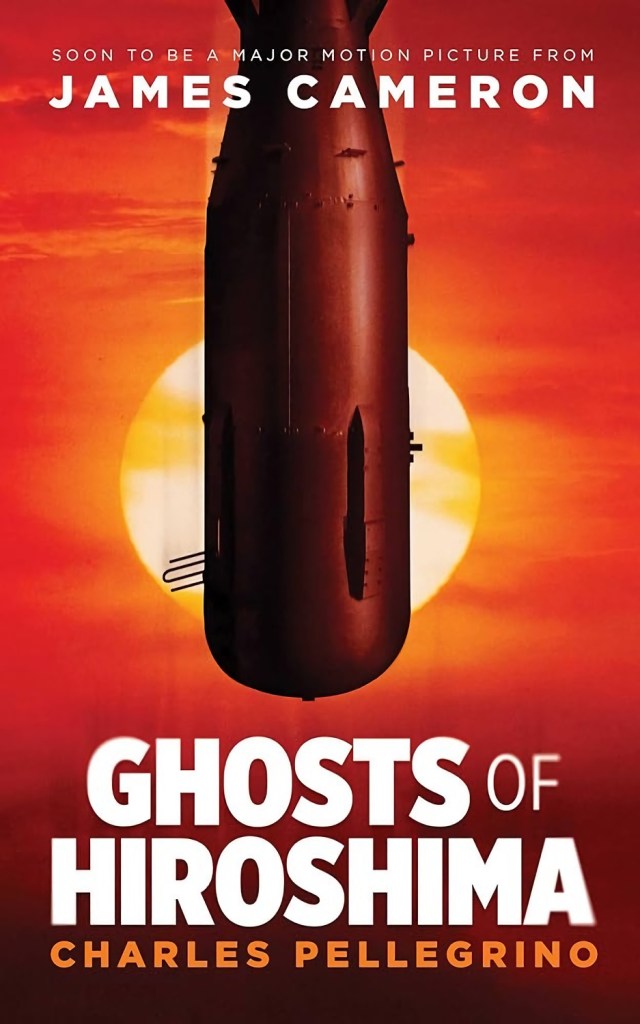
Ghosts of Hiroshima
- Author: Charles Pellegrino
- Genre: Nonfiction, History
- Publication Date: August 5, 2025
- Publisher: Blackstone Audio
Thank you to libro.fm and Blackstone Audio for providing me with an ALC of this audiobook. I am freely offering my honest review.

From the acclaimed New York Times bestselling author of Her Name, Titanic
SOON TO BE A MAJOR MOTION PICTURE FROM ACADEMY AWARD–WINNING FILMMAKER JAMES CAMERON
For all humanity, it was, literally and figuratively, childhood’s end.
No one recognized the flashes of bright light that filled the sky. Survivors described colors they couldn’t name. The blast wave that followed seemed to strike with no sound. In that silence came the dawn of atomic death for two hundred thousand souls.
On August 6, 1945, twenty-nine-year-old naval engineer Tsutomu Yamaguchi was on the last day of a business trip, looking forward to returning home to his wife and infant son, when the bomb was dropped on Hiroshima. He survived the atomic blast and got on a train to Nagasaki, only to be bombed again.
Jacob Beser, a Manhattan Project engineer, looked down on Hiroshima and saw the ground boiling. He refused to look at Nagasaki at all. Years afterward, he referred to what he witnessed as “the most bizarre and spectacular two events in the history of man’s inhumanity to man.”
From that first millionth of a second, people began to die in previously unimaginable ways. Near Hiroshima’s hypocenter, teeth were scattered on the ground, speckles of incandescent blood were converted to carbon steel, a child’s marbles melted to blobs of molten glass.
From the bombs were born radioactive substances that mimicked calcium in growing bones and which, ten years after, filled entire hospitals with a shocking nuclear weapons, more than anything else, were child-killers.
Based on years of forensic archaeology combined with interviews of more than two hundred survivors and their families, Ghosts of Hiroshima is a you-are-there account of ordinary human beings thrust into extraordinary events, during which our modern civilization entered its most challenging phase—a nuclear adolescence that, unless we are very wise and learn from our past, we may not survive.

Fun fact about me: I studied the Japanese language for my junior and senior years of high school (and one memorable unit in the gifted and talented program in about 4th grade). While much of it didn’t stick with me, I can still politely introduce myself formally, and I remember the basics – hello, goodbye, please, thank you, you’re welcome, etc.
The gifted teacher was going over vocabulary with us, and it was going great until one of the students shouted out that the Japanese word for thank you sounds a lot like ‘don’t touch my mustache,’ and they quickly stopped our Japanese language lessons and had us do a play and eat seaweed instead. But I can promise you every single kid in that class still knows how to say ‘you’re welcome’ in Japanese.
Now on to the book. This shows you the side of the people impacted by dropping nuclear weapons—the civilians of Hiroshima and Nagasaki. The audiobook is narrated by Martin Sheen, who was really able to bring out both the humanity of the people impacted without ever losing the solemnity required to voice this book. Somehow, he manages to keep his narration steady and easy to understand, even when reading the most heartbreaking passages.
My public school taught about the US dropping atomic bombs on two cities in Japan, but really didn’t get into the more nuanced views of the war and the civilians impacted. In this book, Pellegrino really breaks it down and makes the unimaginable tangible and real through his use of first person narratives from those who survived the bomb drops at both cities.
Upon reading this, it became very clear that I didn’t even get half the story in school, and that this was going to change that and quickly. The story jumps back and forth a bit between narratives, and I had a little trouble following along with who was relating their story and the timeline. I chalk this up partially to my lack of knowledge about the events, along with the fact that sometimes it is easier for me to conceptualize things when I can see them on a page/screen, as opposed to hearing them narrated—it comes down to my own personal preference, so I really can’t fault the book for not being tailor made for me specifically.
This never felt like gratuitous exploitation of a tragedy—instead, we hear the voices of survivors who were immediately thrown into a new reality that no one had ever seen and no one really knew what to expect. In a society where much of the culture is wrapped up in status, strict rules, and shame as a consequence, those who survived the atomic blasts, lived in the range of the blast radius, and in some cases, those who were born of blast survivors, became known as hibakusha. This was a shameful status to hold, and people don’t want to disclose and receive judgment or discrimination. Even worse was the fact that there were double hibakusha, those who survived the bomb in Hiroshima and flee home to Nagasaki to check on their loved ones, only to be exposed to a second atomic bomb. The shame prevented survivors from seeking out any kind of benefits or protections for a long time, and when survivors had children who were more likely to develop cancer or other major health issues, this stigmatized a new generation of hibakusha.
I can’t imagine how difficult it must have been to experience a nuclear explosion—buildings or people completely vanished into thin air and leaving just a shadow impression, but through the stories of various survivors, or hibakusha, Pellegrino manages to humanize the events. Instead of giving us a dry recitation of facts and information, readers are given insight into the minds of individuals during and after the bombing, and they’re inevitably of their loved ones and making sure they are safe. Nowadays, radiation sickness has been studied and is better understood, but in 1945 Japan, these people had no idea what was happening to them when they started seeing flash burns and other symptoms.
This is the kind of book that changes you. After reading this, I can’t ever think of a huge number like 200,000 people affected without thinking of the man collecting dust and hoping it contained fragments of his wife, then carrying it throughout a decimated city. Even still, it is difficult to wrap one’s head around something like this. I found that it added value when descriptions from Manhattan Project employees—from engineers to pilots—shared their perspectives on the bombings, and their reckoning with their part in the eradication of two entire cities. One aspect that I was, unfortunately, familiar with, was the way WWII didn’t only affect Japanese people in Japan, but how Japanese-Americans with US citizenship were collectively viewed as ‘enemies of the state’ and were forced into harsh internment camps and lost their businesses and homes. It shows yet another of the ugly aspects of American history that are whitewashed in schools. Fortunately, there are some good books about the internment camps suitable for a range of ages, or you might know about it from the words or books from one of the most prominent survivors of the internment camps—George Takei. No matter how you choose to learn about Japanese history on both sides of the Pacific, do it. This was a great introduction for me and I highly recommend it to others.
Disclaimer: This post contains affiliate links, and I may earn a small commission at no cost to you if you purchase through my links.
Categories: Book Review
 Leah's Books
I have read a book about this time in Japan too. It was called Nagasaki; Life After Nuclear War by Susan Southard and it taught me so much.
LikeLiked by 1 person
I might have to circle back to that one – this one taught me a lot, and kept the focus on the people impacted most strongly. The fact that it shared not only the stories of Japanese civilians, but also the pilots and scientists who worked on the Manhattan Project.
LikeLiked by 1 person
Everything I learned about Hiroshima happened in history class when I was a kid. I’m sure there’s a lot about it I don’t know, either.
This sounds like an excellent read.
LikeLiked by 1 person
It was excellent, and I highly recommend it to learn what we didn’t in school.
LikeLike
This sounds like a very emotional read, Leah. I honestly don’t think I’ve read anything about the aftermath of the dropping of the atomic bomb. I did learn about it in school, but in the sense of ending the war, not much about the people affected. Excellent review, Leah.
LikeLiked by 1 person
Thank you! I’m always interested in learning more about history and other countries, and this sounded like a good way to learn about the human impact. It was a tough read, but so informative and important.
LikeLiked by 1 person