
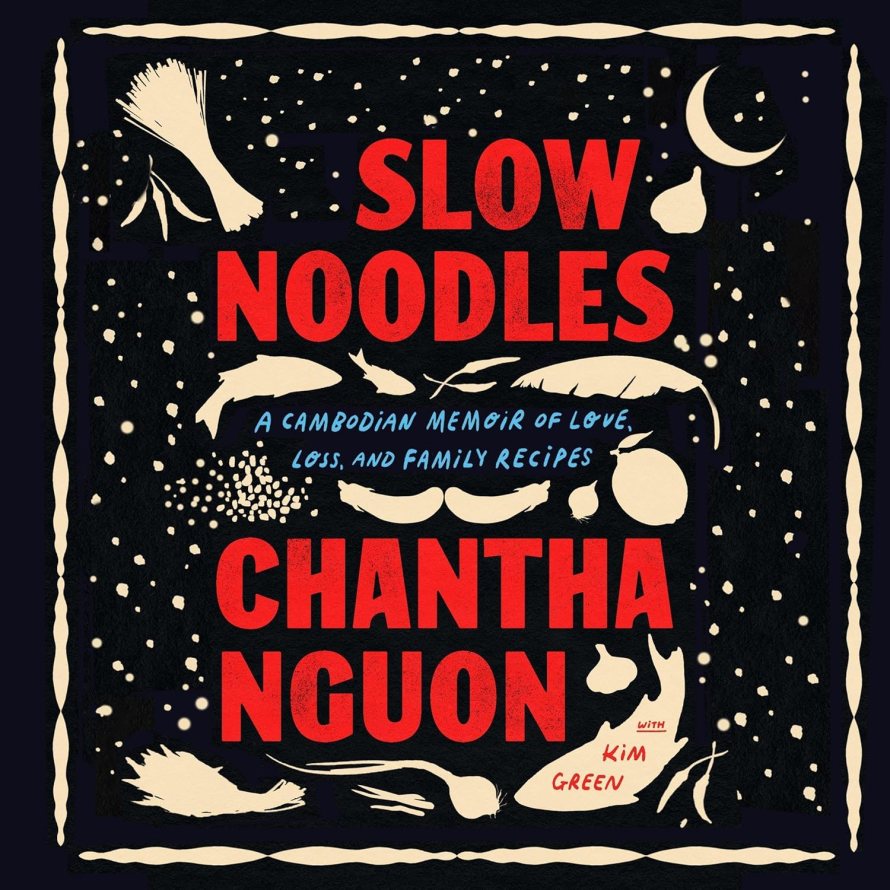
Slow Noodles: A Cambodian Memoir of Love, Loss, and Family Recipes
- Author: Chantha Nguon
- Genre: Memoir
- Publication Date: February 20, 2024
- Publisher: Algonquin Press

A haunting and beautiful memoir from a Cambodian refugee who lost her country and her family during Pol Pot’s genocide in the 1970s but who finds hope by reclaiming the recipes she tasted in her mother’s kitchen. With over 20 Khmer recipes included, Slow Noodles will resonate with readers who loved the food and emotional truth of Michelle Zauner’s Crying in H Mart, and it has the staying power of Loung Ung’s First They Killed My Father.
Take a well-fed nine-year-old with a big family and a fancy education. Fold in 2 revolutions, 2 civil wars, and one wholesale extermination. Subtract a reliable source of food, life savings, and family members, until all are gone. Shave down childhood dreams for approximately two decades, until only subsistence remains.
In Slow Noodles, Chantha Nguon recounts her life as a Cambodia refugee who lost everything and everyone—her house, her country, her parents, her siblings, her friends—everything but the memories of her mother’s kitchen, the tastes and aromas of the foods her mother made before the dictator Pol Pot tore her country apart in the 1970s, killing millions of her compatriots. Nguon’s irrepressible spirit and determination come through in this emotional and poignant but also lyrical and magical memoir that includes over 20 recipes for Khmer dishes like chicken lime soup, banh sung noodles, pâté de foie, curries, spring rolls, and stir-fries. For Nguon, recreating these dishes becomes an act of resistance, of reclaiming her place in the world, of upholding the values the Khmer Rouge sought to destroy, and of honoring the memory of her beloved mother.
From her idyllic early years in Battambang to hiding as a young girl in Phnom Penh as the country purges ethnic Vietnamese like Nguon and her family, from her escape to Saigon to the deaths of mother and sister there, from the poverty and devastation she experiences in a war-ravaged Vietnam to her decision to flee the country. We follow Chantha on a harrowing river crossing into Thailand—part of the exodus that gave rise to the name “boat people”—and her decades in a refugee camp there, until finally, denied passage to the West, she returns to a forever changed Cambodia. Nguon survives by cooking in a brothel, serving drinks in a nightclub, making and selling street food, becoming a suture-nurse treating refugees abused by Thai authorities, and weaving silk. Through it all, Nguon relies on her mother’s “slow noodles” approach to healing and to cooking, one that prioritizes time and care over expediency. Haunting and evocative, Slow Noodles is a testament to the power of culinary heritage to spark the rebirth of a young woman’s hopes for a beautiful life.

When I decided to read my way around the world, I knew it would broaden my horizons. I discovered more than I ever expected. A lot of the time, I choose nonfiction or memoirs to really get a good feel for actual events, places, and experiences, although translated works of fiction have also given me a different perspective. This book has been compared to Crying in H Mart, which I was blown away by, but discovered that while there is a heavy focus on food, the stories themselves are much different.
While Zauner’s memoir is a way of connecting with her mother through recipes while grieving her passing, this book is a memoir of war, genocide, forced migration, loss, and trauma, making the subject matter much heavier. If you choose to read this one, be aware that it deal with some very heavy topics in addition to grief.
I read this as an audiobook, narrated by Clara Kim, the daughter of the author. It was done really well, although she tends to have a monotonous tone of voice. I did really enjoy hearing the Khmer words pronounced correctly, which made the audiobook worth it.
Nguon begins with what her life was like in Cambodia before Pol Pot’s dictatorship. She was from a wealthy family, went to a fancy school, and loved to eat the home-cooked foods that her mother worked so hard on. However, once Pol Pot came to power, the Khmer Rouge’s communist regime tried to return Cambodia to ‘Year Zero’ and create an agrarian society with no classes. Naturally, this would have the biggest impact on people with a higher socioeconomic class, such as that of Nguon and her family. They lost more and more, until they had nothing left. I can’t imagine how difficult it must be to lose your home, your family, everything you own, and try to escape a genocide, especially at such a young age. I guess none of us know what we are capable of doing in order to survive.
Nguon fled her home with her mother and sister, moving from a rural farming area to hiding out in the capital city, while the country was being purged of ethnic Vietnamese living in Cambodia. As she continues to flee, she continues to lose people and places that were once vital to her. Fleeing from Cambodia to Vietnam, only to get caught up in another war. From there, she made her way to a refugee camp in Thailand, where they were treated as less than human while waiting to get resettled.
Among all this trauma and loss, Nguon simply continues to focus her energy on survival. After the loss of her mother and sister, the only way she was able to feel connected to them was through her memories of her mother’s cooking. Throughout the book, the author incorporates various recipes that she had strong connections to. From the different recipes, it’s clear that none of this is a meal you whip together in 20 minutes. The author was raised on a range of traditional Khmer foods, such as slow noodles and spring rolls, along with some recipes associated with the French colonization of the region, like pâté de foie. I enjoyed hearing the recipes, although they often come with long ingredient lists and a lot of time to invest in preparing them, hence the name ‘slow noodles,’ because they take a long time to prepare and can’t be rushed.
While I probably won’t be spending a day making noodles from scratch, there are other recipes that really intrigued me, like the curries and spring rolls, things I’m reasonably capable of being somewhat successful with. There is a lot of ingredient overlap between Cambodia, Vietnam, and Thailand, although the recipes are different from place to place. Each of these recipes involves time and energy, but they are what taught the author how to survive. She wasn’t afraid of hard work, and at a time when women were struggling to find work in any field they could, her happiest and most satisfying memories of time spent in her mother’s kitchen gave her not only work ethic, but also a knowledge of amazing recipes that she could use to stay afloat.
I am always amazed at the strong drive to survive that people exhibit in incomprehensible times, allowing them to overcome challenges that seem impossible to live through. However, pairing the hugely traumatic events of the author’s life with the recipes left me feeling a disconnect between the lighter tone of a recipe with some sarcasm included and the heavier tone of what the author was going through. Rather than feeling more like a memoir where things are recalled as more stream-of-consciousness than a memoir of her life, which felt more like telling instead of showing.
Overall, this is a powerful and moving memoir. It really made me think about how scent is the sense most strongly associated with memory, and how much comfort is derived from recipes we grew up with. I know my family has our own comfort foods, and it sounds like the ones that Nguon viewed as most comforting are what got her through years of loss, grief, displacement, hunger, poverty, and violent times. In addition, her skill at cooking and sewing allowed her to translate those into job opportunities, while waiting for her life to stabilize and go back to normal, or at least as normal as it can be after surviving a genocide and many displacements. I strongly recommend this read.
Disclaimer: This post contains affiliate links, and I may earn a small commission at no cost to you if you purchase through my links.
Categories: Book Review
 Leah's Books
Reading your way around sounds like such a wonderful way to armchair travel and get a real feel for different cultures.
LikeLiked by 1 person
Yes! It really is, and I’ve already learned so much and haven’t even worked my way through many countries.
LikeLiked by 1 person