
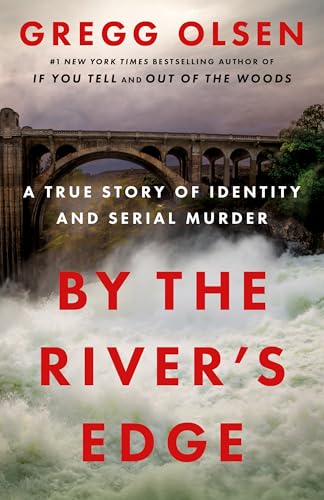
By the River’s Edge: A True Story of Identity and Serial Murder
- Author: Gregg Olsen
- Genre: True Crime
- Publication Date: June 23, 2026
- Publisher: Brilliance Audio
Thank you to NetGalley and Brilliance Audio for providing me with an ARC of this book in exchange for an honest review.

The decades-long manhunt for a serial killer takes a stunning turn in a haunting and harrowing true crime shocker by Gregg Olsen, the #1 New York Times bestselling author of If You Tell.
In 1990 in Washington state, the bodies of Yolanda Sapp, Nickie Lowe, and Kathy Brisbois were found on the banks of the Spokane River. They were part of a close-knit alliance of sex workers whose oath to protect each other was, in the end, hopeless. For twenty-two years their brutal murders went unsolved.
In 2012, a DNA cold hit pointed to Douglas Perry. A repeat assault offender, Douglas was currently incarcerated in Carswell, Texas. But there was a twist: The facility was for female prisoners. The man authorities hunted for decades was now Donna Perry. Her gender reassignment not only helped to mask the evil deeds of the past, it ended a life of childhood traumas and a pent-up rage unleashed on nearly thirty victims, according to Donna herself. Through total reinvention, she believed she’d finally slayed the monster within.
By the River’s Edge is the astonishing true story of an elusive serial killer, an escape plan like no other, and the women who lived and died on the fringes of the Lilac City for whom justice was at long last served.

I’ve read a few other books written by Olsen, and this one sounded too intriguing and convoluted to pass. Olsen has a wonderful way of turning victims into people, and I was curious how this story would unfold, featuring three murdered sex workers and a transgender suspect. In this case, truth really does seem to be stranger than fiction.
Ever since reading The Five by Hallie Rubenhold, I have been so much more aware of the different ways that both killers and their victims have their stories told, and struggle a lot with stories that (for lack of a better word) seem to focus more on the killer, often barely even mentioning anything about the people who have been murdered. Think about what you know about Jack the Ripper, then think about his victims. Can you name a single one? Do you know anything about their lives? That’s what Rubenhold’s book was about, and I was thrilled to see Olsen offer the same respect to the women in this book. Despite the fact that they had limited options and turned to sex work, Olsen really dives into who each of these women were outside of their profession. They were wives, mothers, sisters, friends, and most importantly, they were human beings who deserved respect.
Yolanda, Nickie, and Kathy are the focus of the first section of the book. People who live on the fringes of society often have a lot of cards stacked against them, and it is no different for these three women. Climbing out of the hole of addiction and prostitution is a long, hard journey. These three formed a bond and promised to protect each other, unable to know that they would all be killed by the same person in 1990. It was so fascinating to learn about these women and who they actually were. So much of a person’s identity in America has to do with your profession—I noticed this when I became disabled and people asked what I did for work—having no answer prepared left a gap in the conversation, and I can only imagine how much worse the reaction is when you have a profession like sex work.
It isn’t until later parts of the book that we learn more about the suspected killer, Douglas/Donna Perry. After more than 20 years, the updated DNA technology and associated databases available were used on evidence that was part of a cold case. A DNA hit came back, and was linked to the name of a man who had been arrested for assault charges. But when law enforcement officers searched for him, they discovered that he had flown to Thailand and gotten gender reassignment surgery, and he was being held in a women’s federal facility in Texas, living his life as Donna Perry.
While I find myself with significantly less empathy for a person who kills innocent people, it wasn’t easy learning about Douglas’s early years. Born intersex, his parents chose his gender as male to match his external genitalia, and raised him as a son. He faced a lot of trauma, including sexual abuse from both his father and older brother. Even so, it’s clear that none of this makes his murders acceptable or even understandable.
The case got really interesting when Donna’s defense strategy was made clear: she was claiming that the murders had been committed by Douglas, and that becoming Donna basically gave her a clean slate as a completely different person. She made statements about how becoming a woman totally removed any aggression, which was challenged as mistaken since there is no scientific evidence to support this. I was really caught up and wanted to find out if justice was going to be served for these three women, and was glued to the book.
It is narrated by Karen Peakes, and she does a wonderful job with the voices. Different characters had different voices in her narration, and for such a potentially touchy topic, it was handled pretty sensitively for the most part. Sometimes language grows more rapidly than is recognized widely. Douglas was born when the term for his ambiguous genitalia was called hermaphroditism, although this is now viewed as a slur and has been replaced by intersex. Perry’s identity as both an intersex individual and a transgender woman was handled sensitively and her preferred pronouns were always used. If she was misgendered in the story, Peakes makes it clear that it was one of the characters using the terminology. However, I would have liked to see the words ‘sex worker’ to replace prostitute, but both are used about equally in the book, and referring to these women as hookers or prostitutes is an insult to them, since they’re so much more than sex workers.
What really made a huge impression on me was the huge impact that rippled out from the murder of three sex workers. Even more than 2 decades later, there were people who were around to make impact statements. These women left behind partners, husbands, children, and families, all of who had something taken from them. People are part of an interconnected web, and even targeting sex workers can have major consequences—these women left behind children who never got to know her, in some cases not remembering anything about her, while it was frequently said how much light these women had to offer the world, and losing them impacted their families in such a deep way.
Overall, this was a really interesting case, and honestly did justice to the victims, which is really what I look for in a good true crime book. I would have liked to see less harmful language surrounding the sex workers, rather than referring to them repeatedly throughout the book as prostitutes, which has a negative connotation. But I did like how much more attention was paid to the victims and how the killer’s upbringing and life was discussed but not given a free pass for what he did as Douglas, even if Donna viewed Douglas as a completely different individual than her female identity. I wasn’t aware of this case, but it was inspiring to see that this cold case was never ignored or forgotten about, using updated technology to identify the killer.
Bottom line: An outstanding discussion of the women who were murdered along the Spokane River and the long journey to find justice for them, along with the devoted detectives and family who never gave up on their search for answers.
Disclaimer: This post contains affiliate links, and I may earn a small commission at no cost to you if you purchase through my links.
Categories: Book Review


2 replies »