
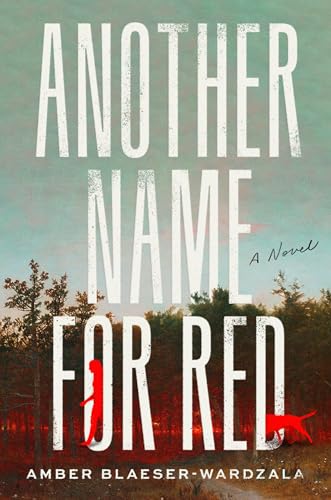
Another Name for Red
- Author: Amber Blaeser-Wardzala
- Genre: Mystery
- Publication Date: October 13, 2026
- Publisher: Pantheon
Thank you to NetGalley and Pantheon for providing me with an ARC of this ebook in exchange for an honest review.

The debut novel by one of the bestselling Never Whistle at Night’s most memorable contributors, in which, after a young Anishinaabe woman vanishes, her sister tries to pick up the pieces of her broken family, even as her investigations put her at risk of suffering a similar fate.
Middle Sister is haunted by everyone in her community who has disappeared—as well as those who remain. Her ex-best friend and ex-boyfriend are walking relics of the girl she used to be, while her family—her activist mother, checked-out father, and attention-starved younger siblings—are reminders of the elder sister she can never live up to. Then there’s John Smith, the infamous white man with red cowboy boots living on stolen reservation land, whose obsessive attentions are as repellant as they are compelling. But most of all, there are the thousands of unacknowledged missing and murdered Indigenous women, including Older Sister, whose year-long absence from the reservation has torn her remaining family apart.
With local authorities proving useless, Middle Sister decides to start an investigation of her own, beginning with the mysterious “Eric”—a white man from a neighboring town who Older Sister claimed to love, and who she swore loved her. Attempting to hunt down the correct white Eric in the haystack of Minnesota forces Middle Sister to seek help from the community from which she’s grown alienated, starting with her coworker, Casanova; a stray rez dog; and Nookomis, her grandmother who’s foreseen her own death. Yet John still lurks in the growing wintry shadows, offering a sort of surrender that Middle Sister can’t help being drawn to. In the end, she must either let the guilt consume her or forgive herself and fight.

I’ve leaned into Indigenous literature in the past few years, and discovered some really great authors. It’s a shame that I only discovered it so late, but I’m glad to see how much representation has changed since when I was young. This book provides a grim, unvarnished portrait of the MMIP (Missing and Murdered Indigenous People) issue. I knew going into this that it wasn’t likely to be a happy read, but it turned out to be a really powerful one and I appreciated that more.
The story focuses on a main character who isn’t named, and is only referred to be her social and family position—Middle Sister, Middle Daughter, Oldest Friend. Everyone on the Rez goes by a nickname, and there seems to be a lot of value in a person’s real name so it isn’t shared very often. Life on the Rez is a lot like small town life, where everyone knows everyone else’s business and families know each other for generations.
When the book opens, we discover that a year ago, Oldest Sister went missing and left the family shattered. Their father doesn’t participate in life—he just sits in front of the TV and doesn’t interact with the family. Their mother has thrown herself into activism for MMIP, but Middle Daughter feels neglected. Her younger siblings, Prim and Bobo, are also affected and the trauma that results from MMIP is a major focus of the story. These characters are all well-developed and complex enough to feel realistic, and the changes that they experience as the result of a daughter going missing occur over the course of the story. In one scene, an Amber Alert is issued for a young white girl who has gone missing, but they haven’t been able to get any support or assistance from cops, either white or tribal.
Our protagonist (sorry, it feels awkward saying Middle Sister) has felt alienated by the trauma and is trying to learn more about what happened to her sister, while simultaneously being responsible for her two younger siblings as well as her father. She’s in her early 20s and works at a hardware store on the Rez, but since Oldest Sister disappeared, she has distanced herself from a boyfriend, best friend, and basically everyone outside of her family. She spends a lot of time with her grandmother, Nookomis, who has foreseen her own death and is preparing for it, so even she’s distracted and is unable to fully offer support.
It felt very much like all of the family members are trying to cope the best they can, but struggle in the absence of answers or even attention from law enforcement. This is an emotionally heavy read and focuses on the trauma associated with MMIP, but especially on how it can impact a family. But it was really Middle Sister’s journey that fascinated me. She crosses paths with a white man who lives on land sneakily stolen from the Rez, and the name he gives her is John Smith, while he calls her Pocahontas. Apparently he doesn’t realize or care that this is a stereotype, but he does seem to have a fetish for Indigenous women. This puts Middle Sister into a bind, because he clearly has an interest in her, and while she is disgusted by him and what he represents, she is also inexplicably drawn to him and the danger he poses.
The story is told with a deliberately moderate pace, allowing the reader to fully grasp the characters and their struggles, but the mystery is also a slow-burn one. As Middle Sister goes through her usual routine, she’s still haunted by the fact that she couldn’t live up to her perfect older sister, as well as the guilt she carries over her part in the disappearance. In the absence of clues, she meanders through daily life while still trying to figure out for sure what happened to her sister. In doing so, she discovers more than she ever realized about her sister.
Overall, this was an outstanding debut. The author portrays Rez life as grim, gritty, and despairing, with few opportunities and a population that is still being picked off by white men. The setting was done beautifully, and I can’t resist a dog that pops up as a character as well. Rather than leaning on action scenes, the author focuses on character dynamics and inner growth in an intentional way. While I didn’t always agree with the choices the characters made, I was still able to empathize, most strongly with Middle Sister. I normally like fast-paced stories, but I really enjoyed the slow-burn mystery aspect of the story since it allowed me to fully become engrossed in the story. There are a lot of Anishinaabe words, and would have liked it there were translations so I could understand the meaning, rather than relying on sparse contextual clues. This is a dark, emotional story—dealing with a missing family member that they suspect is dead, strained family relationships, grief, and the unsettling dynamic that develops between John Smith and the protagonist, which was so uncomfortable to read about. However, the subject matter is deliberately unsettling and traumatic, and I appreciated the look at a family who has lost a daughter to MMIP a year into the future. Blaeser-Wardzala does a fantastic job of exploring family trauma and coping skills, whether they are healthy or not. Either way, this is not only a fantastic portrayal of Indigenous characters, but also addresses a major issue faced by Indigenous people in the present day.
Bottom line: An addictive and engrossing read focusing on an MMIP and how it impacts a family a year after the disappearance, but it also focuses on heavy themes like grief, trauma, and the issue of MMIP while incorporating traditional Indigenous practices.
Disclaimer: This post contains affiliate links, and I may earn a small commission at no cost to you if you purchase through my links.
Categories: Book Review

