
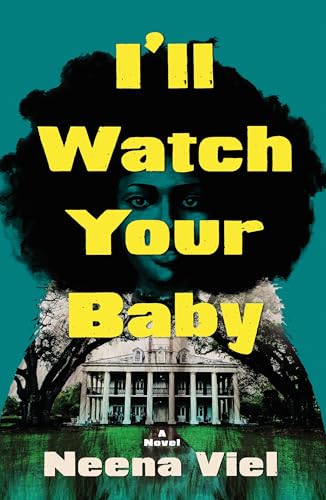
I’ll Watch Your Baby
- Author: Neena Viel
- Genre: Horror
- Publication Date: May 26, 2026
- Publisher: St. Martin’s Griffin
Thank you to NetGalley and St. Martin’s Griffin for providing me with an ARC of the ebook in exchange for an honest review.

A suffocating and sharp narrative horror novel for fans of Victor LaValle and The Reformatory, I’ll Watch Your Baby is a haunting reimagining of Linda Taylor -known as the original Welfare Queen – pursued, scrutinized, celebrated and vilified, and the impact her image has had for generations.
1974. Lottie Turner is already infamous. Running a wheel of schemes and scams, she’s willing to work for what she wants in…creative ways. But no business is more lucrative than desperate families looking to adopt a child—and there’s only one way to procure children quickly.
And the only way to take what’s owed you is to cross the line no one else is willing to cross.
1994. Bless has finally found the family she deserved. After suffocating slowly with lackluster parents and a non-starter past, she’s found the friends that means everything to her. That she’d live and die for. As they make their way across the country, one smash and grab at a time, Bless is used to acting fast and thinking on her feet.
But someone is playing a long game. Someone has unfinished business. Soon Bless is trapped in a web of horrors past and present, where the only escape hatch is a path only she can walk, if she finds the courage to take it.

I wasn’t quite sure what to expect, but I have read The Reformatory by Tananarive Due and one book by Victor LaValle, so I figured I could handle this particular brand of horror. What I didn’t realize is that it wouldn’t just be horror, but also incorporated elements of thrillers, mystery, and historical fiction. The story had a lot of strengths and potential, but didn’t quite meet my expectations. Then again, this whole blog is simply airing out my opinions of books, so keep that in mind and take this review with a grain of salt.
Let me start this with a little bit of information, since this is a reimagining of a real person and the echoes she has made that carried through decades. Linda Taylor was a woman in the 1970s who engaged in welfare fraud, and there were strong suspicions of darker crimes that were never prosecuted—like murder and kidnapping. For more information on that, you can find a link below to The Queen, Josh Levin’s biography of Linda Taylor. I know I’ll be checking that one out in the near future. She was prosecuted for welfare fraud and was found to have bilked the welfare system for $8,000 that she wasn’t entitled to (although since this occurred in the 1970s, the adjusted amount would be about $54,000 today). Media and politicians jumped on the bandwagon of the idea of the Welfare Queen, an idea which President Ronald Reagan focused heavily on. Except the legend of a Welfare Queen has been turned into a stereotype that is applied to poor, Black women and still impacts them today. Reading this book pushed me to do a little research and I’ll be reading more about Linda Taylor soon.
Disclaimer: This post contains affiliate links, and I may earn a small commission at no cost to you if you purchase through my links.
In this book, Viel tackles this topic in a creepy, suspenseful, and original manner. Lottie Turner is the central character in the 1974 timeline, and she’s morally gray. Despite her doing some pretty despicable things, I still found her to be a mostly empathetic character, especially as we learn more and more about Lottie and her past. She started life at a plantation house, and her mixed race status is a curse—she isn’t allowed to attend the white school, and when she went to Black school, she didn’t fit in there either. Ultimately, Lottie grows up uneducated but savvy and opportunistic, and there were so many times when I could really empathize with her. Once she’s on her own, she used her ethnically ambiguous look to pose as different races and identities to further scam the system. Also,
Lottie has one close friend, but Filly has a chronic illness. As her illness progresses, she relies on Lottie more and more: initially it is a little help with the household chores, but then it becomes caring for Filly’s children, and at this point in the story, Lottie also helps clean up Filly and her messes when she’s sick, and takes over the cooking as well. However, Lottie doesn’t respect Roy, Filly’s husband and it can lead to some pretty tense confrontations.
There is another timeline in the story, and it focuses on Blessyn, or Bless for short, a Black woman in her 20s. Bless never felt as though she fit in with her parents, and left her home to travel across the country with a group of young adults who become her found family. But like any found family, there can be strained relationships or small betrayals that occur, and Bless’s found family is no different. Additionally, the family supports themselves through burglaries, so this adds a bit of tension.
I found myself much more interested in Lottie’s timeline than I did with Bless. Lottie felt like she had so much more depth, although to be fair, Bless is only starting her adult life, while Lottie is an established adult who cooks up endless schemes to amass resources. Additionally, Lottie has some pretty significant trauma in her personal history that is slowly revealed over the course of the story, with the hammer dropping in the last 25% of the book when we learn more about what happened to make Lottie the way she is. Even so, it doesn’t excuse her behaviors—there are way more people who go through trauma and don’t turn out like Lottie. This is where I appreciated the complexity Viel built into Lottie, while Bless felt more like someone new to adulthood who is just starting to determine her own path. It also wasn’t until the last quarter of the book that I really started to get more of a peek into Bless and began really empathizing with her.
The story veers into paranormal elements slowly at first and then all of a sudden. The worst part of this book for me was that there were multiple scenes with whiteflies, and it skeeved me out so bad. But it still kept me hooked, trying to figure out what was going to happen next and how these storylines would intersect and make it all make sense. When they do connect, I couldn’t help but be fascinated at how beautifully the story came together. Lottie isn’t even fazed by the paranormal elements, she’s leaned on those to either make money or gain entry into a person’s life, and leaves a trail of dead behind her.
Overall, this was a book that had so much potential but ultimately didn’t quite live up to how good it could have been. There was an ick factor with the flies, but that wasn’t what made this just a middle of the road read for me. Part of the lowered rating was from the uneven pacing and different levels of interest that I had with the two different timelines, becoming way more invested and interested in Lottie’s story than Bless’s. It also felt like the switch from Lottie to Bless was jarring, and it isn’t until the last 25% of the book that the whole story felt like it was finally coming together and I could see the bigger picture. I didn’t have a problem with the paranormal elements, especially since throughout the book Lottie prays to Legba, one of the gods worshiped in Voodoo and Filly is from Haiti, so it didn’t feel like an unexpected aspect. Instead it was more of a natural progression with Lottie’s beliefs and her use of fortunetelling to further scam people. Towards the end of the book, a lot is revealed in a short space of time and I couldn’t help but feel a bit overwhelmed and wish that more had been revealed at a slower pace. And while the ending is exciting and full of action, it ultimately felt unnecessarily convoluted and pretty ambiguous.
Bottom line: A fascinating premise that didn’t quite live up to the potential, but it was still a unique and exciting way of reimagining the life of the Welfare Queen, and I couldn’t help but empathize with Lottie in a lot of ways even though she’s more on the dark side of the morally gray spectrum.
Categories: Book Review

